

Overview: Best Affiliate Earning Apps
Here are the top mobile platforms and apps for affiliate marketing to earn commissions in 2026:
- LetsEarn (by Cuelinks): A top-tier platform for publishers, bloggers, influencers, and even home earners (housewives, part-time seekers, students, etc.) looking to seamlessly monetize their Content without upfront investment.
- EarnKaro: Best suited for beginners and deal-sharing groups, allowing users to easily create and share profit links across social and messaging apps.
- ExtraPe: An affiliate marketing app that allows you to earn money without any investment by sharing product deals from popular stores like Amazon, Flipkart, and Myntra.
- Meesho: A social commerce and reselling app where you can start an online business with zero investment and earn extra money from home by reselling wholesale products.
- Shopsy: A user-friendly mobile app by Flipkart offering access to millions of affordable products, allowing you to earn through reselling, referral rewards, or its dedicated affiliate program.
Table of Contents
1. The Mobile-First Affiliate Marketing Paradigm
The global affiliate marketing landscape has undergone a profound transformation, evolving from a desktop-centric digital advertising strategy into a mobile-first, multi-billion-dollar ecosystem.
In India alone, the affiliate marketing industry has witnessed staggering growth, expanding from a mere 1.6 billion USD in 2010 to an estimated 12 billion USD by 2026. This geometric expansion is not merely a function of increased internet penetration; rather, it is underpinned by a highly complex digital acquisition infrastructure driven predominantly by the ubiquity of smartphones, the proliferation of mobile-first social ecosystems, and the maturation of the creator economy.
For content creators, publishers, and performance marketers, the smartphone is no longer solely a device for content consumption; it has become the primary monetization engine.
The friction inherent in logging into cumbersome web-based dashboards has been largely eradicated. Modern mobile affiliate marketing platforms have adapted to this reality by deploying sophisticated applications that allow publishers to generate tracking links, monitor granular analytics, and manage payouts entirely on the go.
This transition has birthed innovations such as seamless share-sheet integrations, automated Telegram bots, and advanced deferred deep-linking technologies, which collectively ensure that attribution remains intact across complex app-to-app user journeys.
This comprehensive article explores the premier mobile applications and platforms for affiliate marketing in 2026. It offers an exhaustive analysis of commission models, tracking technologies, niche suitability, and the underlying technological frameworks that empower modern digital entrepreneurs to maximize their commission yields.
2. The Cuelinks Ecosystem: Pioneering Mobile Monetization
As an award-winning affiliate network, Cuelinks has established itself as a dominant force in the Indian and global affiliate space, trusted by over 60,000 publishers and processing more than 10 million clicks per month across 2,500+ active campaigns.
Cuelinks operates as a comprehensive content monetization platform designed to minimize the technical friction of affiliate marketing. Rather than applying to hundreds of individual merchant programs, publishers gain instant access to a vast repository of campaigns upon a single approval.
The strength of the Cuelinks ecosystem lies in its diverse suite of tools, which includes JavaScript auto-monetization (converting organic links to affiliate links automatically), specialized WordPress plugins, a Chrome Extension, and robust APIs for enterprise integration. However, for the mobile-first creator, the ecosystem’s crown jewel is the LetsEarn application.
2.1 The LetsEarn App: Revolutionizing Mobile Workflows
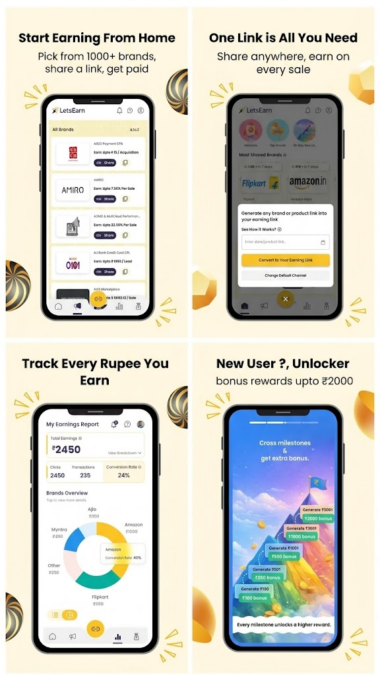
The LetsEarn App, powered by the Cuelinks infrastructure, represents a paradigm shift in how publishers interact with affiliate networks on mobile devices.
Designed specifically to eliminate the cumbersome manual copy-paste workflows of legacy systems, LetsEarn allows creators to monetize their daily digital activities instantaneously without any upfront investment.
The application’s most significant technological advancement is its seamless integration with the smartphone’s native share-sheet. When a publisher browses a supported e-commerce application such as Amazon, Flipkart, Myntra, or Ajio, they simply tap the native “Share” icon and select LetsEarn. The application automatically intercepts the product URL, converts it into a personalized affiliate tracking link, and copies it to the clipboard, ready for distribution across social channels. This one-tap link generation drastically reduces the time to market for flash sales and ephemeral deals.
Beyond link generation, LetsEarn provides a comprehensive performance dashboard directly on the mobile device. Publishers can monitor total clicks, track “Pending” earnings (sales currently within the merchant’s return/refund window), and view “Approved” commissions.
The platform maintains an exceptionally low payout threshold often configurable down to ₹10 on mobile, compared to the standard ₹500 web threshold, utilizing a Net60 payment cycle to process withdrawals directly to Indian bank accounts or UPI without transfer fees.
By automatically deploying deferred deep links, LetsEarn ensures that users clicking an affiliate link are routed directly to the specific product page within the merchant’s application, a critical factor that industry data suggests increases conversion rates by 20% to 50%.
2.2 The Broader Cuelinks Tool Suite
While LetsEarn handles direct mobile sharing, the broader Cuelinks suite provides infrastructure for mobile web and app developers.
- CueWords and CueWidgets: For publishers operating mobile-optimized blogs, CueWords automatically scans content and converts specific, relevant keywords into high-paying affiliate links based on configurable keyword density settings (typically optimized between 2 to 10 links per article). CueWidgets allows publishers to deploy dynamic, contextual ad units displaying live coupons and deals from e-commerce stores directly in their mobile sidebars or content streams.
- Mobile SDK and API Integration: For independent mobile app developers, Cuelinks provides a dedicated Software Development Kit (SDK) and a comprehensive API. This allows app owners to natively convert advertiser URLs into affiliate links within their own applications, effectively creating a passive revenue stream without disrupting the user experience.
- Telegram Bot Automation: Recognizing the explosive growth of messaging platforms, Cuelinks offers a Telegram bot that allows channel administrators to paste organic links into a chat and instantly receive monetized tracking URLs, streamlining operations for deal-sharing communities.
3. Deal-Sharing and Micro-Affiliate Applications
The democratization of affiliate marketing has given rise to a specific class of mobile applications tailored for micro-influencers, homemakers, students, and WhatsApp/Telegram group administrators. These platforms abstract the complexities of network approvals and technical integration, focusing purely on content distribution.
3.1 EarnKaro
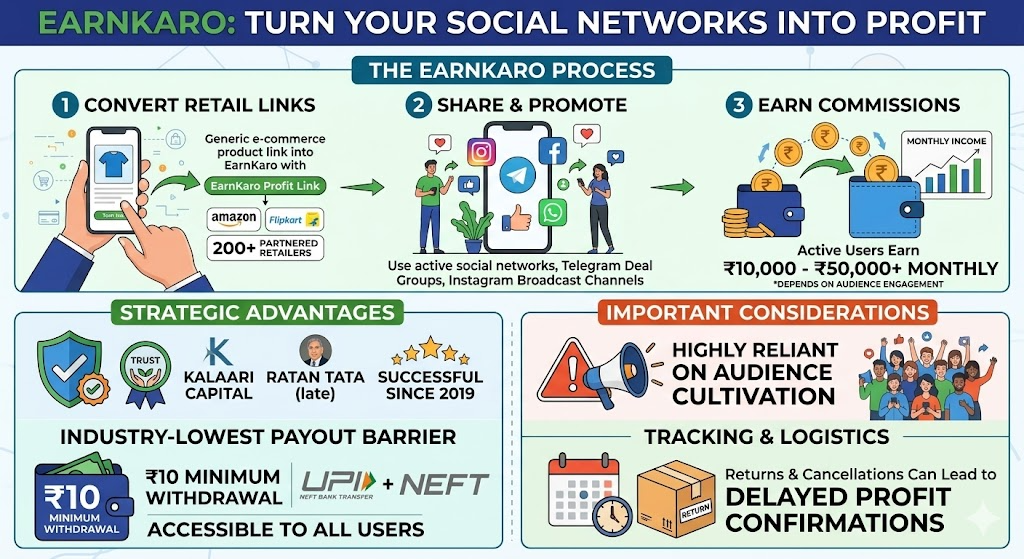
Backed by prominent investors, including Kalaari Capital and the late Ratan Tata, EarnKaro is engineered specifically for users who lack dedicated websites but possess highly active social networks. Operating successfully since 2019, the platform allows users to convert retail links from over 200 partnered retailers into “profit links”.
The strategic advantage of EarnKaro lies in its accessibility. The platform features the lowest payout barrier in the industry, setting a minimum withdrawal threshold of merely ₹10 via UPI or NEFT bank transfers.
Active EarnKaro users with substantial social media followings report monthly earnings ranging from ₹10,000 to ₹50,000. However, the platform is entirely reliant on the publisher’s ability to cultivate an engaged audience; without a dedicated distribution channel like a Telegram deal group or an Instagram broadcast channel, conversion volumes remain negligible.
Furthermore, some publishers note that the tracking of returns and cancellations can occasionally result in delayed profit confirmations, reflecting the complex logistical realities of the Indian e-commerce market.
3.2 ExtraPe and CashKaro
Operating on a similar model to EarnKaro, ExtraPe is a social deal-sharing platform that aggregates offers from over 200 major e-commerce sites. ExtraPe distinguishes itself through a highly aggressive multi-level referral architecture.
Publishers not only earn up to 20% CPS on direct sales but also secure a 10% lifetime commission on the earnings generated by users they refer to the platform. This creates a compounding revenue effect, encouraging publishers to recruit their own sub-affiliates. Like EarnKaro, ExtraPe maintains a minimal ₹10 payout threshold and processes payments monthly.
CashKaro, while fundamentally a consumer-facing cashback application developed by the same parent company as EarnKaro, utilizes identical underlying affiliate tracking mechanics. It allows users to earn cashback on their own purchases across 1,500+ brands, with minimum withdrawals set at ₹200. Having facilitated over ₹2,000 crore in cashback payouts and generating ₹600 crore in revenue for FY26, CashKaro underscores the massive scale of the incentive-driven affiliate sector.
3.3 Social Commerce Alternatives: Meesho and Shopsy
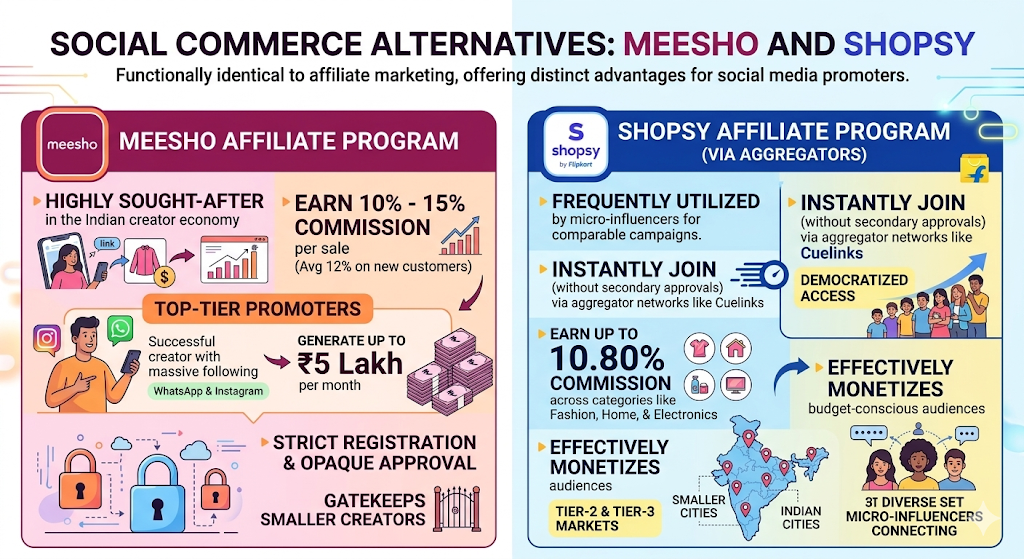
Social commerce applications, while traditionally viewed as reselling platforms, execute business models that are functionally identical to affiliate marketing, offering distinct advantages for social media promoters.
The Meesho Affiliate Program represents one of the most highly sought-after opportunities in the Indian creator economy. Affiliates can earn between 10% to 15% commission per sale (averaging 12% on new-customer acquisitions).
Top-tier promoters leveraging massive WhatsApp and Instagram distribution networks purportedly generate up to ₹5 Lakh per month in commissions. However, Meesho’s strict registration criteria and opaque approval processes often gatekeep smaller creators from participating directly.
Consequently, micro-influencers frequently utilize aggregator networks to access comparable social commerce campaigns. A prime example is Shopsy, Flipkart’s zero-commission social commerce initiative. Through platforms like Cuelinks, any publisher can instantly join the Shopsy affiliate program without secondary approvals, earning up to 10.80% commission per sale across fashion, home, and electronic verticals. This democratized access allows smaller creators to monetize budget-conscious, tier-2 and tier-3 market audiences effectively.
| App / Platform | Primary Vertical Focus | Key Differentiator | Minimum Payout | Typical Cost Model |
| LetsEarn (by Cuelinks) | Aggregator (5,000+ Brands) | Share-sheet deep link generation | ₹10 / ₹500 (web) | CPS, CPA, CPI, CPFT |
| EarnKaro | E-commerce Deal Sharing | Optimized for WhatsApp/Telegram | ₹10 | CPS |
| ExtraPe | Social Deal Sharing | 10% Lifetime Referral Commission | ₹10 | CPS |
| Shopsy (via Cuelinks) | Budget Social Commerce | Instant approval for all creators | ₹500 (Network) | CPS (up to 10.80%) |
| CashKaro | Consumer Cashback | Self-monetization across 1,500 brands | ₹200 | CPS / Cashback |
4. High-Yield Financial Product Applications
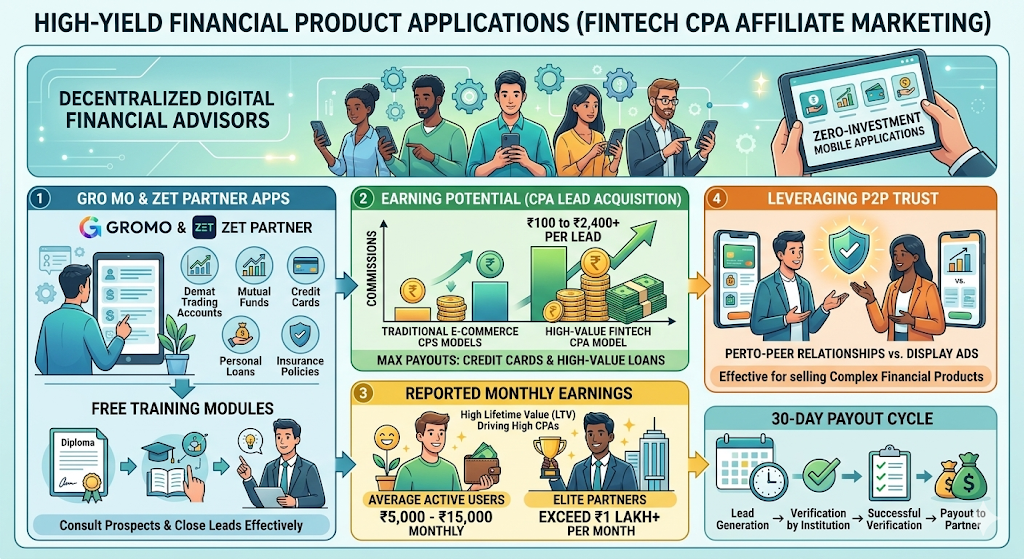
The financial technology (fintech) sector consistently offers the highest CPA payouts in the affiliate industry. This is driven by the high lifetime value (LTV) of financial customers, allowing institutions to spend aggressively on user acquisition. Applications designed specifically for financial product distribution essentially transform everyday individuals into decentralized, digital financial advisors.
4.1 GroMo and ZET Partner
GroMo is a zero-investment mobile application that enables users to distribute high-demand financial products, including Demat trading accounts, mutual funds, credit cards, personal loans, and insurance policies.
The earning potential within these applications dwarfs traditional e-commerce CPS models. Commissions for successful financial product acquisitions range from ₹100 to an impressive ₹2,400 per lead, with credit cards and high-value loans yielding the maximum payouts.
GroMo provides extensive training modules on all listed products, ensuring that partners can effectively consult prospects and close leads. Active average users report earnings between ₹5,000 and ₹15,000 monthly, while elite partners capable of generating high-volume leads routinely exceed ₹1 Lakh per month.
The platform operates on a 30-day payout cycle following the successful verification of the lead by the financial institution.
Similarly, the ZET Partner app (formerly OneCode) operates within this identical niche, allowing users to become financial advisors and earn high CPA commissions without capital investment. These platforms thrive because they leverage the trust inherent in peer-to-peer relationships, which is often far more effective for selling complex financial products than traditional display advertising.
5. Native In-App Solutions from Global E-commerce Leaders
The largest global e-commerce platforms maintain proprietary affiliate programs. As consumer behavior has shifted to mobile, these programs have been forced to evolve their publisher tooling to accommodate creators who operate exclusively from smartphones.
5.1 Amazon Associates and the Mobile GetLink Feature
The Amazon Associates program is widely considered the cornerstone of the affiliate marketing industry. Its dominance is driven by unparalleled consumer trust, a virtually infinite product catalog, and the highly lucrative “whole cart” advantage. This policy stipulates that a publisher earns a commission on any product a user purchases within the 24-hour cookie window, not just the specific product initially linked.
Recognizing that modern creators discover products and publish content predominantly via mobile devices, Amazon introduced the Mobile GetLink feature. Previously, publishers were tethered to desktop environments, relying on the browser-based SiteStripe toolbar to generate customized links. The Mobile GetLink feature resolves this bottleneck by integrating directly into the Amazon mobile shopping app.
By logging into the consumer Amazon app using their Associate credentials, publishers unlock a specialized “Share” icon on product detail pages. Tapping this icon presents the publisher’s available StoreIDs and TrackingIDs. With a single tap, the app generates a shortened amzn.to URL embedded with all necessary attribution tags, copying it to the clipboard for immediate deployment across social channels.
While highly efficient, it is vital to note that Mobile GetLink is currently restricted to physical product detail pages, excluding digital categories such as eBooks, Audible subscriptions, and luxury stores, which is where the Amazon Affiliate Program by Cuelinks on the LetsEarn app comes to the rescue!
5.2 The Flipkart Affiliate Program
The Flipkart Affiliate Program remains a primary monetization vehicle in the Indian market, offering highly competitive commissions of up to 12% on specific categories like fashion and home appliances.
Flipkart provides a robust suite of tools directly to its direct affiliates, including customizable product banners, sophisticated deep-linking utilities, and a comprehensive API for developers aiming to automate product feeds on their websites.
However, navigating individual network approvals can be tedious. Consequently, scores of affiliate marketers prefer accessing the Flipkart affiliate program through aggregator networks like Cuelinks on the LetsEarn app.
This approach bypasses the standalone Flipkart approval parameters, allowing new websites and social pages to start promoting Flipkart products instantly, while consolidating Flipkart earnings alongside revenue from other merchants into a single, unified payout.
6. The Technological Backbone: Deep Linking and Attribution Mechanisms
The effectiveness of mobile affiliate marketing is entirely dependent on the integrity of the underlying tracking architecture. When users operate on mobile devices, traditional web-based tracking frequently fractures due to app-to-web friction and aggressive privacy updates. Understanding tracking technology is non-negotiable for professional publishers.
6.1 The Mechanics and Imperative of Deep Linking
Deep linking refers to the deployment of specialized URLs that route users directly to specific content within a mobile application, bypassing the generic mobile website homepage.
In the affiliate context, this means a shopper clicking an Instagram link for a pair of shoes is launched directly into the Myntra app’s product page, rather than a mobile browser prompt asking them to log in.
The data supporting deep linking is unequivocal: industry estimates demonstrate that deep links improve conversion rates by 20% to 50% by eliminating navigation steps and reducing purchase friction. Furthermore, mobile deep linking improves overall app engagement by a factor of 2x to 3x.
The technical pinnacle of this technology is Deferred Deep Linking. If a user clicks an affiliate link but does not possess the merchant’s application, the link dynamically routes them to the iOS App Store or Google Play Store. Upon installation and the initial app launch, the deferred deep linking engine seamlessly transports the user to the exact product page they originally clicked, ensuring the affiliate’s tracking remains unbroken through the installation process.
Platforms like LetsEarn app & Cuelinks and specialized mobile networks like Tapp automate this complex routing, allowing publishers to generate a single link that functions dynamically across all operating systems and environments.
6.2 Evaluating Tracking Methodologies
As global privacy regulations tighten and mobile browsers implement aggressive tracking prevention (such as Safari’s Intelligent Tracking Prevention, which purges cookies within 24 hours), the industry is pivoting toward more resilient attribution methods.
| Tracking Methodology | Mechanism of Action | Primary Strengths | Critical Weaknesses |
| First-Party Cookies | Deposits a data file in the user’s browser upon link click. | Easy deployment; remains the standard for desktop e-commerce. | Highly vulnerable to ad-blockers, mobile app environments, and rapid browser purges. |
| Pixel Tracking | A 1×1 image or JavaScript snippet fires on the merchant’s confirmation page. | Provides real-time conversion insights. | Fails entirely within mobile apps; susceptible to client-side fraud like pixel stuffing. |
| Server-to-Server (S2S) / Postback | Direct, secure data transfer between the merchant’s server and the affiliate network’s server. | The gold standard. Immune to ad-blockers, browser cookie purges, and cross-device fragmentation. | Requires advanced technical development and API integration to deploy. |
| Promo Code Tracking | Conversions are tracked via unique discount codes entered at checkout, ignoring link clicks. | Cookieless by design. Functions perfectly for verbal podcast mentions or ephemeral social media. | Susceptible to revenue leakage if the exclusive code is scraped by coupon aggregator sites. |
For publishers operating across diverse mobile ecosystems, transitioning toward Server-to-Server (S2S) tracking and Promo Code attribution provides the highest degree of revenue security against an increasingly fragmented privacy landscape.
7. Monetizing Social Platforms via Mobile
Affiliate marketing on mobile is inextricably linked to the social platforms where users congregate. Specialized applications and bots have emerged to optimize affiliate workflows specifically for Telegram and Instagram.
7.1 Telegram Marketing and Automation Strategies
Telegram has surpassed 1 billion monthly active users, becoming a dominant channel for affiliate marketing. The platform’s appeal lies in its open API, the absence of algorithmic suppression (chronological feeds ensure 100% reach to active subscribers), and astronomical open rates approaching 80% to 100% within 24 hours.
- Channel vs Group Dynamics: Channels are utilized for broadcasting one-to-many deal alerts, signal sharing, and content distribution. Groups foster community discussions, which are highly effective when peer-to-peer validation drives conversions, such as in crypto trading or sports betting niches.
- Telegram Bots for Attribution: Bots automate the qualification, drip sequencing, and delivery of affiliate links directly within the chat interface.
- Cuelinks Telegram Bot: Designed for seamless link conversion and automated distribution. Publishers can connect the bot to their account by verifying their Cuelinks channel ID (e.g., using /login or /channel_id commands). Users can drop multiple regular product URLs (up to 5 at a time) into the chat, and the bot instantly returns monetized tracking links. Furthermore, it features an auto-posting capability (/enable_autoposting) that automatically pushes newly generated affiliate links directly to the publisher’s connected Telegram channels, significantly reducing manual workflows.
- Admitad Bot: Admitad provides a highly functional Telegram bot (@admitad_bot) for its publishers. A user simply sends a standard merchant URL to the bot, and it instantly replies with a monetized, shortened deep link (fas.st or lite.al), complete with commission rates if the item is a designated “Hot Product”. This eliminates the need to switch between the Telegram app and browser dashboards.
- CRMChat: For B2B or high-ticket affiliates, platforms like CRMChat offer all-in-one automation. These tools extract member lists from public groups, identify lookalike audiences, and run multi-account outreach sequences with built-in account warming protocols to mitigate ban risks directly within Telegram.
7.2 Instagram Affiliate Ecosystems
Instagram remains a visual powerhouse for product discovery. For creators monetizing via Instagram, the ecosystem involves a mix of influencer collaboration platforms and mobile-first link-in-bio strategies.
- Influencer Talent Platforms: Brands and creators often connect through specialized talent discovery platforms. In India, platforms like Starplify serve as comprehensive solutions, acting similarly to a modern talent agency to connect brands with influencers for targeted campaigns. Other notable platforms include Winkl, which provides data-driven campaign tracking, and Plixxo, which focuses heavily on the fashion, beauty, and lifestyle segments.
- Link-in-Bio and Story Selling: Since Instagram restricts clickable links in standard post captions, mobile affiliates rely heavily on “Story selling” (using link stickers for 24-hour ephemeral deals) and curated link-in-bio aggregators. Creators can utilize aggregator apps to generate one-tap affiliate links and populate their custom storefronts or Instagram Stories, driving immediate, low-friction conversions directly from their smartphones.
8. Analyzing High-Converting Mobile Campaigns for 2026
To contextualize the earning potential of these platforms, it is essential to analyze the performance metrics of top-tier campaigns accessible via networks like Cuelinks and Admitad.
| Campaign / Brand | Affiliate Cost Model | Commission / Payout | Target Audience & Strategy |
| Swiggy / Zomato | CPI + CPFT | ₹48 – ₹55 per acquisition | Urban consumers; relies heavily on promoting high-value coupon codes to drive the first transaction. |
| MakeMyTrip | CPS (Holiday Packages) | Up to 1.89% Per Sale | High-ticket travel traffic. Requires deep-linking to specific seasonal packages or flight routes. |
| Upstox | CPI + CPA (Trading Acc.) | ₹157 – ₹765 per account | High-intent finance traffic. The payout structure rewards both the app install and the subsequent funding of the trading account. |
| Canva (Android | iOS) | CPA (Pro Subscription) | Fixed bounty per signup | Digital marketers and students. Affiliates must strictly adhere to brand guidelines, avoiding trademark bidding on terms like “Canva Pro”. |
| Rupee Redee | CPI + CPA (Registration) | ₹18 – ₹35 per acquisition | Targets tier-2/3 demographics seeking instant micro-loans. High conversion volume compensates for lower individual payouts. |
9. Strategic Blueprint for Mobile Publishers
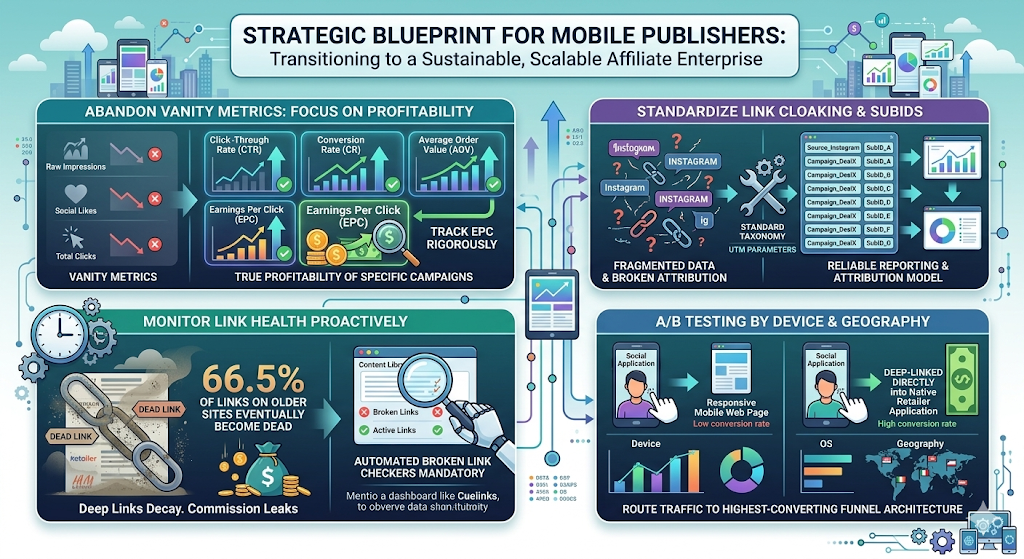
Transitioning from sporadic earnings to a sustainable, scalable affiliate enterprise requires publishers to move beyond simple link-sharing and implement rigorous, data-driven operational strategies.
- Abandon Vanity Metrics: Focusing on raw impressions, social likes, or total clicks provides a false sense of trajectory. Professional affiliates rigorously monitor Click-Through Rate (CTR), Conversion Rate (CR), Average Order Value (AOV), and Earnings Per Click (EPC). Tracking EPC is paramount, as it serves as the ultimate metric dictating the true profitability of a specific campaign relative to the traffic sent.
- Standardize Link Cloaking and SubIDs: Proper naming conventions and automated link cloaking are essential for data integrity. Inconsistencies in UTM parameters or SubIDs (e.g., arbitrarily tagging links as “Instagram,” “INSTAGRAM,” and “ig”) lead to fragmented data and broken attribution models. Utilizing tools that enforce standardized tagging taxonomies ensures reliable reporting across multiple campaigns.
- Monitor Link Health Proactively: Deep links decay. Affiliate campaigns are routinely paused, and specific products go out of stock. A comprehensive industry study indicates that approximately 66.5% of links on older publisher sites eventually become dead, creating massive, invisible commission leaks. Utilizing automated broken link checkers, such as those provided within the Cuelinks dashboard, is mandatory for maintaining revenue integrity across extensive content libraries.
- A/B Testing by Device and Geography: User intent and behavior vary wildly depending on the device being used. For instance, analytics consistently reveal that mobile users clicking from social applications often convert poorly when directed to responsive mobile web pages, but excel when deep-linked directly into native retailer applications. Affiliates must segment and track device, OS, and geographic data to tailor their strategies, ensuring traffic is routed to the highest-converting funnel architecture.
10. Conclusion
The transition toward mobile-first affiliate marketing is absolute. The era of relying solely on desktop-based blogs, manual link generation, and fragile cookie-based tracking is rapidly drawing to a close.
In 2026, success within the performance marketing space is dictated by technical agility: the ability to generate monetized links seamlessly from a smartphone share-sheet, the utilization of Telegram automation to distribute ephemeral offers instantly, and the reliance on deep linking and Server-to-Server (S2S) postbacks to guarantee unshakeable attribution in a privacy-first web environment.
For novice creators and community managers in emerging markets, applications like LetsEarn and EarnKaro have democratized access to the digital economy, effectively removing the barrier of complex website development and API integration.
Conversely, for enterprise media buyers, platforms like Cuelinks, Impact, Admitad, and vCommission provide the robust, AI-driven infrastructure required to process millions of transactions securely across borders.
By aligning the correct mobile application with highly targeted content strategies and precise attribution data, publishers can effectively transform digital influence into a highly scalable, enduring revenue stream.

Sahil Ajmera is content writer with more than 7 years of work experience in field of Affiliate Marketing, Digital Marketing, etc. He loves saving money on everything. His aim is to get readers exactly what they are looking for and that too without wasting much of their time. Whatever he is writing on, you are sure to find a way to earn & save good!