

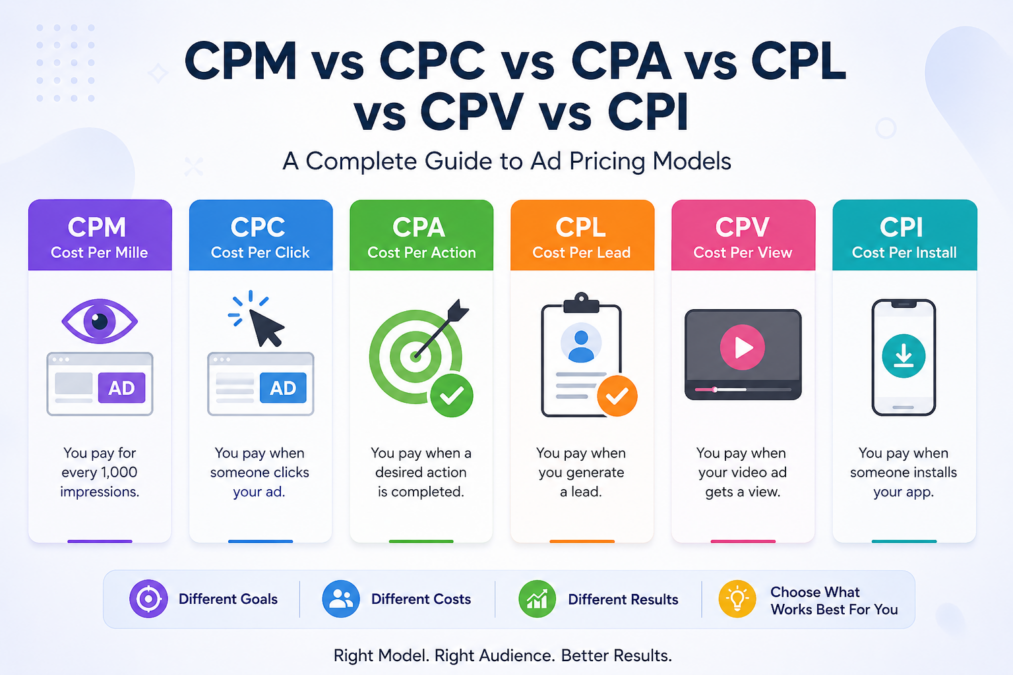
Digital advertisers and publishers have a host of pricing models to choose from: including Cost Per Mille (CPM), Cost Per Click (CPC), Cost Per Action (CPA), Cost Per Lead (CPL), Cost Per View (CPV), and Cost Per Install (CPI). Each model aligns with different goals and risk profiles. This article provides clear, up-to-date definitions of each, with formulas, use cases, pros and cons, and real-world benchmark examples (global and India-specific). We also offer a decision flowchart and comparison table to help marketers pick the right model for branding, traffic, conversions, video engagement, or app installs.
Table of Contents
Understanding Advertising Cost Models
Digital advertising is measured by different metrics. The main pricing models are:
- Cost Per Mille (CPM): Also called Cost Per Thousand, CPM charges advertisers for every 1,000 ad impressions (views). It’s a traditional branding model, focusing on reach and awareness.
- Cost Per Click (CPC): Also known as Pay Per Click (PPC), this model charges only when a user clicks the ad. It’s performance-based and suits advertisers who prioritize site visits and engagement.
- Cost Per Action (CPA): The advertiser pays only when a specific action (conversion) occurs, such as a sale, signup, or download. This model minimizes wasted spend by tying cost directly to results (often used in affiliate and performance marketing).
- Cost Per Lead (CPL): CPL measures spend per lead generated. A lead typically means a prospect’s contact info (email, phone) showing purchase interest. CPL is effectively a subset of CPA focused on lead-gen, and it’s calculated as total marketing cost divided by the number of leads.
- Cost Per View (CPV): A video-ad model where advertisers pay each time a user views a video ad (for a set minimum duration, e.g. 10-30s). CPV is common on YouTube and other video platforms. It optimizes for video engagement rather than clicks.
- Cost Per Install (CPI): Used in mobile app marketing. The advertiser pays for each app install driven by the campaign. CPI is essentially CPA for mobile installs, where cost = (total spend / installs). It ensures only actual users pay.
Each of these models has a formula to compute cost:
- CPM Formula: CPM = (Total Ad Cost / Impressions) * 1000.
- CPC Formula: CPC = Total Ad Cost / Number of Clicks.
- CPA Formula: CPA = Total Ad Cost / Number of Conversions (Actions).
- CPL Formula: CPL = Total Marketing Spend / Number of Leads.
- CPV Formula: CPV = Total Ad Cost / Number of Views.
- CPI Formula: CPI = Total Ad Cost / Number of App Installs.
Use Cases and Pros/Cons
In brief,
- CPM is best for brand exposure – pros: broad reach | cons: pay even if there are no actions.
- CPC suits traffic acquisition – pros: pay only for clicks | cons: no guarantee of conversions.
- CPA/CPL focus on results – CPA for purchases/downloads | CPL for lead generation (pros: low risk | cons: higher cost per event).
- CPV is for video campaigns – pros: pay for engaged views | cons: can be wasteful if viewers skip.
- CPI targets app installs – pros: only pay for real users | cons: high competition for quality installs.
The right choice depends on your campaign goals and budget.
Confused About CPC, CPA, or CPM Earnings?
Join Cuelinks (14+ Yrs Affiliate Marketing Platform) and monetize your traffic with high-converting affiliate campaigns across multiple payout models.
How Each Model Works (Definitions & Examples)
Below we define each metric with context, example, and industry insights:
Cost Per Mille (CPM)
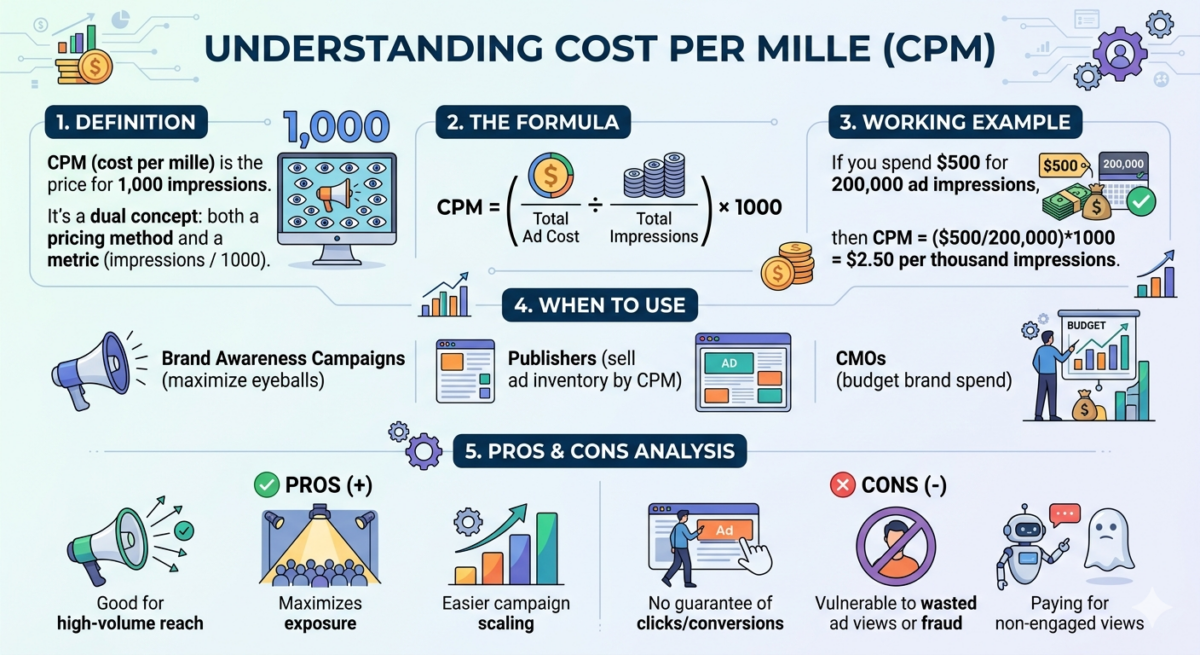
- Definition: CPM (cost per mille) is the price for 1,000 impressions. It’s a dual concept: both a pricing method and a metric (impressions / 1000).
- Formula: CPM = (Total Ad Cost ÷ Total Impressions) × 1000.
- Example: If you spend $500 for 200,000 ad impressions, then CPM = ($500/200,000)*1000 = $2.50 per thousand impressions.
- When to Use: For brand awareness campaigns when you want maximum eyeballs. Publishers often sell ad inventory by CPM. CMOs use CPM to budget brand spend.
- Pros/Cons: CPM is simple and maximizes exposure, but you pay whether users care or not. Its effectiveness depends on large, quality impressions.
- Pros: Good for high-volume reach, easier campaign scaling.
- Cons: No guarantee of clicks/conversions; vulnerable to wasted ad views or fraud.
Cost Per Click (CPC)
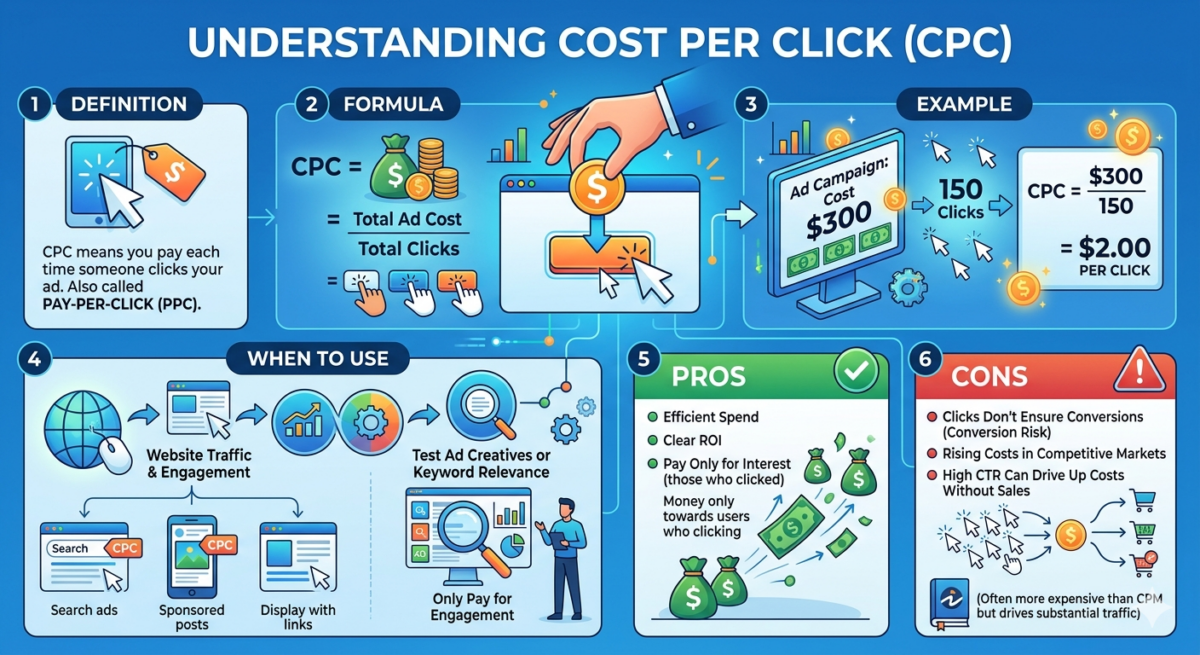
- Definition: CPC (cost per click) means you pay each time someone clicks your ad. Also called pay-per-click (PPC).
- Formula: CPC = Total Ad Cost ÷ Total Clicks.
- Example: If an ad campaign costs $300 and gets 150 clicks, CPC = $300/150 = $2.00 per click.
- When to Use: Ideal when the goal is website traffic or engagement. Use CPC for search ads, sponsored posts, display with links, etc. Marketers use CPC to test ad creatives or keyword relevance since you only pay for actual engagement.
- Pros: You only pay for interested users (those who clicked), offering more efficient spend and clear ROI.
- Cons: Clicks don’t ensure conversions, you still bear conversion risk. CPC costs can rise in competitive markets. Also, high click-through rates (CTR) can drive up costs without sales. As Investopedia notes, CPC is often more expensive than CPM but drives substantial traffic.
Cost Per Action (CPA)
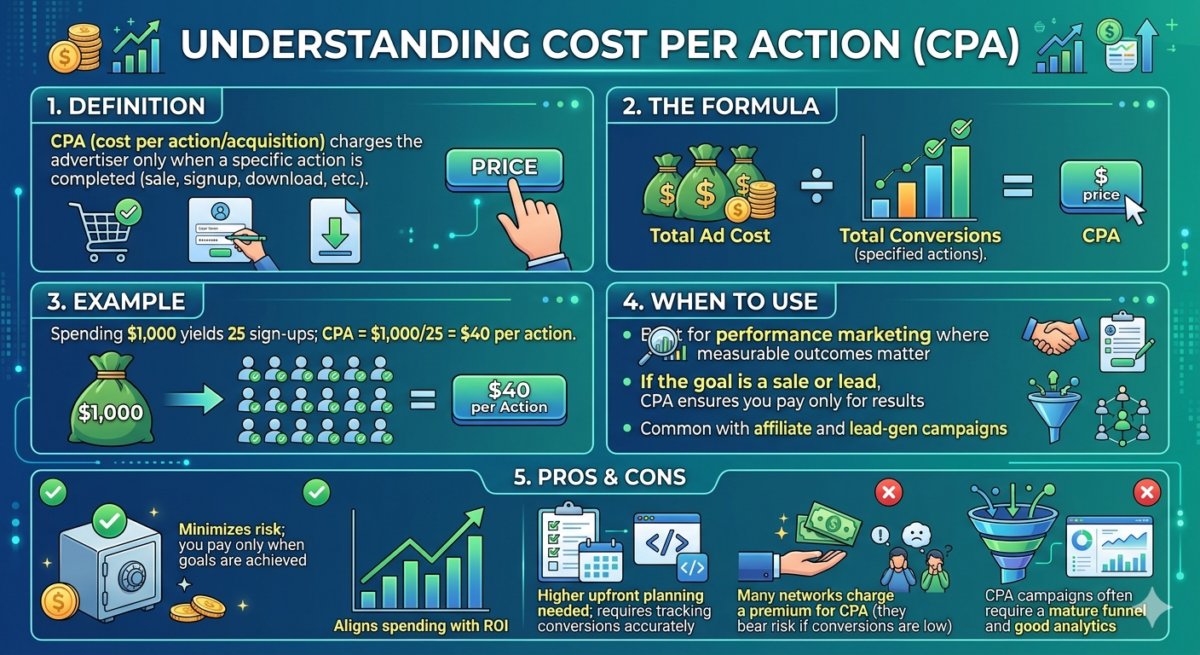
- Definition: CPA (cost per action/acquisition) charges the advertiser only when a specific action is completed (sale, signup, download, etc.).
- Formula: CPA = Total Ad Cost ÷ Total Conversions (specified actions).
- Example: Spending $1,000 yields 25 sign-ups; CPA = $1,000/25 = $40 per action.
- When to Use: Best for performance marketing where measurable outcomes matter. If the goal is a sale or lead, CPA ensures you pay only for results. Common with affiliate and lead-gen campaigns.
- Pros: Minimizes risk; you pay only when goals are achieved. Aligns spending with ROI. Cons: Higher upfront planning needed; requires tracking conversions accurately. Many networks charge a premium for CPA (they bear risk if conversions are low). CPA campaigns often require a mature funnel and good analytics.
Cost Per Lead (CPL)
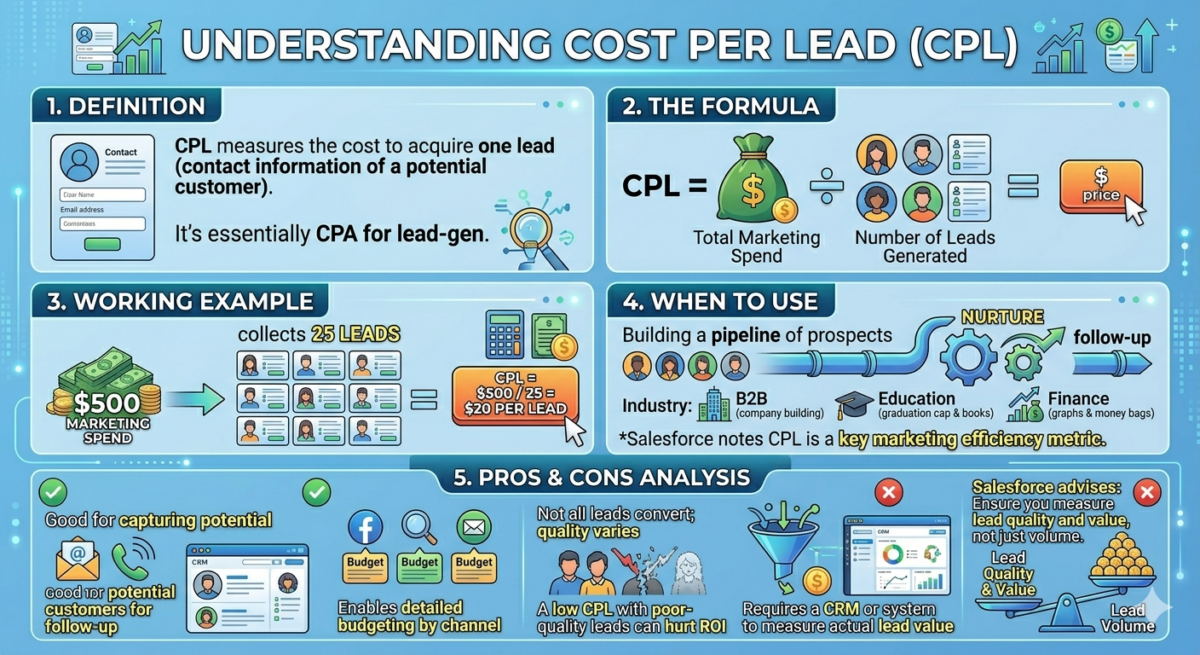
- Definition: CPL measures the cost to acquire one lead (contact information of a potential customer). It’s essentially CPA for lead-gen.
- Formula: CPL = Total Marketing Spend ÷ Number of Leads Generated.
- Example: If you spend $500 on ads and collect 25 leads, CPL = $500/25 = $20 per lead.
- When to Use: When your focus is building a pipeline of prospects. CPL is common in B2B, education, finance: any industry where nurturing leads is critical. Salesforce notes CPL is a key marketing efficiency metric.
- Pros/Cons: Pros: Good for capturing potential customers for follow-up. Enables detailed budgeting by channel. Cons: Not all leads convert; quality varies. A low CPL with poor-quality leads can hurt ROI. It requires a CRM or system to measure actual lead value. As Salesforce advises, ensure you measure lead quality and value, not just volume.
Cost Per View (CPV)
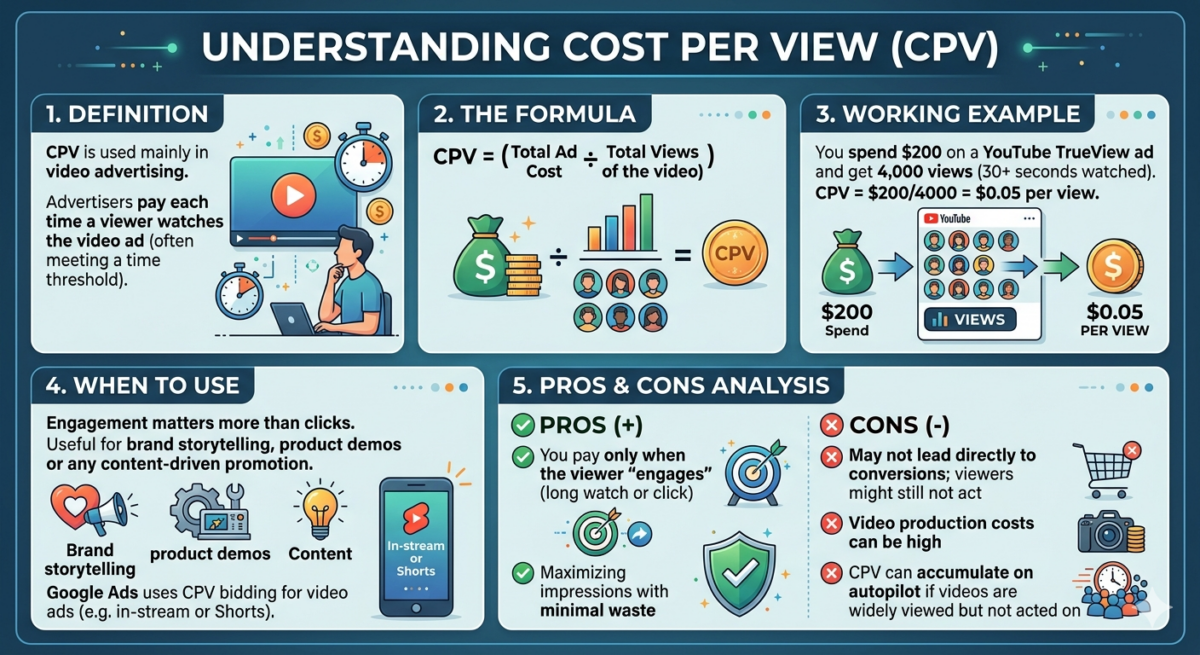
- Definition: CPV is used mainly in video advertising. Advertisers pay each time a viewer watches the video ad (often meeting a time threshold).
- Formula: CPV = Total Ad Cost ÷ Total Views of the video.
- Example: You spend $200 on a YouTube TrueView ad and get 4,000 views (30+ seconds watched). CPV = $200/4000 = $0.05 per view.
- When to Use: For video campaigns where engagement matters more than clicks. Useful for brand storytelling, product demos or any content-driven promotion. Google Ads uses CPV bidding for video ads (e.g. in-stream or Shorts).
- Pros/Cons: Pros: You pay only when the viewer “engages” (long enough to watch or click); good for maximizing impressions with minimal waste. Cons: May not lead directly to conversions; viewers might still not act on the message. Video production costs can be high, and like CPM, CPV can accumulate on autopilot if videos are widely viewed but not acted on.
Cost Per Install (CPI)
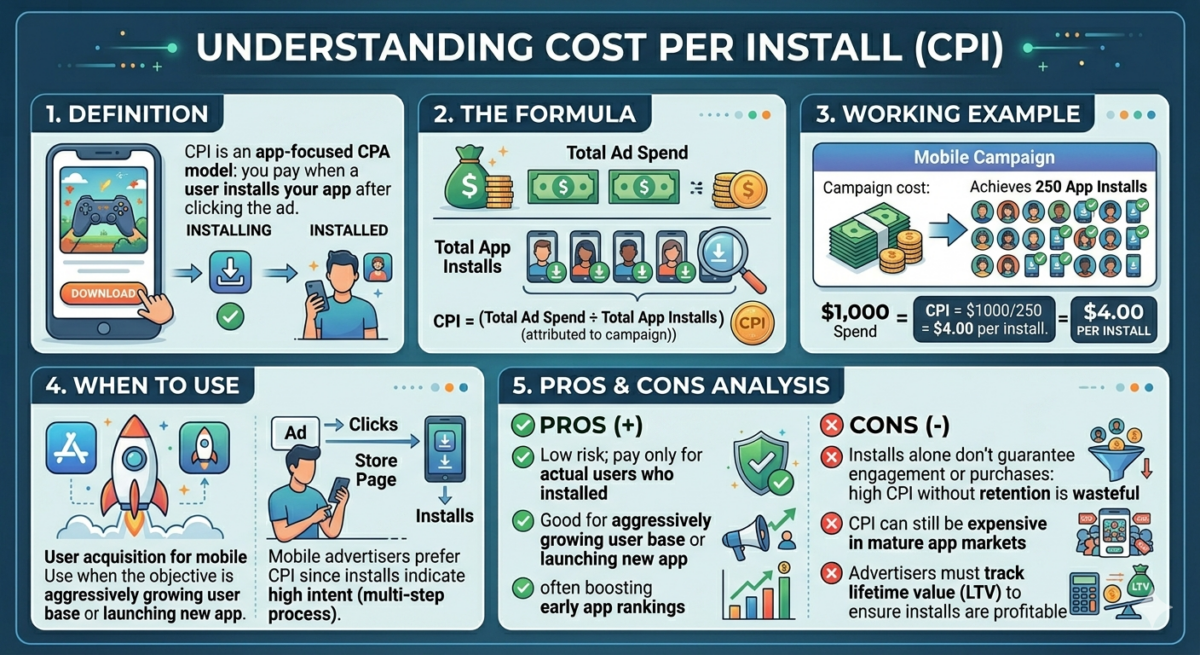
- Definition: CPI is an app-focused CPA model: you pay when a user installs your app after clicking the ad.
- Formula: CPI = Total Ad Spend ÷ Total App Installs (attributed to campaign).
- Example: A mobile campaign costs $1,000 and achieves 250 app installs; CPI = $1000/250 = $4.00 per install.
- When to Use: When the objective is user acquisition for mobile apps. Mobile advertisers prefer CPI since installs indicate high intent (user completes a multi-step process).
- Pros: Low risk; pay only for actual users who installed (often boosting early app rankings). Good for aggressively growing user base or launching new app.
- Cons: Installs alone don’t guarantee engagement or purchases: high CPI without retention is wasteful. CPI can still be expensive in mature app markets. Advertisers must track lifetime value (LTV) to ensure installs are profitable.
Choose the Right Ad Pricing Model for Better ROI
Run CPC, CPA, CPL, CPI, or CPM campaigns with Cuelinks for Advertisers and pay only for the results that matter to your business.
Comparing Models by Campaign Goals
Choosing a model depends on what you want to achieve. Below is guidance on when to pick each:
CPM vs CPC
- Use CPM when brand awareness or reach is the goal. It’s ideal if you want volume of views regardless of immediate action. For example, a large consumer brand launching a TV-style video ad online would use CPM.
- Use CPC for driving site traffic or engagement. It’s better if you want to pay only for actual clicks, not just views. For example, an ecommerce site might use CPC on Google Search to attract buyers researching products.
CPC vs CPA (or CPL)
- CPC suits top-of-funnel goals (awareness, traffic, testing new offers). Advertisers using CPC are willing to pay per click even if not all clicks convert.
- CPA/CPL are for bottom-of-funnel goals (conversions and lead gen). Use CPA when every action (sale or signup) is valuable and you want to pay only on success. Use CPL if your goal is specifically to capture leads. For example, a SaaS company may use CPL bidding to only pay for qualified trial signups.
CPA vs CPL
- CPL is effectively a type of CPA focused on lead events. Use CPL if you just need contact info to nurture later.
- CPA is broader; use CPA if you can define any valuable action (purchase, subscription, form fill) and you want the ad or affiliate network to optimize for that high-value outcome.
CPL vs CPV
- CPL should be used when generating leads is your primary objective, and you have a plan (email outreach, sales team) to follow up. It ties cost to a directly monetizable outcome.
- CPV is better for video storytelling or demonstrations. For example, if you have a new product video and want many people to watch it, CPV ensures you pay when that engagement occurs. It’s not about leads but about visual engagement.
CPV vs CPI
- CPV is for video engagement and brand. Use it if you want to maximize video views (e.g. YouTube ads).
- CPI is for mobile app installs. Choose CPI if your key metric is new app users. For example, a gaming app launching in a country might run CPI campaigns on Facebook/Google to boost installs.
In short, your marketing objective drives the choice.
Brand awareness → CPM/CPV
Traffic/Clicks → CPC
Lead generation → CPL
Sales or signups → CPA
App growth → CPI
The table below offers typical values (approx) across channels to contextualize this choice.
| Channel / Ad Type | Avg. CPM | Avg. CPC | Avg. CTR | Avg. CVR |
| Google Search Ads | $12.00 | $2.70 | 3.2% | 3-4% |
| Google Display (GDN) | $11.00 | $0.63 | 0.5% | 0.7% |
| Facebook/Instagram Ads | $6.59 | $0.63 | 1.0% (est.) | 9-10% (lead-gen) |
| LinkedIn Ads | $10.00 (est.) | $5-6 (est.) | 0.4% (est.) | 6% (B2B lead-gen) |
| YouTube TrueView Video Ads | $3.50 | $0.49 | 0.65% | 0.1-0.3% |
Estimates based on industry reports and platform data. Actual figures vary by industry and targeting.
For example, WordStream’s Google Ads benchmarks (2018) show average search CPC $2.69 and search CTR 3.17%. YouTube CPV (Cost per View) is often just a few cents: AWISEE reports a 2025 average around $0.026. In India, ad costs are typically lower: Meta ads saw CPM $2.60 and CPC $0.20, and Facebook app-install CPI dropped under $1 in late 2025.
Industry Benchmarks (Global & India)
Knowing typical benchmarks helps set realistic expectations:
- Global Benchmarks: A global 2026 study found average Meta (Facebook) CPM ≈ $6.59, but this varies by country (Tier 1 markets like the U.S. can hit $23 CPM). Average Meta CPC ranges from $2.69 in the U.S. to $0.12 in low-cost markets. Google Ads’ median CPM was $12.79 and CPA $23.74 for 2025 (Triple Whale), reflecting intense competition. WordStream (2018) reported Google search CPC $2.69 (search) and $0.63 (display) as ballpark figures. Video CPV on YouTube averages just a few cents per view ($0.026 globally).
- India Benchmarks: Advertising costs in India tend to be much lower. Meta Ads study shows India CPM ≈ $2.60, CPC ≈ $0.20. On Facebook, SuperAds reported India’s average mobile CPI for app installs at about $4.00, 70% below the global $13.43. After seasonal spikes, monthly CPI in India often dipped under $0.50. Google Ads in India similarly see lower CPCs (roughly one-quarter of U.S. levels) according to industry analyses. For CPL, First Page Sage (2026) finds, for example, eCommerce CPL ≈ $91 (blended) globally, whereas high-end verticals (e.g. Higher Ed) exceed $900. These ranges highlight that benchmarks must be tailored to the platform, industry, and locale.
Use these figures as a guideline, not a target. Always track your own campaign data. Industry averages can rise year-over-year due to inflation and competition (Triple Whale notes CPM/CPA jumped 10-12% in 2025). Localize benchmarks when possible: many platforms and agencies publish country-specific reports.
Choosing the Right Model: Decision Guide
Ultimately, selecting CPM/CPC/CPA/CPL/CPV/CPI is about aligning your goals with pricing and risk. Advertisers should ask:
- What is my campaign objective? (Awareness, Traffic, Leads, Sales, Installs, etc.)
- Do I care more about scale or efficiency? (Impressions vs conversions.)
- What level of control vs risk am I comfortable with? (Paying for reach vs guaranteed results.)
- What is my budget and value per action? (Higher-value products can afford higher CPA.)
From a publisher’s perspective, the choice also matters. Publishers selling ad space may prefer CPM for predictability on high-traffic pages, but they can offer CPC or CPA deals for performance-based publishers. Advertisers should align with publishers who support their chosen model. For instance, many affiliate networks (like Cuelinks) allow publishers to pick CPC or CPA offers that match their audience’s intent.
In practice, marketers often use multiple models in a funnel. A typical approach is to start broad (CPM/CPV for awareness) then switch to pay-per-click for engagement, and finally track CPA for bottom-of-funnel conversions.
Continually measure ROI: if your CPA is too high or CTR too low, consider switching models or refining targeting. Use analytics and A/B tests to decide.
Weigh trade-offs: CPM can yield many impressions at low cost per view, but if you need clicks, a CPC campaign might be more efficient, even if each click costs more.
Always run small tests with each model in your target market (e.g. India vs global) before scaling up. The right affiliate or ad network can help with this. For instance, leveraging an affiliate network (like Cuelinks) connects you to campaigns across models, optimizing your return on ad spend.
Cost Models at a Glance
| Model | Billing Basis | When to Use | Key Metric | Advantages | Disadvantages |
| CPM (Impressions) | Pay per 1,000 views | Brand awareness, reach | Impressions (per 1000) | Easy to scale; great for branding | No guarantee of action; may waste ad spend |
| CPC (Clicks) | Pay per click | Traffic, engagement | Clicks | Only pay for engagement; well-suited for performance; measurable ROI | Clicks may not convert; costs can climb in competitive markets |
| CPA (Actions) | Pay per conversion | Direct response (sales, signups) | Conversions (actions) | Low-risk (pay for results); maximizes ROI per action | Higher CPM/CPC needed; requires precise tracking |
| CPL (Leads) | Pay per lead | Lead generation | Leads | Focuses on capturing contacts; clear funnel building | Lead quality varies; still upstream of purchase |
| CPV (Views) | Pay per video view | Video engagement | Views (seconds watched) | Engages users with video; pay only when ad is watched | Views ≠ actions; may not drive direct sales |
| CPI (Installs) | Pay per app install | Mobile user acquisition | App Installs | Only pay for actual installs (high intent) | High cost; installs may not equal active users |
Frequently Asked Questions (FAQ)
What is the difference between CPM and CPC?
CPM charges for 1,000 ad impressions, making it ideal for brand campaigns focused on reach. CPC charges only when a user clicks the ad, which suits performance campaigns. In CPM you pay for views, in CPC you pay for clicks. If you want only traffic to your site, use CPC. If you want maximum eyeballs (awareness), use CPM.
How do I calculate CPC and CPM?
Use the basic formulas: CPC = Total Spend ÷ Clicks, and CPM = (Total Spend ÷ Impressions) × 1000. For example, $500 spend on 200,000 impressions yields CPM = ($500/200000)*1000 = $2.50; if that same $500 got 250 clicks, CPC = $500/250 = $2.00.
When should I choose CPA over CPC?
Choose CPA (Cost Per Action) when you want to pay only for actual conversions (sales, sign-ups). Use CPC (Cost Per Click) when your goal is clicks or traffic and you prefer to control traffic volume. If maximizing ROI is critical and you have reliable tracking, CPA minimizes wasted spend because the ad network optimizes for conversions. If you are earlier in the funnel or want to test interest, start with CPC.
What is considered a good CPC or CPM?
“Good” depends on industry, platform, and region. Globally, average Google search CPC is $2.70, but luxury and finance keywords can be much higher. For CPM, US Facebook ads may cost $10-$20, while India CPMs often run only a few dollars. Always benchmark against similar campaigns and focus on ROI rather than arbitrary “good” numbers.
What is Cost Per Lead (CPL) and how is it different from CPA?
CPL is essentially a type of CPA specifically for lead capture. CPL measures spend per lead (a prospect’s contact info). CPA can refer to any desired action. So CPL = CPA focused on leads. Both are bottom-funnel metrics, but use CPL when your marketing goal is to build a list of leads for follow-up.
How does CPV (Cost Per View) work on YouTube?
CPV means you pay when viewers watch your video ad (typically 30 seconds or more). You set a target CPV bid in Google Ads. YouTube only counts a “view” when the watch threshold or interaction is met, so you’re not charged for skipped views under that threshold. This model is best for maximizing video impressions.
What is CPI (Cost Per Install) in mobile app marketing?
CPI is what you pay for each user that installs your app due to the campaign. For example, if a $500 campaign yields 100 installs, CPI = $5. It’s a popular model when launching an app, because you pay for actual acquisition of a user. Mobile ad platforms often quote an eCPI (effective CPI) after campaigns complete to compare against target CPI.
How do these models apply to affiliate marketing?
In affiliate marketing, advertisers (brands) and publishers (affiliates) often use CPA, CPC, or CPL. Affiliates earn commissions usually on a CPA basis (pay per sale or lead). However, publishers with high traffic might opt for CPM or CPC ad units. It’s crucial that affiliates track the model: for CPA affiliate offers, the affiliate network pays only upon completed sales/signup. For advertisers, using an affiliate network lets you leverage all models seamlessly to monetize publisher traffic.
Are these models mutually exclusive? Can I mix them?
You can and often should mix models. For example, use CPM for broad awareness, then switch to CPC or CPA for retargeting or direct response. In programmatic campaigns, it’s common to optimize for multiple metrics (e.g. bid with CPM but target an effective CPA). The best strategy often layers models across the funnel. What matters is aligning each campaign’s objective with the right metric.

Sahil Ajmera is content writer with more than 7 years of work experience in field of Affiliate Marketing, Digital Marketing, etc. He loves saving money on everything. His aim is to get readers exactly what they are looking for and that too without wasting much of their time. Whatever he is writing on, you are sure to find a way to earn & save good!