


Affiliate marketing lets bloggers and content creators earn commissions by recommending products, rather than relying on display ads. It requires no product creation or inventory: you promote others’ goods or services and earn a share of each sale. Because startup costs are low and programs exist in nearly every niche (tech, fashion, finance, health, etc.), affiliates can target their specific audiences with relevant offers. Over time, a well-optimized affiliate system can generate passive income: once you publish evergreen reviews or tutorials with affiliate links, those links can keep earning even if you step away from your blog. For example, Amazon’s Affiliate Program alone boasts millions of products and pays up to ~10% commission on qualifying purchases.
Affiliate marketing is powerful because you control what you promote and can tailor offers to your audience. There’s a huge variety of affiliate programs to choose from: in tech, fashion, finance, home, and more. Not having to create or ship products means you can start quickly and scale up with low risk. Many affiliates report making many times more per sale than they would with a single ad click. For instance, many bloggers note that a single affiliate sale often exceeds their weekly AdSense revenue! In short, affiliate marketing is lucrative, flexible, and accessible: especially for beginners who want a powerful alternative to standard display ads.
Affiliate Marketing vs Google AdSense
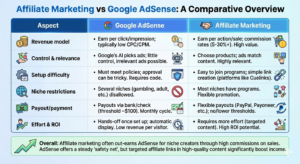
| Aspect | Google AdSense | Affiliate Marketing |
| Revenue model | Earn per click/impression; typically low CPC/CPM. Income is steady but limited by traffic and ad rates. | Earn per action/sale; commission rates vary widely (often 5-30%+). One sale can equal many ad-clicks worth of revenue. |
| Control & relevance | Google’s AI picks ads automatically; you have little control and may get irrelevant ads for your niche. Ads could distract readers. | You choose exactly which products or services to promote, so ads match your content. Tailored affiliate links are highly relevant and tend to convert better. |
| Setup difficulty | Must meet Google’s policies; approval can be tricky. Requires adding Google’s code snippets to your site. | Easy to join many affiliate networks or programs (often free sign-up). Getting affiliate links usually just involves registering and copying URLs. Platforms like Cuelinks simplify this even more. |
| Niche restrictions | Several niches (e.g. gambling, adult, certain finance or medical) are disallowed. Google controls ad categories. | Most niches have affiliate programs. You can promote in any content area (fashion, tech, finance, etc.). Many networks even specialize by niche (e.g. tech gadgets, beauty products, credit cards). |
| Payout/payment | Payouts only via bank transfer or check (threshold $100 in many countries). Google’s payment cycle is monthly. | Affiliate Platforms often offer flexible payouts (PayPal, Payoneer, etc.) and many networks have no or lower thresholds. Some programs pay quickly or on recurring schedules. |
| Effort & ROI | Very hands-off once set up: ads display automatically. Even sites with modest traffic can earn something. But revenue per visitor is relatively low. | Requires more effort to create targeted content and optimize links. But well-executed campaigns (targeted posts, SEO, etc.) can yield much higher ROI: one promotion might earn hundreds of dollars. |
Overall, affiliate marketing out-earns AdSense for many niche bloggers and tech creators. Google’s AdSense may provide a “safety net” of small daily earnings, but affiliate programs pay commissions on each sale or action, which means content tailored to a niche (e.g. a smartphone review with an affiliate link) can drastically boost your income. Affiliate ads tend to look better and earn more than generic AdSense units. Importantly, Google does not ban affiliate links as long as your content is high-quality: the key is value, not the ad format.
How to Get Started with Affiliate Marketing?

Getting started is straightforward. Follow these steps:
- Choose a niche and platform. Select a subject you’re passionate about (tech gadgets, fashion, personal finance, etc.) and a content platform (blog, YouTube, social media). Your audience’s interests will guide which affiliate products work best.
- Create useful content. Before adding any links, build content that attracts readers. Write tutorials, product reviews, lists, or how-to guides that naturally tie into the products you might promote. High-quality content attracts organic traffic and builds trust.
- Join affiliate programs/networks. Sign up for affiliate networks or direct programs that fit your niche. For example, Amazon affiliate program is a popular choice for general merchandise, while in India networks like Cuelinks provide access to programs like Flipkart, Myntra, or Ajio. Application is free, and approval is often quick.
- Get your affiliate links. After approval, log into the affiliate dashboard and generate unique tracking links for products you want to recommend. Many networks let you deep-link directly to specific items. Platforms like Cuelinks can even automate this: you install their tool and it turns all eligible links on your site into tracked links.
- Integrate links into content. Place your affiliate links strategically where they add value. For example, in a tech review post link to the product, or in a tutorial link to tools you use. Avoid spammy placements: the links should fit naturally. (Tip: use link management plugins or platforms, such as Cuelinks’ script or WordPress plugins, to cloak and organize your links.)
- Disclose affiliate relationships. Legally and ethically, inform readers when links are affiliate links (e.g. “This post contains affiliate links”). This transparency builds trust and complies with regulations.
- Track and optimize. Use the affiliate dashboard (and tools like Google Analytics) to monitor clicks and conversions. If a link underperforms, try different wording, placement, or products. Over time, drop low-earning links and promote the best-converting ones.
How Cuelinks (and Similar Platforms) Simplify Affiliate Marketing?
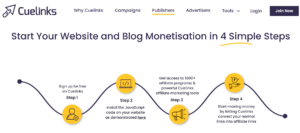
Managing affiliate links across many programs can be daunting. That’s where platforms like Cuelinks shine. Cuelinks is an all-in-one affiliate network that aggregates 2500+ campaigns from hundreds of brands. For example, it offers Indian e-commerce programs like Flipkart Affiliate Program (electronics, home goods) and Myntra Affiliate Program (fashion, beauty). Instead of joining each retailer separately, you can sign up once with Cuelinks and access them all.
Cuelinks also automates link integration. You simply add one JavaScript snippet (or install their WordPress plugin) to your site, and Cuelinks automatically converts regular product links into affiliate links. This means you don’t have to manually update every link: existing and future links become monetized instantly.
If you prefer, Cuelinks’ Chrome extension can identify affiliate opportunities as you browse and even generate tracked links on the fly. In short, platforms like Cuelinks remove much of the technical hassle, letting you focus on content while ensuring your links and commissions are handled for you. Besides, Cuelinks’ advantage is its convenience and support: it provides a unified dashboard with earnings reports and an account manager for assistance.
Popular Affiliate Niches and Examples
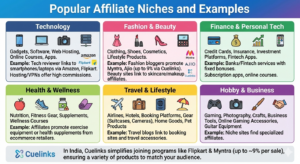
There are affiliate programs in nearly every interest area. Some lucrative niches include:
- Technology: Blog or video reviews of gadgets, software, web hosting, online courses, or apps. For instance, a tech reviewer could link to smartphones or laptops (via Amazon or Flipkart) and accessories. Tech tools like web hosting or VPNs often pay high commissions.
- Fashion & Beauty: Fashion bloggers can promote clothing, shoes, cosmetics, or lifestyle products. Programs like Myntra or Ajio (9% via Cuelinks) offer high commissions on apparel. Beauty sites often link to skincare or makeup affiliates.
- Finance & Personal Tech: Finance niches include credit cards, insurance, investment platforms, and fintech apps. Many banks and fintech services have affiliate/referral programs with fixed bonuses. For tech, apps or subscription services (e.g., productivity apps, online courses) also have affiliates.
- Health & Wellness: Nutrition, fitness gear, supplements, and wellness courses are big sellers. Affiliates might promote exercise equipment or health supplements from ecommerce retailers.
- Travel & Lifestyle: Travel blogs can earn by linking to airlines, hotels, booking platforms, or gear (suitcases, cameras). Lifestyle blogs also partner on home goods, pet products, or educational content.
- Hobby & Business: Niche sites (gaming, photography, crafts, business tools, etc.) find affiliates too. Even specialized niches like online gaming accessories or guitar equipment have affiliate partners.
Each example above has established affiliate programs. In India, Cuelinks lets you easily join programs like Flipkart (up to ~9% per sale) or Myntra (up to ~9% per sale). The variety ensures you can pick products that match your blog’s content and audience interest.
Tips to Maximize Your Affiliate Revenue
Once your affiliate links are live, focus on optimization to boost earnings:
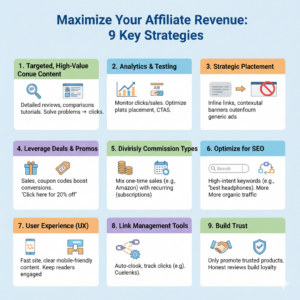
- Create targeted, high-value content. Write detailed product reviews, comparison articles, tutorials, or listicles that help readers make decisions. Content that genuinely solves a problem or answers a question will naturally guide readers to click your affiliate links.
- Use analytics and testing. Monitor which pages and links get clicks and sales. For example, Google Analytics and affiliate dashboards can show click-through rates and conversion rates. If a link isn’t converting, try moving it higher on the page, rephrasing the call-to-action, or using a different product.
- Strategic placement over banners. Inline links and contextual banners usually outperform generic ads. Avoid cluttering pages with irrelevant banners; instead, insert links where readers expect them (e.g. at the end of a product description or within a how-to guide).
- Leverage deals and promotions. Seasonal sales, coupon codes, or limited-time offers can greatly increase conversions. If affiliates provide coupon codes (advertisers giveaway to increase sales), display them prominently. Even simple phrases like “Click here to get 20% off” can boost engagement.
- Diversify commission types. Mix one-time sales with recurring programs. For example, web hosting or subscription services (e.g. email marketing tools) often pay recurring commissions for each month a customer stays subscribed. Amazon provides “sitewide” commissions (you earn on all purchases within 24 hours). Including some recurring or broader commissions can stabilize your income.
- Optimize for SEO. Good search rankings drive more organic traffic. Target high-intent keywords (e.g. “best wireless headphones 2026”, “how to start a fashion blog”). More targeted traffic means more clicks on your affiliate links.
- Focus on user experience. Ensure your site loads quickly and content is clear. Long, mobile-friendly pages with clear headings keep readers engaged. A smooth experience means more people stay on your page and are likely to notice your affiliate recommendations.
- Use link management tools. Whether it’s a WordPress plugin or a platform like Cuelinks, managing links is easier when they’re organized. These tools can auto-cloak and track clicks, so you don’t have to manually update each link.
- Build trust. Only promote products you trust or have tested. Honest reviews and disclosures build loyalty. Readers are more likely to click your links if they believe your recommendation is genuine.
By treating affiliate marketing as a long-term business: continually refining content, trying new products, and analyzing data: you can maximize your revenue. Many bloggers find that, over time, their affiliate income surpasses what they ever earned from AdSense alone. Focus on quality content and relevant offers, and your affiliate strategy will pay off handsomely.

Sahil Ajmera is content writer with more than 7 years of work experience in field of Affiliate Marketing, Digital Marketing, etc. He loves saving money on everything. His aim is to get readers exactly what they are looking for and that too without wasting much of their time. Whatever he is writing on, you are sure to find a way to earn & save good!


Comments are closed.