
Overview
This article explores the rapidly expanding U.S. online grocery and meal kit markets in 2026, highlighting the essential role of coupon affiliate marketing for publishers and deal-hunters. It provides a curated analysis of the top 10 (Walmart, Amazon, Kroger, Weee, Distacart, Hungryroot, EatClean, Marley Spoon, Chicago Steak Company, eat2explore) affiliate programs available via the Cuelinks network, focusing on their commission structures, cookie durations, and conversion strategies.
Table of Contents
Introduction
The United States online grocery and meal delivery sector is currently undergoing a period of profound structural transformation and unprecedented fiscal expansion.
Valued at a formidable $217.04 billion in 2025, the U.S. online grocery market is estimated to reach $253.98 billion in 2026. It is advancing along an aggressive compound annual growth rate (CAGR) of 17.02% that projects the industry toward an $893.06 billion valuation by 2034.
Parallel to this, the U.S. meal kit delivery service market, which was valued at $13.55 billion in 2025, is projected to reach $14.59 billion in 2026 and eventually scale to $21.29 billion by 2031, reflecting a sustained CAGR of 7.84%.
📌 Why Grocery Coupon Affiliate Marketing is Essential in 2026
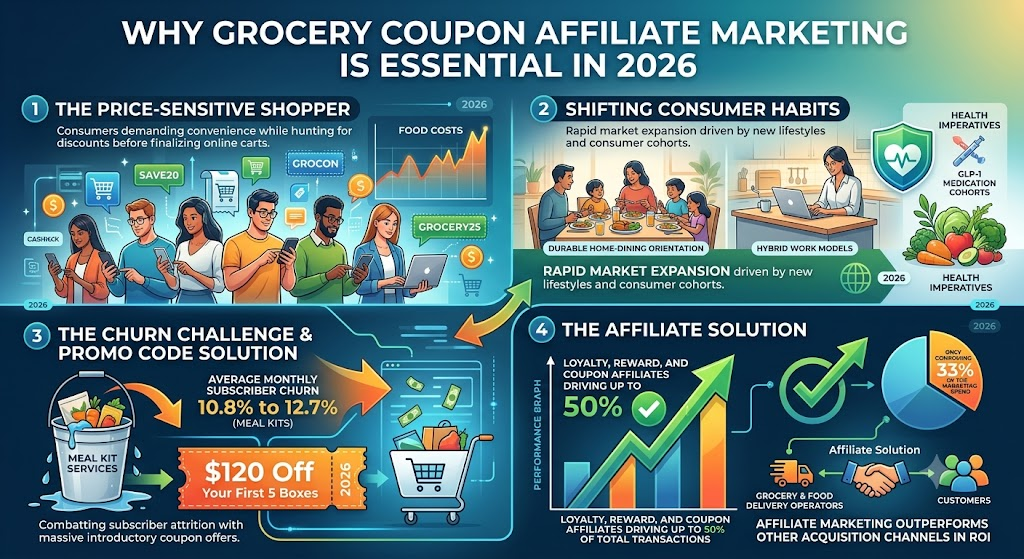
- The Price-Sensitive Shopper: While consumers demand convenience, fluctuating food costs have created a hyper price-sensitive shopper. Consumers are actively hunting for promo codes, digital coupons, and cashback offers before finalizing their online grocery carts.
- Shifting Consumer Habits: This rapid market expansion is underwritten by systemic shifts in consumer behavior, including durable home-dining orientations, hybrid work models, and the emergence of distinct consumer cohorts driven by health imperatives such as GLP-1 medication usage.
- The Churn Challenge & Promo Code Solution: The perennial challenge for grocery and food delivery operators remains top-of-funnel customer acquisition and long-term retention. The meal kit sector, for example, currently grapples with an average monthly subscriber churn rate of 10.8% to 12.7%, primarily driven by menu fatigue and the labor associated with meal preparation. To combat this, brands rely on massive introductory coupon codes (e.g., “$120 Off Your First 5 Boxes”) to drive conversions.
- The Affiliate Solution: To combat this structural attrition, brands rely heavily on performance-based affiliate marketing channels. Globally, affiliate marketing continues to outperform other acquisition channels in return on investment, with loyalty, reward, and coupon affiliates driving up to 50% of total transactions while consuming only 33% of the marketing spend.
For digital publishers, coupon aggregators, and social media deal hunters operating within the affiliate marketing space, this macroeconomic trajectory presents a highly lucrative monetization landscape.
This article evaluates the top 10 grocery and meal kit coupon affiliate programs available in the U.S. market for 2026, specifically curated for publishers operating through the Cuelinks sub-affiliate network. The analysis explores commission architectures, cookie duration mechanics, coupon conversion strategies, and the stringent regulatory compliance required to maximize yield in a highly competitive digital ecosystem.
📈 Macro-Trends Shaping the 2026 Grocery Coupon Affiliate Market in the US
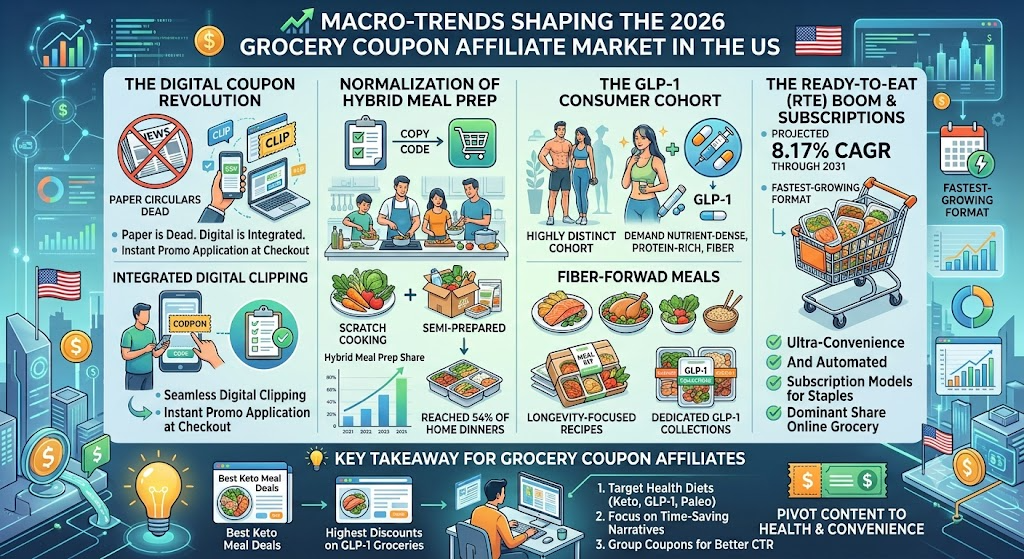
Before examining specific merchant programs, it is necessary to contextualize the prevailing consumer dynamics shaping the 2026 grocery landscape. Publisher strategies must align with consumer purchasing behaviors to optimize conversion rates.
- The Digital Coupon Revolution: Paper circulars are effectively dead. Today’s consumers expect integrated digital clipping and instant promo code application at checkout. Coupon publishers must ensure their platforms can instantly copy promo codes to a user’s clipboard for seamless checkout integration.
- The Normalization of Hybrid Meal Prep: This structural shift combines scratch cooking with semi-prepared, value-added components. This hybrid approach reached 54% of all home dinners in 2024, creating a natural entry point for partially prepped meal kits and grocery delivery services that emphasize convenience alongside culinary engagement.
- The GLP-1 Consumer Cohort: Concurrently, the emergence of GLP-1 medications has created a highly distinct consumer cohort that demands nutrient-dense, protein-rich, and fiber-forward meals. Meal kit operators have responded aggressively, launching dedicated GLP-1 collections and longevity-focused recipes that compete directly with functional supplement brands.
- The Ready-to-Eat (RTE) Boom: Furthermore, the Ready-to-Eat (RTE) category is projected to grow at an 8.17% CAGR through 2031, making it the fastest-growing format within the broader U.S. meal kit space. This shift toward ultra-convenience is mirrored in standard grocery delivery, where consumers increasingly rely on subscription models to automate the procurement of household staples and cooking essentials, which currently hold the dominant share of the U.S. online grocery market.
💡 Key Takeaway for Grocery Coupon Affiliates: These trends dictate that deal roundups and promo codes should pivot toward health-specific dietary plans (keto, paleo, GLP-1 compliance) and time-saving convenience narratives. Grouping coupons by “Best Keto Meal Deals” or “Highest Discounts on GLP-1 Groceries” will drastically improve click-through rates.
🛒 Category 1: The Mega-Retailers and Volume Drivers
The foundational layer of any comprehensive grocery coupon affiliate strategy relies on mega-retailers. These platforms possess vast inventories, immense brand equity, and high baseline conversion rates, though they typically offer lower percentage commission tiers compared to niche direct-to-consumer brands.
1. Walmart US
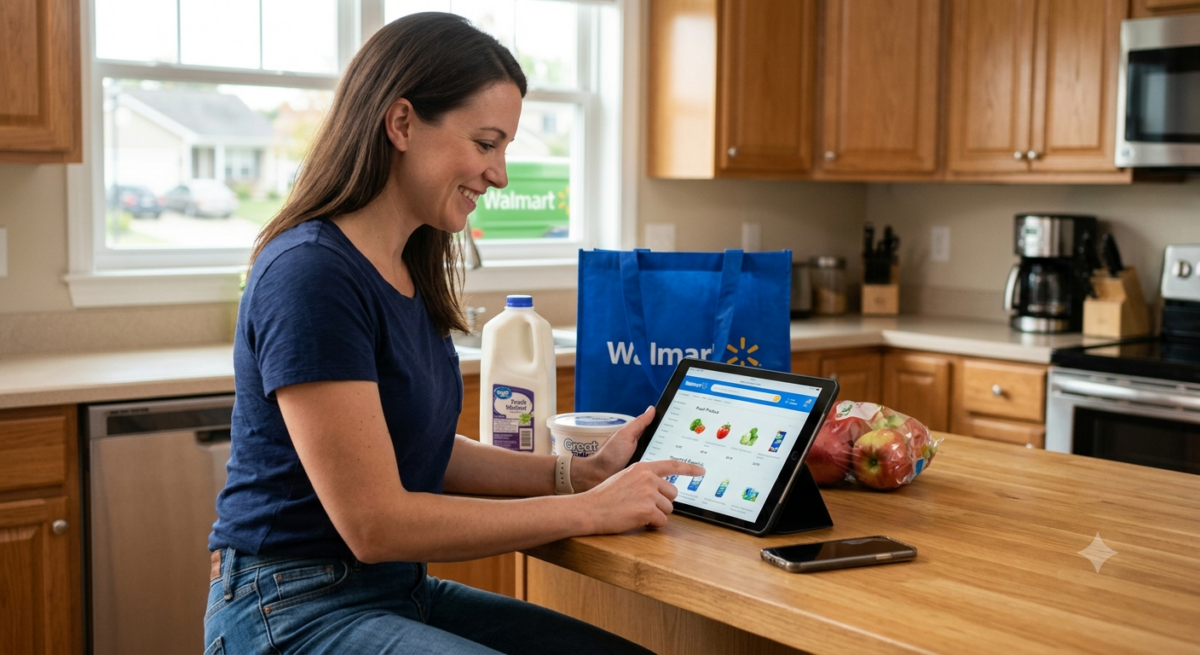
Walmart’s digital footprint is a cornerstone for grocery and household essential promotions. Operated natively via the Impact network and syndicated efficiently through platforms like Cuelinks, Walmart commands a massive share of the online grocery delivery market, leveraging its physical store footprint for rapid last-mile fulfillment.
- Commission Structure: The program typically features a baseline commission structure ranging from 1% to 4% depending on the specific product category, with standard grocery and household items frequently yielding commissions between 1% and 3%. However, Cuelinks’ Walmart affiliate program’s dynamic payouts can reach up to 7.20% per sale during specific promotional windows or within targeted high-margin categories.
- Cookie Duration: Walmart provides a standard 3-day (72-hour) cookie duration, utilizing a last-click attribution model.
- Coupon Strategy: Walmart frequently utilizes “Rollback” deals and limited-time category discounts rather than traditional sitewide promo codes. Coupon publishers should exploit the 3-day window by publishing comprehensive weekend meal prep deal guides mid-week. Curating pages like “Top 20 Grocery Rollbacks at Walmart This Week” perfectly aligns with the extended attribution timeframe. The lower percentage commission is ultimately offset by the sheer volume of transactions and the massive basket sizes generated by Walmart’s “Everyday Low Prices” consumer proposition.
2. Amazon US
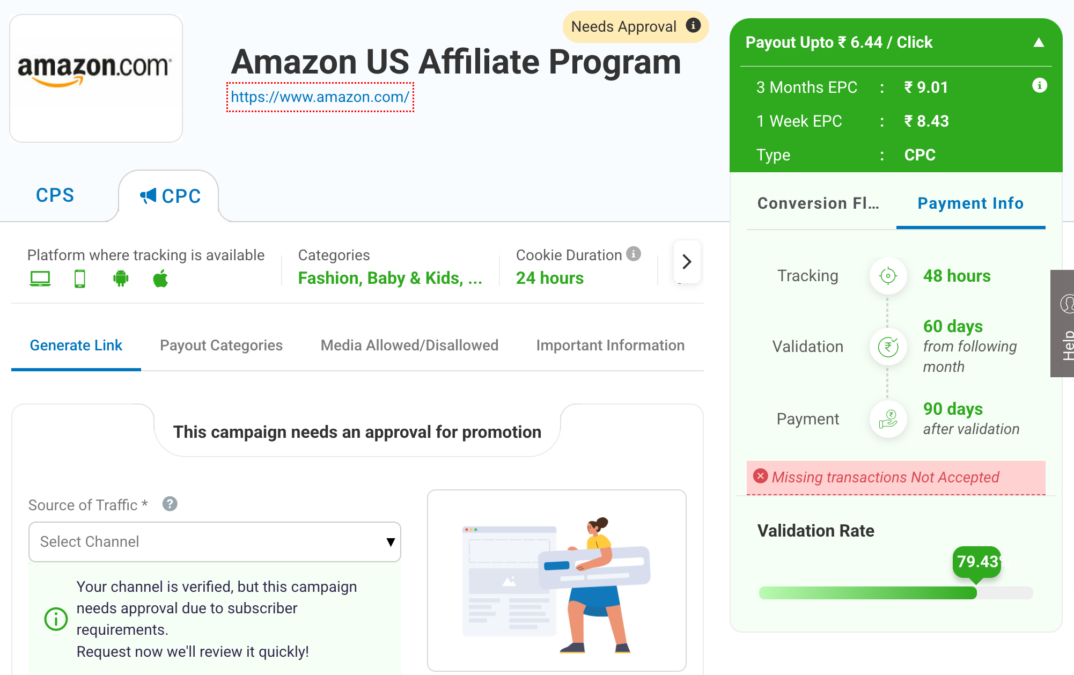
Amazon remains the undisputed titan of e-commerce, possessing the most sophisticated logistical infrastructure for grocery delivery via its Amazon Fresh and Whole Foods Market integrations.
- Commission Structure: While Amazon operates natively on a fixed standard commission income rate (Cost-Per-Sale) based on distinct product categories (where grocery categories typically hover around 1%), it is crucial to note that via the Cuelinks platform, the Amazon US affiliate program actually operates on a Cost-Per-Click (CPC) model. Through Cuelinks, publishers can access dynamic CPC payouts of up to $0.081 (₹7.77) per click. This CPC structure dramatically alters the promotional strategy, allowing publishers to monetize pure traffic volume without strictly relying on completed sales.
- Cookie Duration: The most defining characteristic of the Amazon program is its strict 24-hour cookie duration. However, this is mitigated by a unique cart mechanic: if a user clicks an affiliate link and adds an item to their shopping cart within the initial 24 hours, the cookie duration for that specific item is extended to 90 days, provided the transaction is eventually finalized.
- Coupon Strategy: Because the baseline cookie is severely restricted to 24 hours, Amazon affiliate links must be targeted exclusively at high-intent, bottom-of-the-funnel traffic. Deal aggregators should focus entirely on instant gratification: highlight items with the “Clip this Coupon” digital badge, run real-time Telegram alerts for massive grocery price drops, and blast “Deal of the Day” pantry staples.
3. Kroger
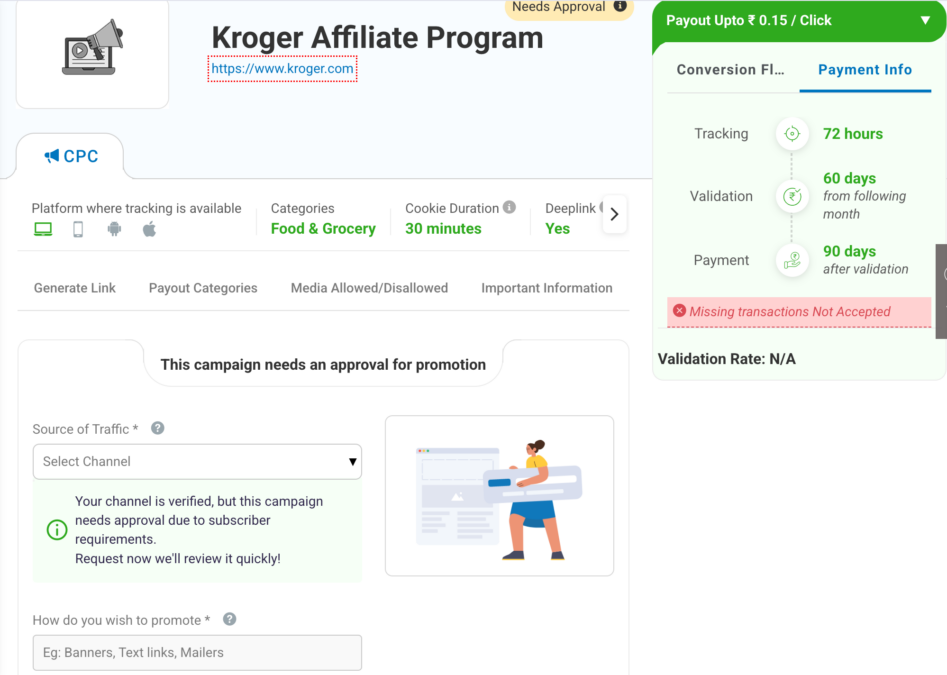
As the largest dedicated supermarket chain in the United States, Kroger’s affiliate program caters to a vast consumer base seeking traditional grocery shopping combined with modern digital convenience and curbside pickup capabilities.
- Commission Structure: Kroger offers a highly competitive commission rate ranging from 1.6% to 4.8% per sale. The program requires a standard $50 payout threshold on its native network.
- Cookie Duration: The program is structured around a 7-day cookie duration.
- Coupon Strategy: Digital coupon clipping is native to the Kroger experience. Kroger’s 7-day cookie strikes an optimal balance for digital publishers, providing a full week to capture the eventual conversion. Deal sites should create localized digital deal-sharing communities and Sunday digital coupon roundups.
Pro Tip: Because Kroger possesses a highly localized physical footprint, affiliates utilizing geo-targeted search engine optimization (SEO) strategies for queries like “Kroger digital coupons [City Name]” can achieve extraordinarily high conversion rates. The 4.8% upper bound on commissions is notably higher than the base grocery rates of both Amazon and Walmart, making Kroger a highly lucrative focus for high-traffic food and deal bloggers.
Note: You might see the Dynamic-CPC commission model on Cuelinks, but when payout is averaged out, it will be similar to the CPS structure.
| Mega-Retailer | Commission Architecture | Cookie Duration | Optimal Coupon Publisher Strategy |
| Walmart US | 1% – 4% (Up to 7.20% dynamically via Cuelinks) | 3 Days (72 Hours) | Flash Rollback roundups, mid-week grocery lists. |
| Amazon US | Dynamic CPC (Up to $0.081 (₹7.77)/click via Cuelinks) | 24 Hours (90 days if added to cart) | “Clip this Coupon” items, Telegram flash deal alerts. |
| Kroger | 1.6% – 4.8% or Dynamic CPC | 7 Days | Digital circular syndication, regional digital coupon clipping. |
🌍 Category 2: Specialized and Cross-Border Grocers
As the demographics of the U.S. consumer base continue to diversify, specialized grocers catering to specific ethnic, regional, and dietary demographics are capturing significant market share. These platforms often offer substantially higher commission structures to aggressively acquire new, highly loyal customer cohorts that are underserved by legacy mega-retailers.
4. Sayweee (Weee!)
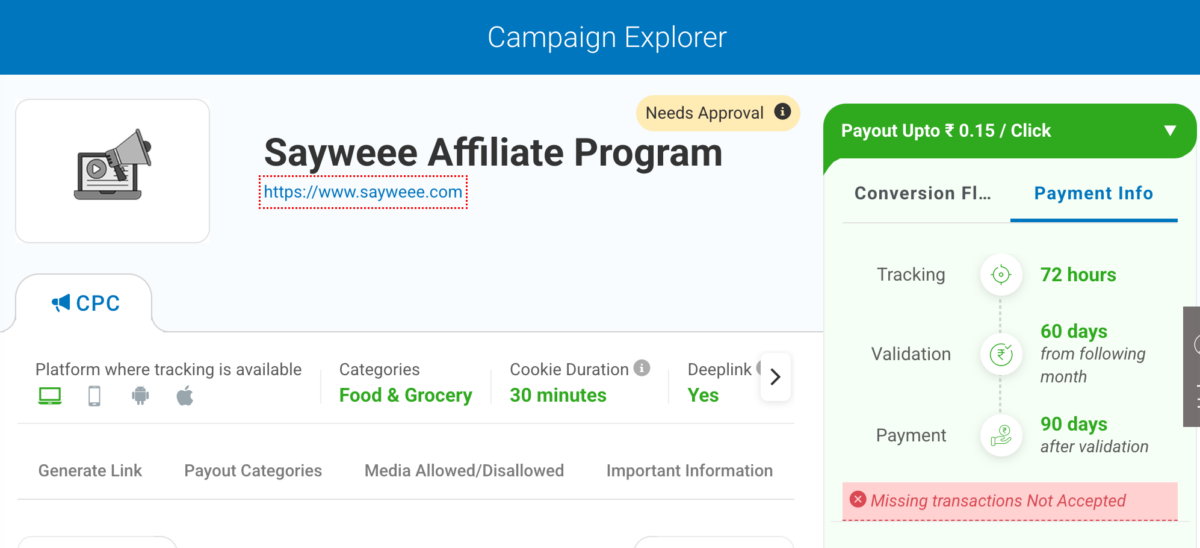
Weee! (Sayweee) operates as the premier e-grocer specializing in Asian and Hispanic food products within the United States. It addresses a massive logistical gap in the traditional supermarket supply chain, delivering hard-to-find produce, premium imported meats, and global pantry staples directly to consumers.
- Commission Structure: Sayweee operates on dynamic compensation models depending on the specific network iteration. Cuelinks’ Weee affiliate program often utilize a dynamic Cost-Per-Click (CPC) model (base: $0.0016-0.0019 / ₹0.15-0.18 per click) or highly localized Cost-Per-Sale (CPS) structures focused on coupon redemptions.
- Cookie Duration: Depending on the specific campaign iteration on Cuelinks, the cookie duration can be as short as 30 minutes for hyper-targeted coupon redemption campaigns, or it can extend up to a standard 30-day window on broader affiliate networks.
- Coupon Strategy: Weee! utilizes a highly effective referral and promotional model that drives exceptional trial rates among urban demographics. If a publisher is operating on the restricted 30-minute coupon cookie via Cuelinks, the strategy must rely entirely on instant-gratification channels.
Pro Tip: Utilizing the Cuelinks Telegram Bot to blast exclusive “$20 off your first $35 order” discount codes to an active, engaged user base is the only reliable method to convert within a half-hour window. Coupon sites should aggressively market these high-value introductory promos.
5. Distacart
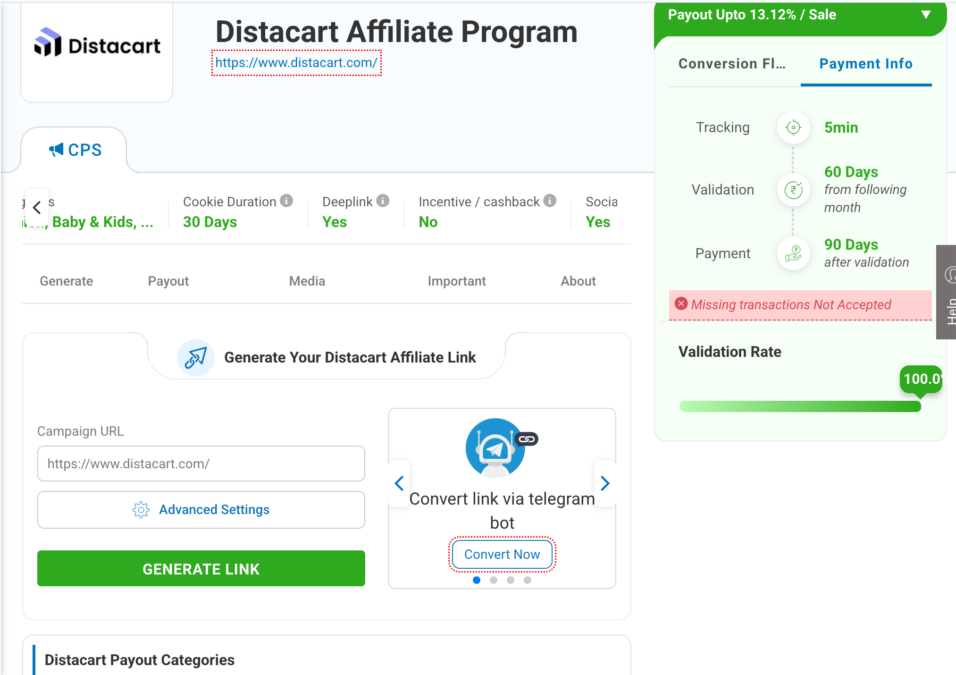
Distacart bridges the cross-border e-commerce gap for the South Asian diaspora in the United States, providing direct delivery of authentic Indian groceries, wellness products, Ayurvedic supplements, and traditional apparel directly from manufacturers in India.
- Commission Structure: Distacart affiliate program offers one of the most generous and well-structured tiered commission architectures in the specialized grocery space. Base rates offer a 15% commission for acquiring a new customer and an 8% to 10% commission for returning customers. High-volume affiliates are incentivized to scale, unlocking a 20% “Silver Tier” for driving 50 or more confirmed orders a month, and a 25% “Gold Tier” for surpassing 100 orders.
- The Dedicated Coupon Bounty: Notably, the program explicitly classifies dedicated coupon websites separately, offering them a flat $2 bounty per order rather than a percentage. This is specifically designed to control coupon-poaching at checkout.
- Cookie Duration: The program boasts a robust 30-day cookie duration.
- Coupon Strategy: Because Distacart limits strict coupon sites to a flat $2 bounty, deal publishers must decide their path. You can either operate as a high-volume coupon repository relying on sheer numbers of $2 bounties by ranking for “Distacart promo code”, OR you can pivot to educational, review-style content integrated with deals to access the lucrative 15% to 25% acquisition bounties.
| Specialized Grocer | Commission Architecture | Cookie Duration | Core Coupon Strategy |
| Sayweee (Weee!) | Dynamic CPC/CPS (min $0.0016-0.0019 (₹0.15-0.18) per click) | 30 Mins to 30 Days | Telegram blasts of high-value introductory promo codes. |
| Distacart | 15% – 25% (Tiered) / $2 flat for coupon sites | 30 Days | Ranking for “promo code” keywords to harvest high-volume $2 bounties. |
🥗 Category 3: Health-Conscious Meal Kits and Ready-to-Eat Delivery
The meal kit market in 2026 is pivoting sharply toward health optimization and hyper-convenience. With 47% of U.S. consumers following highly specific eating plans, the demand for diet-customized meal formats is structurally elevated.
The rise of functional foods and GLP-1 tailored diets creates a high-margin environment where brands are willing to pay aggressive Cost-Per-Acquisition (CPA) bounties to secure recurring subscribers. To combat the inherent 10.8% to 12.7% monthly churn rates, these brands rely on massive, eye-catching introductory coupons (e.g., “Free Shipping + $150 Off Across Your First 6 Boxes”).
6. Hungryroot
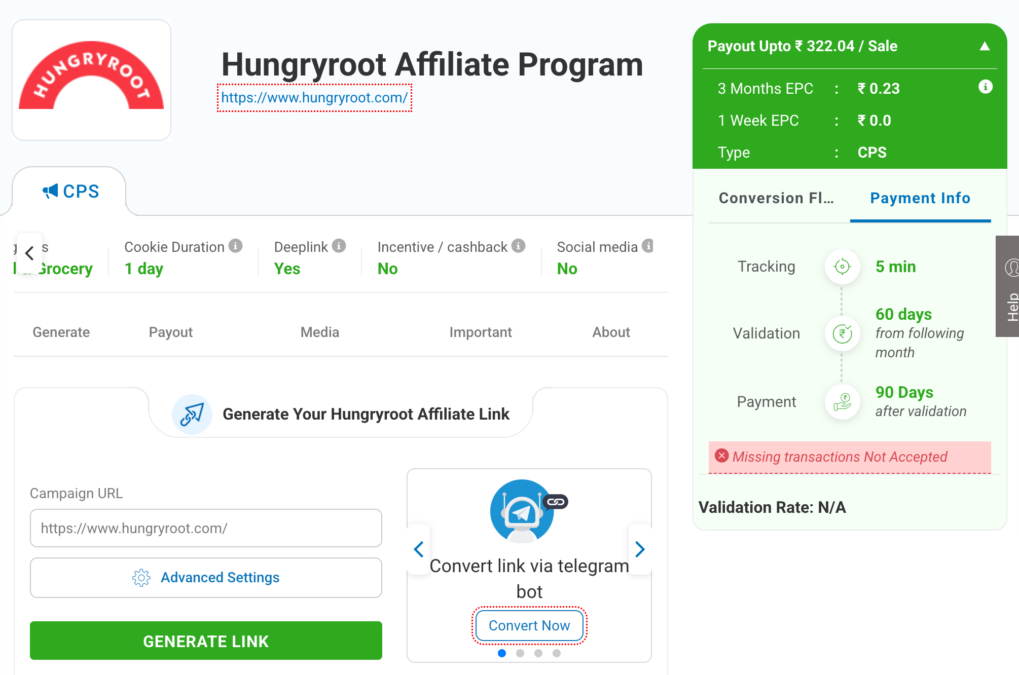
Hungryroot occupies a unique, highly profitable hybrid space between a traditional online grocer and a structured meal kit delivery service. Utilizing proprietary AI-driven algorithms, it curates weekly grocery boxes of plant-based, gluten-free, and health-conscious foods based on consumer behavior, dietary restrictions, and stated health goals.
- Commission Structure: Affiliates in the Hungryroot affiliate program typically earn a flat $4-10 commission per successful acquisition (CPA) and sale (CPS).
- Cookie Duration: The cookie duration is relatively compressed for the subscription space, positioned rigidly between 1-10 days.
- Coupon Strategy: Hungryroot frequently tests massive acquisition offers, such as “30% Off Your First Delivery + Free Gift for Life.” Deal publishers need to maintain meticulously updated coupon pages for Hungryroot. The low duration cookie requires publishers to move users from the consideration phase to purchase relatively quickly, so emphasizing the massive upfront savings of the promo code is key to overcoming initial subscription hesitation.
7. EatClean
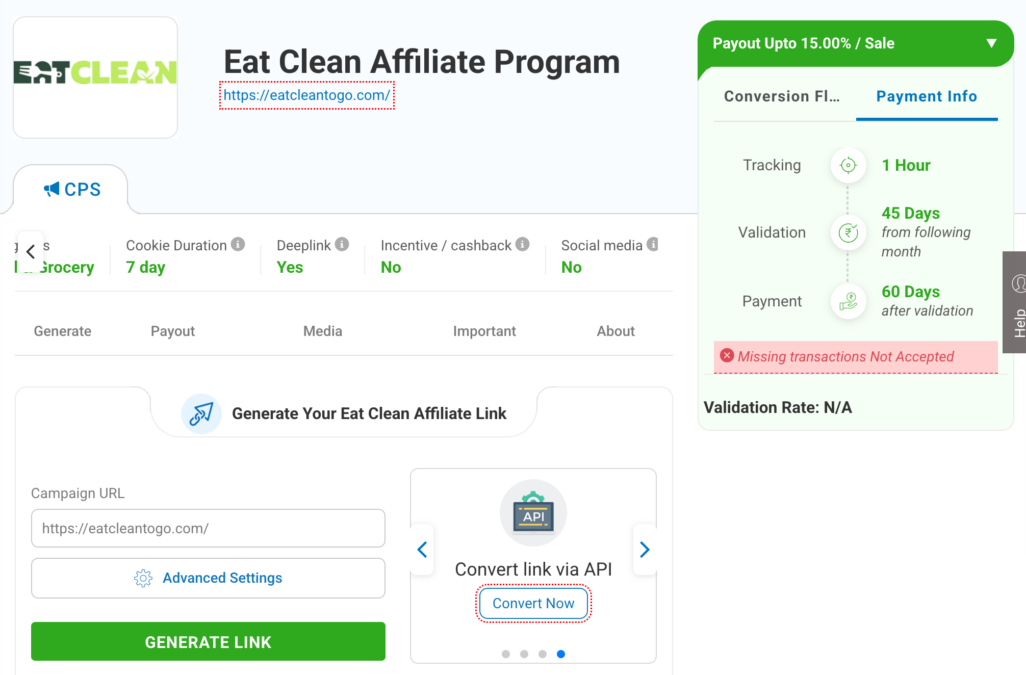
EatClean focuses heavily on the prepared, Ready-to-Eat (RTE) sector, catering directly to fitness-oriented consumers with keto, paleo, plant-based, and traditional macro-balanced meal plans. The RTE category is highly strategic, as it is projected to grow at an 8.17% CAGR through 2031, making it the fastest-growing format in the U.S. meal kit space.
- Commission Structure: While broader syndication networks may offer a flat $15 commission per verified sign-up, the EatClean affiliate program specifically via Cuelinks offers an attractive percentage-based commission of up to 18% per sale.
- Cookie Duration: Depending on the specific campaign routing, the cookie duration typically features a standard 7-day window via Cuelinks, though it can extend up to 60 days.
- Coupon Strategy: The up to 18% Cost-Per-Sale (CPS) commission is highly lucrative. EatClean targets time-constrained consumers who often search for discounts right before subscribing. Deal sites should rank for terms like “EatClean Keto discount codes.” Because Ready-To-Eat meals can carry a premium price tag, prominently displaying percentage-off coupons is critical for conversions within the 7-day cookie window.
8. Marley Spoon
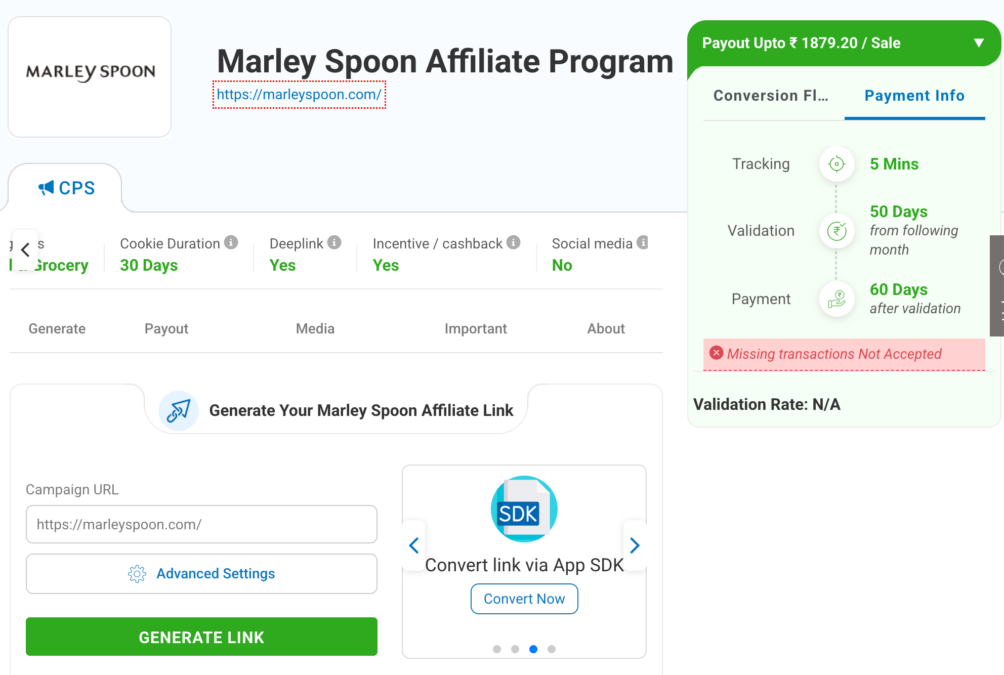
Operating in partnership with lifestyle icon Martha Stewart, Marley Spoon delivers premium, pre-portioned ingredients and culinary-focused recipes. It targets households that enjoy the experiential aspect of cooking, plating, and sharing a meal, but actively wish to avoid the logistical friction of meal planning and grocery shopping.
- Commission Structure: The global baseline commission for Marley Spoon is highly lucrative, offering $30 per sale, while Cuelinks’ Marley Spoon affiliate program’s dynamic payouts report an impressive yield of up to $23.13 (₹2209.28) per confirmed sale. Marley Spoon boasts an attractive average order value (AOV) of over $100.
- Cookie Duration: The program matches this high payout with a generous 30-day cookie duration.
- Coupon Strategy: The long cookie duration is a strategic acknowledgment by the brand of the product’s premium nature. Marley Spoon is notorious for sprawling multi-box coupon codes (e.g., “$200 off your first 8 boxes”). Deal sites must accurately break down how these complex, staggered coupons work to build trust with the consumer. Furthermore, promoting seasonal holiday discount codes can result in massive, sustained conversion spikes.
| Meal Kit Brand | Commission Structure | Cookie Duration | Coupon Deal Focus |
| Hungryroot | $4-10 CPA, CPS | 1 – 10 Days | Emphasize “Free Gift For Life” promo codes. |
| EatClean | Up to 18% CPS via Cuelinks | 7 – 60 Days | Target high-intent “meal prep discount” keywords. |
| Marley Spoon | $30 / up to $23.13 (₹2209) | 30 Days | Explain complex, multi-box promotional offers clearly. |
🥩 Category 4: Niche Gourmet and Experiential Food Kits
Beyond standard weekly groceries and high-churn dinner subscriptions, the high-end gourmet and experiential food markets offer massive single-purchase payouts. These programs do not rely on daily utility, but rather on gifting, seasonal holidays, and luxury consumption patterns.
9. Chicago Steak Company
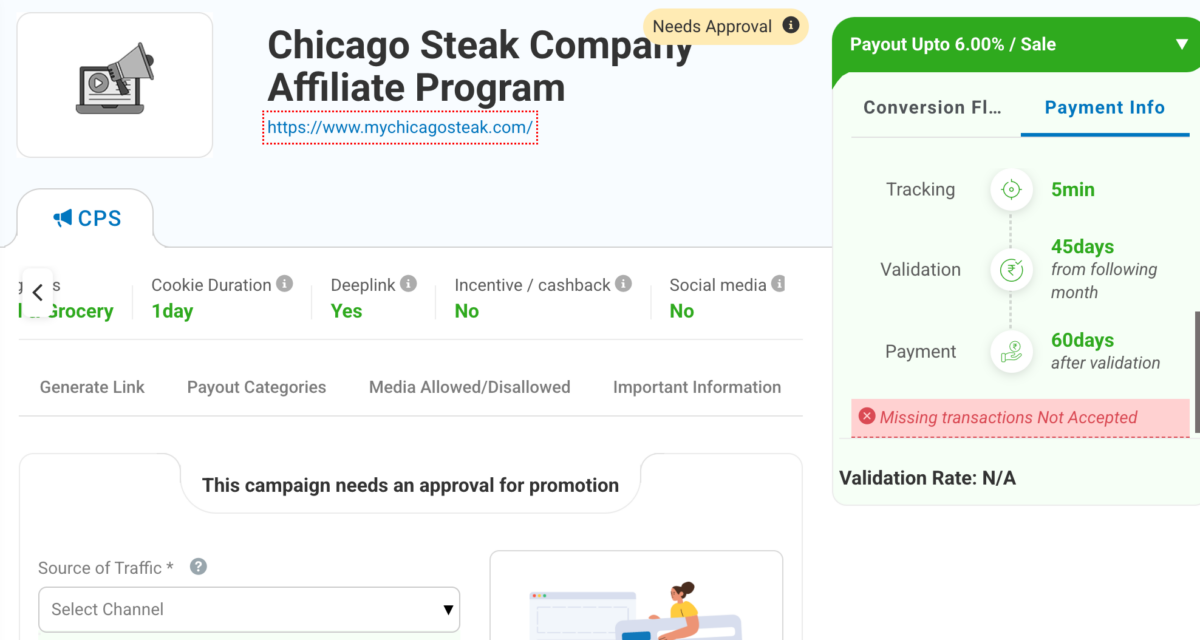
Chicago Steak Company is a premier online purveyor of luxury meats, specializing in dry-aged steaks, USDA Prime beef, and high-end artisanal seafood.
- Commission Structure: The commission potential here remains highly attractive for premium affiliates. While broader networks may advertise varying promotional tiers, the specific campaign available through Cuelinks offers a solid Cost-Per-Sale (CPS) commission payout of up to 7.20% per sale against a remarkably high Average Order Value of $250.
- Cookie Duration: The Chicago Steak Company affiliate program pairs this yield with a lowly unaccommodating 1-day cookie duration 😞.
- Coupon Strategy: Because the AOV is $250, consumers will inherently deliberate and hunt for coupon codes before executing the transaction. Deal sites should feature “Sitewide Free Shipping” codes or “$50 Off Orders Over $200” promos heavily during Father’s Day, Valentine’s Day, and Q4 corporate gifting seasons.
10. Eat2explore
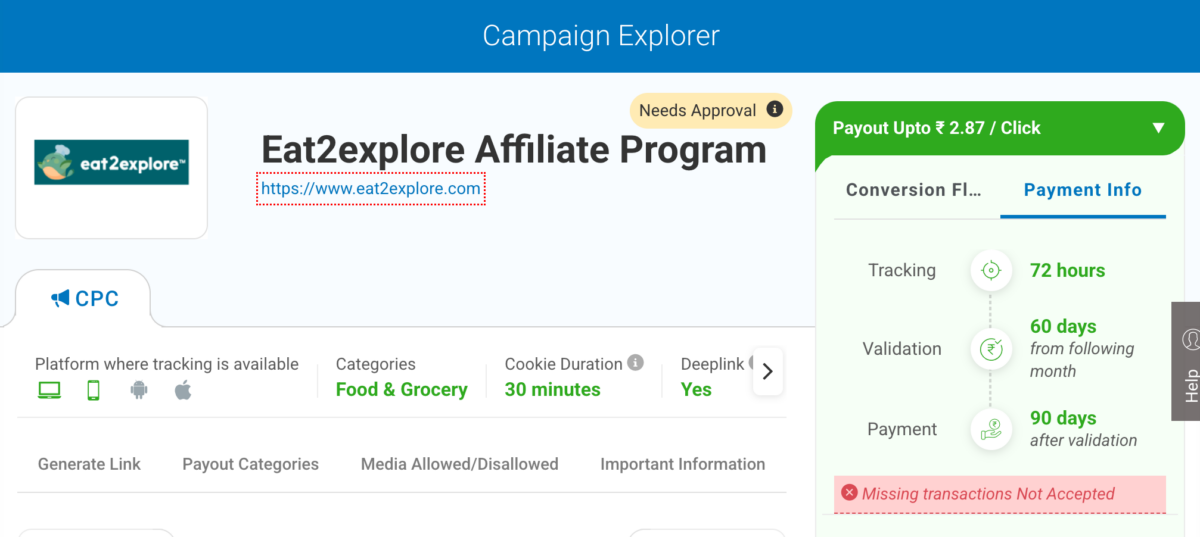
Eat2explore diverges from traditional food delivery by providing experiential, educational cooking kits specifically designed for families with children. Each monthly box focuses on a different global region (e.g., Japan, France, Italy), providing authentic spice blends, localized recipes, and educational materials to teach children about global cultures through culinary exploration.
- Commission Structure: While broader networks may offer a standard 10% commission per sale against an Average Order Value of $50 or more, the specific eat2explore affiliate campaign available through Cuelinks operates on a highly attractive Cost-Per-Click (CPC) model, yielding $0.036 (₹3.44) per click.
- Cookie Duration: The cookie duration varies depending on the specific sub-network, but generally aligns with standard 30-day educational subscription benchmarks.
- Coupon Strategy: Because this program operates on a dynamic CPC rate through Cuelinks, deal publishers can monetize pure traffic by promoting back-to-school or holiday gifting promo codes. Creating urgency with “Limited Time 20% Off Holiday Boxes” will drive massive click-through rates, generating revenue from the click volume regardless of whether the user ultimately buys.
| Gourmet & Experiential Brand | Commission Architecture | Cookie Duration | Coupon Strategy |
| Chicago Steak Company | Up to 7.20% CPS via Cuelinks on $250 AOV | 1 Day | Push high-value ($50+ off) seasonal and corporate gifting codes. |
| eat2explore | $0.036 (₹3.44) per click (CPC) via Cuelinks | Standard (Network Variable) | Drive pure traffic/clicks using urgency-based holiday promo codes. |
🎯 Conclusion
The 2026 U.S. grocery and meal delivery market represents an unparalleled opportunity for digital publishers and coupon deal aggregators. As consumer behavior cements around convenience, health optimization, and hybrid meal preparation, the demand for accessible food delivery and experiential meal kits will only continue to scale.
However, in an era marked by inflation and price-sensitivity, the ability to seamlessly deliver active, high-value promo codes is what will separate top-tier affiliates from the rest. From high-volume mega-retailers like Walmart and Amazon utilizing rapid conversion windows for flash deals, to specialized, high-ticket gourmet experiences like Chicago Steak Company offering high commission for holiday discounts, the diversity of affiliate programs ensures that publishers can monetize nearly every type of deal-hunter.
🚀 Next Steps for Grocery Coupon Affiliates:
- Maintain Coupon Hygiene: Meal kit brands frequently cycle their introductory codes. Ensure your site uses Cuelinks to automate link tracking, but actively audit your coupon pages so users don’t bounce due to expired promo codes.
- Leverage Centralized Power: By utilizing the dynamic payout structures available through Cuelinks, such as robust Cost-Per-Click models for Amazon and eat2explore, or optimized percentage tiers for premium meal kits, affiliates can remove the friction of individual network management and focus entirely on sourcing the best discounts.
- Match Intent with Duration: Success in this highly competitive niche requires matching the correct product offering with precise audience intent. Pushing a 24-hour flash sale for Amazon is entirely different from ranking for a 30-day corporate gifting code for Marley Spoon.
- Adapt and Scale: Coupon publishers who master these nuances and deliver genuine savings will be exceptionally well-positioned to drive consistent, compounding revenue throughout 2026 and beyond.
Note: All the campaign details of the Grocery Coupon Affiliate Programs mentioned in this article can change so check their respective Cuelinks campaign pages for the latest info.
References
- Market Data Forecast
- Grand View Research
- RetentionCheck
FAQs
Q: Why is coupon affiliate marketing essential for grocery brands?
Grocery and meal kit operators face high monthly churn rates (often 10-12%). Massive introductory coupon offers help combat this by driving down the customer acquisition cost (CAC) and converting hesitant, price-sensitive shoppers who are hunting for deals before completing their carts.
Q: Should I prioritize Cost-Per-Sale (CPS) or Cost-Per-Click (CPC) programs?
A: Choose CPS if your traffic is high-intent and ready to convert; this often yields higher returns on premium brands. Choose CPC models (common with mega-retailers like Amazon or specialized niches like eat2explore) if you want to monetize high traffic volume without depending entirely on finalized transactions.
Q: What trends should grocery affiliates focus on to maximize conversions?
A: Align your content with health-specific dietary cohorts (such as keto, paleo, or GLP-1 users) and emphasize time-saving convenience narratives. Grouping coupons by specific dietary needs rather than general ‘grocery coupons’ significantly improves click-through rates.

Sahil Ajmera is content writer with more than 7 years of work experience in field of Affiliate Marketing, Digital Marketing, etc. He loves saving money on everything. His aim is to get readers exactly what they are looking for and that too without wasting much of their time. Whatever he is writing on, you are sure to find a way to earn & save good!