

Affiliate marketing is a performance-based strategy in which your business partners with outside individuals or organizations (affiliates) that promote your products or services for a commission on sales. In essence, you pay only when a sale (or desired action) occurs. This makes an affiliate program a cost-effective way to scale reach and revenue.
For example, affiliates with established audiences (influencers, bloggers, review sites, local groups) can drive new customers to your e-commerce store, SaaS, service, or small business. Each affiliate shares your unique tracking link with their audience; when a purchase is made through that link, the affiliate earns a percentage of the sale. Because commissions are only paid on completed sales, many businesses, especially small or local ones find this approach low-risk and high-reward.
Affiliate programs work for nearly every business model. For an e-commerce store, affiliates can expand your product’s exposure to new audiences online. SaaS companies might pay affiliates a one-time or recurring fee for each subscriber they refer, aligning with subscription revenue. Service-based businesses (like consultants or local service providers) can reward bloggers or community leaders for referring clients. Even brick-and-mortar/local businesses benefit: local bloggers or Facebook group admins can promote your store to nearby shoppers. In all cases, affiliate marketing boosts brand awareness and sales without upfront ad spending.
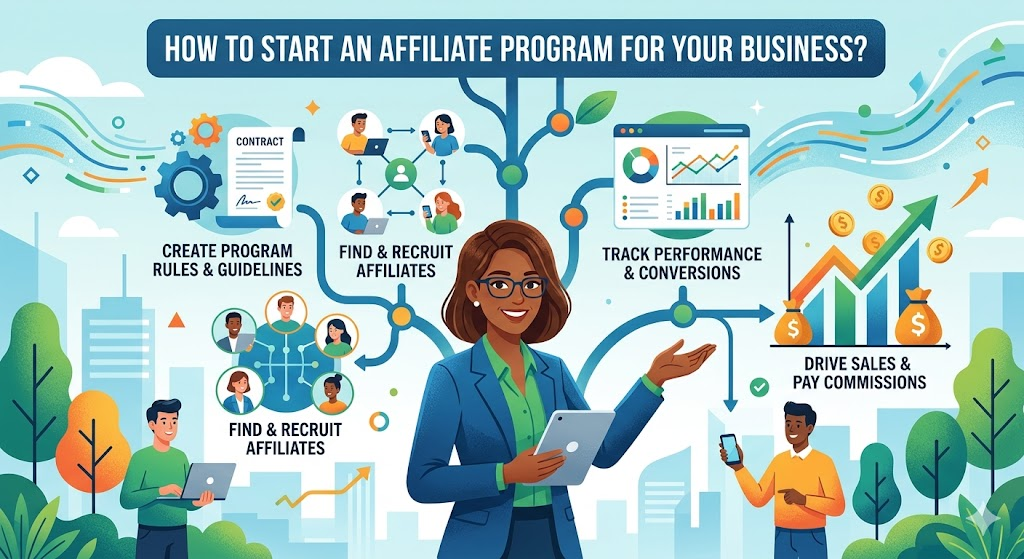
Key benefits include:
- Broader reach, lower cost: Affiliates have their own followers. You tap into their traffic and only pay commissions after a sale. This helps small businesses leverage word-of-mouth to grow on a budget.
- Trust and social proof: Recommendations from known influencers or friends build consumer trust more than ads. Affiliates’ authentic reviews can turn readers into customers.
- Scalability: You can recruit more affiliates as your budget or needs grow. Because it’s pay-for-performance, you can scale up or down easily without wasting money on unqualified leads.
- SEO and content boost: Quality affiliates (like bloggers) often link to your site, helping SEO. As one guide notes, quality affiliate content contributes to your backlink profile, improving search visibility.
- Measurable ROI: Modern affiliate platforms provide real-time tracking, so you see exactly how each affiliate performs and pay for actual conversions, not guesses.
By structuring an affiliate program tailored to your business, whether e-commerce, SaaS, B2B, or local, you create a new revenue channel that rewards partners for tangible results.
How to Launch Your Affiliate Program (Step-by-Step)
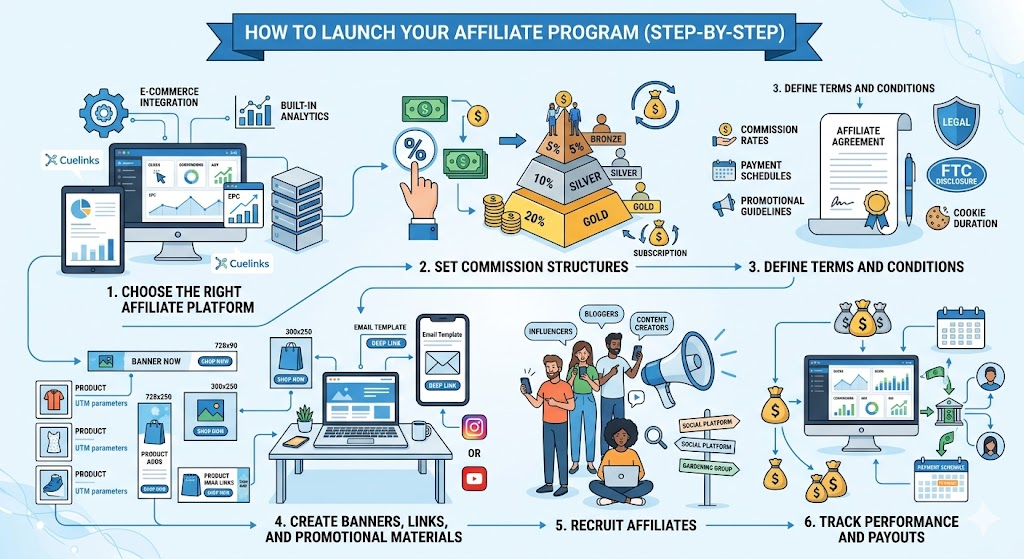
Launching an affiliate program involves planning several key components. Below is a step-by-step guide to get started:
1. Choose the Right Affiliate Platform
Affiliate software or networks make it easy to manage partners, links, and payouts from one place. When selecting a platform, look for features like e-commerce integration, built-in analytics, and automated payments. For instance, Cuelinks lets your brand get promoted and generate sales across lakhs of online platforms via 60K+ publishers. It provides a single dashboard for clicks, EPC, and conversion data. It also offers built-in integrations with Google Analytics for tracking. The key is a solution that fits your business size and tech stack.
2. Set Commission Structures
Decide how affiliates will earn. Common models are pay-per-sale (a percentage of each sale), pay-per-click (a small fixed fee per click), or pay-per-lead (a fee for sign-ups or inquiries). Many programs combine models (e.g. a base commission plus a bonus for a sale). Your rates should balance attractiveness to affiliates with your profit margins.
It’s smart to create tiers: beginners might get a lower percentage and high performers earn more. For example, a bronze/silver/gold tier (5%, 10%, 20%). Some businesses also offer recurring commissions on subscription products. When deciding, consider industry norms (e.g. 5-30% of sale price) and your customer lifetime value. Use flexible tools: modern affiliate software allows percentage or flat-rate payouts, recurring commissions, and product-specific rates.
3. Define Terms and Conditions
Create clear affiliate agreement and rules. This contract outlines commission rates, payment schedules, and promotional guidelines. Specify what marketing methods are allowed or prohibited (e.g. no trademark bidding, no misleading ads). Include legal disclaimers: in the US, the FTC requires affiliates to disclose paid promotions.
Explain cookie durations (how long after a click the affiliate gets credit) and how payouts work (e.g. monthly via PayPal, after reaching a threshold). Also detail any loyalty or tier rules, and conditions for termination. Having signed agreements protects you and the affiliates by preventing misunderstandings. For example, this industry stresses that affiliate terms should cover obligations, compensation, and termination clauses. Ensure affiliates know they must clearly disclose their commissions per FTC rules, and maintain brand standards.
4. Create Banners, Links, and Promotional Materials
Prepare ready-made assets for affiliates to share. Provide a variety of banners (different sizes for web, social media graphics, video ads), text links, product images, and email templates. High-quality creatives help affiliates market effectively. In fact, affiliates given professional, on-brand materials are far more likely to promote actively.
For example, research shows consistent branding across channels can boost affiliate conversion rates significantly. Include affiliate-specific coupon codes or deep links where possible. Ensure all tracking links are set up (with unique IDs and cookie tracking) so sales credit correctly.
Many affiliate platforms automate link generation; if not, tools like Google Tag Manager or UTM parameters can help track clicks. Also draft email outreach copy and sample social posts to make affiliates’ jobs easier. The goal is consistency: every affiliate uses your approved logos and messaging to reinforce brand trust.
5. Recruit Affiliates (Influencers, Bloggers, Content Creators, etc.)
Now seek partners whose audience matches yours. Influencers on Instagram, YouTube, or TikTok, niche bloggers and review sites, email newsletter publishers, and even local community group admins can be excellent affiliates. Start by defining your ideal affiliate “persona” (interests, platforms, audience demographics) and searching where that audience hangs out.
Use social media search, Google operators (e.g. “best [your niche] blog”), or ask AI tools to find relevant sites. You can reach out via direct messages or through affiliate directories. Advertise your program on your website and social channels, inviting applications. Engage online communities: join Facebook groups, Reddit forums or LinkedIn groups in your industry. These can be rich sources of affiliate talent (for example, gardening products in r/gardening).
Attend trade events or webinars to network. Offer competitive sign-up bonuses or trial products to attract top influencers and publishers. Remember to highlight the benefits (good commissions, free products, etc.) in your pitches. Building a personal connection helps: the right influencer/publisher can drive large volume because their recommendation feels authentic to their followers.
6. Track Performance and Payouts
Use your platform’s dashboard (or Google Analytics) to monitor affiliate activity. Track clicks, conversions, average order value, and ROI per affiliate. Accurate tracking is essential: leading affiliate software automatically logs every click, sale, and conversion in real time so each partner is credited correctly.
Pay commissions on a consistent schedule (e.g. net-30 or net-60) and meet payout minimums. You can automate payouts by integrating with PayPal, Stripe, or bank transfers. Set up alerts for exceptional cases (e.g. extremely high conversion rates might signal fraud).
Regularly review which affiliates perform best and why: this can guide recruiting and promotional strategies. Don’t forget to monitor your own KPIs (revenue, growth, customer feedback) so you know if the affiliate program meets your goals. “Tracking key metrics like ROI, average order value, and conversion rate is critical to evaluate success”.
Legal and Financial Considerations
When running an affiliate program, be mindful of legal and tax rules. Ensure your affiliates comply with advertising laws: for example, the FTC requires honest disclosure of paid links. You should have written agreements with your affiliates outlining terms and conditions. These contracts cover commission payments, marketing restrictions, intellectual property use, and termination clauses. Include a clear policy that affiliates must not misrepresent your products and must disclose partnerships (e.g. “I earn a commission from purchases made via links in this post”).
Financially, track all affiliate commissions as business expenses and stay tax-compliant. In many countries, affiliate payouts are deductible marketing expenses for the merchant. Affiliates themselves must report commissions as taxable income. For example, U.S. affiliates who earn more than $600 from one program will receive a Form 1099-NEC from the payer, which they must file with their taxes. You may need to handle similar reporting (issuing forms, deducting withholding if required) depending on your jurisdiction. Additionally, be aware of any sales tax or VAT obligations triggered by affiliate sales in different regions. Maintaining clear records of payments and performance will simplify tax filings for both you and your affiliates. Consult an accountant if needed: the general rule is that affiliate income is taxable, and expenses related to your program are deductible.
It’s also wise to comply with data and privacy laws. If affiliates collect any personal data (e.g. email signups), ensure GDPR (EU) or CCPA (California) requirements are met. Protecting your brand reputation is paramount: choose affiliates carefully, and provide guidance to prevent misleading claims or copyright violations. By addressing these legal and financial factors upfront, you safeguard your business and build trust with affiliates and customers alike.
Recommended Tools and Platforms
Below are some tools and networks to consider for your affiliate program:
- Cuelinks Affiliate Platform: An Indian-born content monetization tool popular with bloggers and publishers. Cuelinks aggregates over 2,500 affiliate campaigns (in niches like e-commerce, travel, finance, etc.) in one place. It automatically converts your outbound product links on publisher’s site into tracked affiliate links, and offers a unified dashboard for clicks, earnings-per-click (EPC), and conversion rates. Cuelinks also provides consolidated payouts (Net60 to your bank) so your publishers don’t chase multiple merchants. This “one-click” setup is ideal for content-driven sites wanting passive income, and in-turn doing marketing and generating sales for your business.
- Content and Social Tools: Google Analytics (with conversion goals) or Facebook Pixel can supplement tracking by verifying affiliate-generated traffic and sales. For creative assets, use Canva or Adobe Spark to design banners. Email platforms (Mailchimp, ConvertKit) can track affiliate-driven subscriber signups. Even chatbots or link shorteners with analytics (Bitly, PrettyLinks) can help monitor affiliate link engagement.
- Payment Gateways: Integrate your affiliate software with PayPal, Stripe Connect, or bank transfers to automate payouts. Many tools support scheduled or instant payments.
When choosing, align tools with your budget and scale. For example, Shopify store owners might use CueApps for seamless Shopify integration. If you have a WordPress site, plugins like Cuelinks WordPress can add affiliate functionality. The right combination of tools will automate as much as possible, so you focus on recruiting quality affiliates and optimizing the program.
Note: If you start your brand/business‘s affiliate program on Cuelinks (14+ yrs experienced affiliate marketing platform & network), it will setup all the affiliate norms and legal T&Cs. You simply need to get your business online (if not) and Cuelinks will do the rest in terms of affiliate marketing (campaigns, publishers/influencers tie-ups, tracking, validation, commission payouts, etc.).
By following these steps: selecting the best platform (we recommend exploring Cuelinks as an option, especially for content-heavy businesses), defining commissions and terms carefully, equipping affiliates with great creatives, and staying compliant, you’ll be well on your way to starting an affiliate program for your business. A well-run affiliate program can become a powerful, scalable marketing channel that drives new customers and revenue with minimal upfront cost, benefiting your small business or enterprise alike.

Sahil Ajmera is content writer with more than 7 years of work experience in field of Affiliate Marketing, Digital Marketing, etc. He loves saving money on everything. His aim is to get readers exactly what they are looking for and that too without wasting much of their time. Whatever he is writing on, you are sure to find a way to earn & save good!