

Affiliate marketing remains one of the most cost-effective channels for publishers and content creators. With the U.S. industry projected to hit $14.47 billion by 2027, savvy affiliates can earn $6-12 back for every $1 spent (source: EMarketer’s 5 Chart Affiliate Marketing guide).
This article synthesizes evidence-based tactics to maximize affiliate success. Key points include: placing links in high-conversion spots (e.g. intro/outro of reviews), using proven content formats (how-to guides, top-10 lists, comparisons), and optimizing site design (fast, mobile-friendly, clear CTAs) to boost conversions.
We cover choosing the right offers, using clear calls-to-action, and running A/B tests on layouts. Real-world examples (e.g. bloggers earning six-figure revenues) illustrate how authentic content and strategic link placement drive clicks and sales.
The article also includes checklists, outreach templates, and recommended tools (with pros/cons) to help publishers implement these strategies.
Affiliate marketing isn’t just about adding links: it’s about placing the right links, in the right content, for the right audience. In this guide, we break down proven affiliate marketing strategies that actually drive clicks, conversions, and real revenue: based on what’s working today.
Link Placement
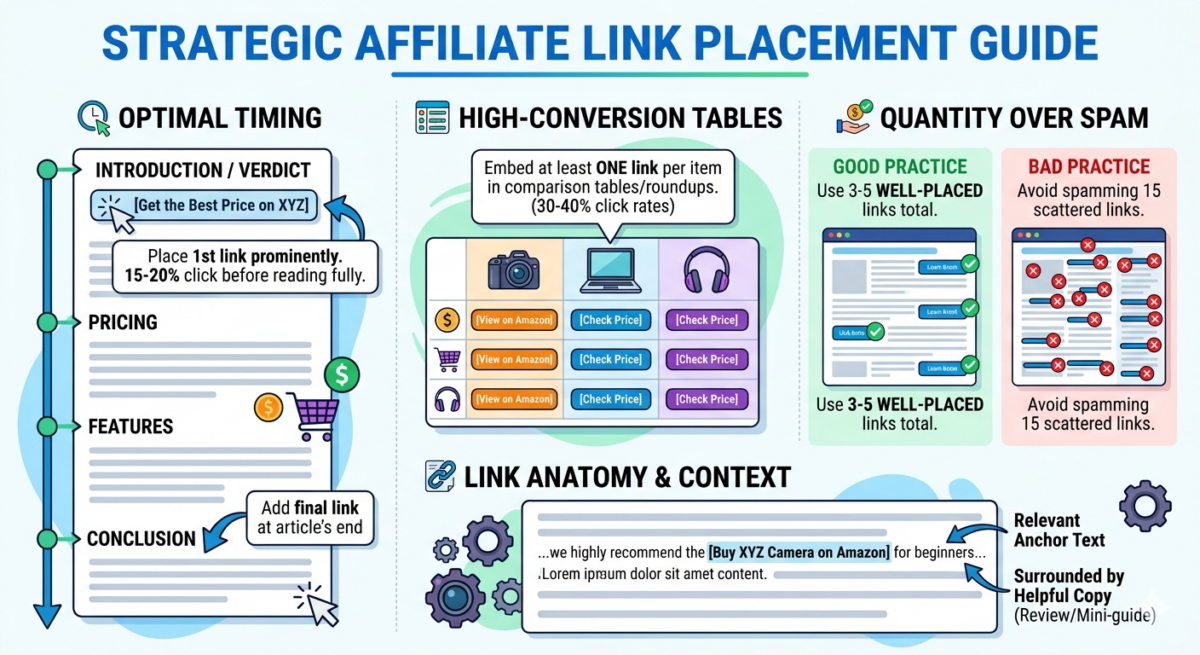
Place the first affiliate link prominently (e.g. in the intro or opening “verdict” of a review) because 15-20% of readers click before reading fully. Add additional links after pricing info and at the article’s end.
In comparison tables or “quick pick” roundups, embed at least one link per item because such tables can garner 30-40% click rates. Use 3-5 well-placed links per page rather than spamming 15 scattered links.
Each link should have relevant anchor text (“Buy XYZ camera on Amazon”) and be surrounded by helpful copy (e.g. a review or mini-guide).
Source: UseArticle’s Affiliate Content Template Formats guide
Content Types
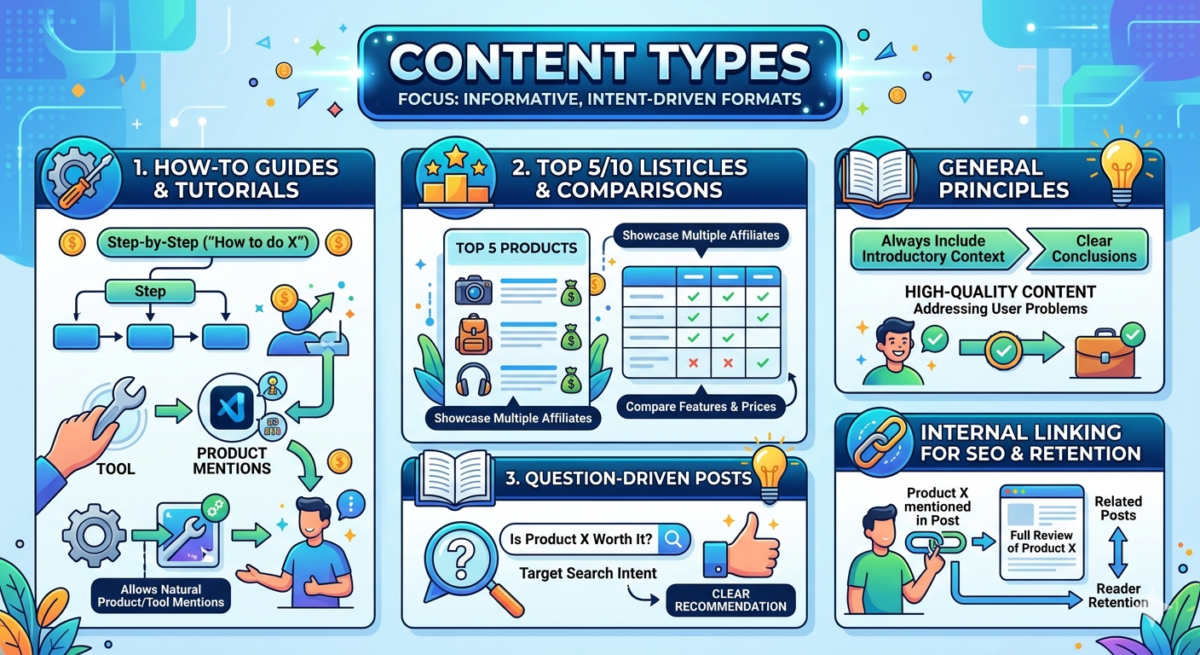
Focus on informative, intent-driven formats. How-to guides and tutorials (e.g. “How to do X – step by step”) naturally allows product/tool mentions. “Top 5/10” listicles or comparison posts are excellent for showcasing multiple affiliates.
Question-driven posts (e.g. “Is Product X worth it?”) can target search intent and end with a clear recommendation. Always include introductory context and clear conclusions.
Use internal links to related posts for SEO and reader retention (e.g. link a product mentioned to a full review). High-quality content that addresses user problems will attract and keep readers, improving the chance they’ll click a link.
Offer Selection & Monetization Mix
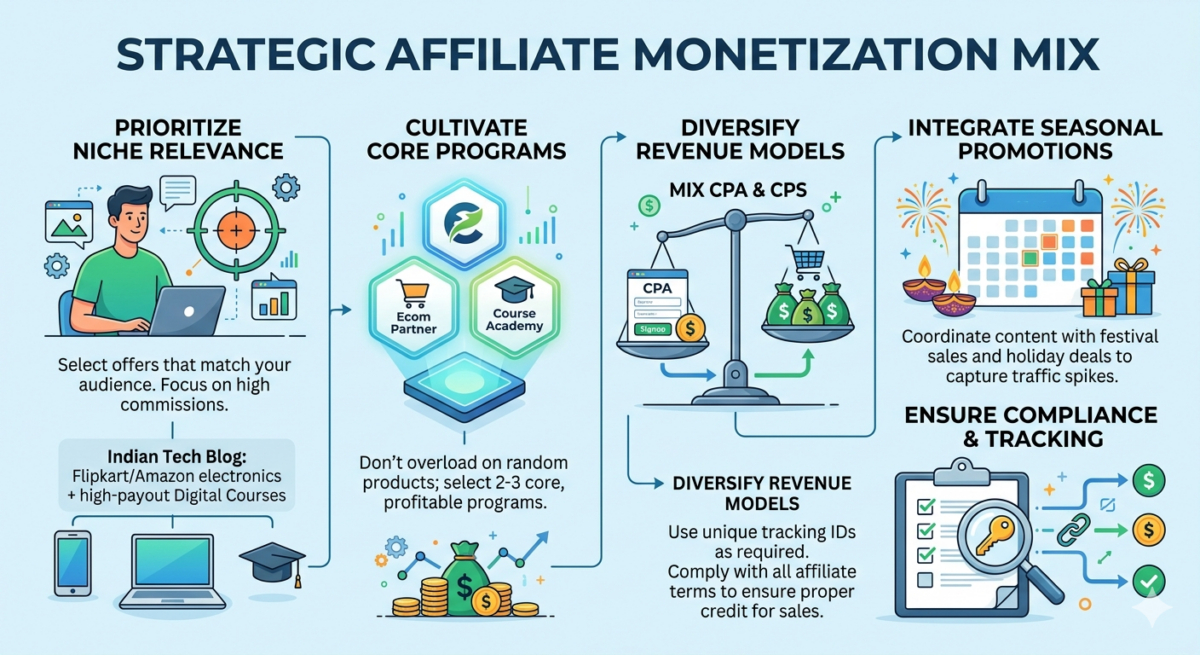
Prioritize offers that match your niche and have attractive commissions. For example, an Indian tech blog might focus on Flipkart/Amazon electronics, plus digital courses with higher payout. Don’t overload on random products; instead, cultivate 2-3 core affiliate programs that pay well and resonate with your audience.
Consider combining CPA (lead generation) and CPS (sale) models to diversify revenue streams. Seasonal promotions (e.g. festival sales, holiday deals) should be integrated into content calendars to capitalize on spikes. Always use unique tracking IDs (as required by each program) and comply with affiliate terms to ensure credit for sales.
Compelling CTAs
Every affiliate mention should be paired with a clear call-to-action. Use action verbs and urgency (“Get 30% off now!”, “Try free for 30 days!”, “Download the guide”). Place CTA buttons or highlighted links near the product name, price, or benefits summary.
For example, a green “Buy Now” button or a bold link “Grab this discount” can boost conversions. Resist generic CTAs; tailor them to the offer (“Enroll in Course X – limited seats!”). Rotate CTA phrasing through A/B tests to see which performs best.
Related post you might like:–
Tracking & A/B Testing

Set up Google Analytics with goals to measure affiliate link clicks and conversions. Also use each affiliate network’s dashboard. For more granular data, tools like Voluum or RedTrack can track links across campaigns.
Start with small tests: change one element at a time (headline, button color, placement of a link) and compare results. For example, test two different images in a product block, or “Buy Now” vs “Learn More” CTAs.
Use landing page split-testing (VWO, Optimizely, or Convert) and analyze metrics like CTR and sales conversion. Regularly review top-performing posts and iterate: update outdated stats or CTAs to keep content fresh (update titles like “Best X of 2023” to 2026 to maintain SEO).

Case Studies & Data Points
Real examples illustrate these tactics in action.

Travel Mexico Solo (blog) earned over $1 million in one year (Year 5 of blogging) primarily from affiliate commissions. The blogger succeeded by targeting high-buy-intent keywords, providing detailed itineraries (context), and transparently sharing earnings.
Making Sense of Cents (personal finance blog) generates about $50,000 per month from affiliates. The owner Michelle Schroeder-Gardner uses social proof: she cites media articles (Forbes, Business Insider) and personal earnings to build trust. She also offers an affiliate marketing course and uses her email list to promote products.
Ryan Robinson (marketing blog) scaled from ~$17K/month (2021) to >$50K/month by updating old content and diversifying products. His strategy highlights the importance of content freshness and multi-channel promotion.
At the publisher scale, Wirecutter (a product review site) exemplifies user-centric strategy: thorough testing, unbiased reviews, and easy navigation. In Q1 2025 Wirecutter earned $70.5 million in affiliate revenue, thanks to loyal readership and transparent disclosures.
Key lessons: prioritize reader trust (clear affiliate disclosures), exhaustive product research, and site speed.
Similarly, The Points Guy (travel credit card reviews) drives massive traffic (10M+ monthly visitors) by leveraging SEO and analytics. They track which articles yield the highest sign-ups and continuously optimize those pages.
Data Highlights: Typical affiliates earn between $3,000 and $15,000 per month with effortful strategy. About 83% of marketers now use affiliate programs. Mobile is crucial: roughly 62% of affiliate traffic is on smartphones (source: Cuelinks’ Affiliate Marketing Statistics guide), so mobile optimization is non-negotiable. Retailers report affiliates contribute up to 20% of revenue, underlining the potential impact of doing it well.
Related post you might like:-
Implementation Checklist
- Define Your Niche & Goals: Determine the audience you serve and what you want from affiliates (e.g. high commissions, recurring income).
- Research Affiliate Programs: Join networks (Cuelinks, Amazon, CJ, ShareASale) and apply to relevant merchants. Look for recurring commissions (subscriptions, services) and proprietary coupons.
- Keyword & Topic Research: Use SEO tools (Semrush, Ahrefs) to find long-tail, buyer-intent keywords in your niche. Plan content (reviews, listicles, tutorials) around these keywords.
- Create Content Calendar: Schedule a mix of evergreen (how-to guides, comparisons) and timely posts (holiday gift guides, product launch reviews). Include targeted seasonal events (Prime Day, Diwali sales).
- Produce High-Quality Content: Write comprehensive, helpful posts with engaging titles. Include visuals (screenshots, infographics) to break up text and highlight products.
- Insert Affiliate Links Strategically: Embed links in relevant anchor text and CTAs. Use tables or bullet summaries for quick-picks. Ensure disclosures (“affiliate link” notice) are clearly visible.
- Optimize On-Page SEO: Use primary keywords in title (50-60 chars), headings, and meta tags. Ensure mobile-friendly design and fast load times.
- Set Up Analytics & Tracking: Install Google Analytics and link it to your affiliate data. Use affiliate dashboards or link trackers (Cuelinks dashboard tracks clicks/sales).
- Promote Content: Share posts via social channels, email newsletters, and relevant forums/groups. Seek guest posting or influencer collaboration opportunities.
- A/B Test & Iterate: Test different headlines, images, and CTA placements. Use the data to double down on what works.
- Refresh & Repurpose: Update older posts (change years, update products). Repurpose high-performing content into new formats (video, infographics).
- Engage Your Audience: Build an email list to drive repeat traffic. Offer exclusive coupons or bonus content to subscribers.
Related post you might like:-
Call-to-Action & Outreach Templates
- Sample CTAs:
- “Grab this 20% discount now on [Product]!”
- “Download the free guide to [topic]”
- “Try [Service] free for 30 days: limited offer!”
Use buttons (“Buy Now”, “Get Coupon”) or bold links to make CTAs stand out.
- Affiliate Outreach Email (to join a program):
Subject: Opportunity for [Your Niche] blog collaboration
Body: “Hi [Name], I’m [Your Name], editor of [Blog], a [niche] site with [traffic stats] readers. I love [Company/Product], and I think it’s a great fit for my audience. I would like to join your affiliate program to recommend [Product] through honest reviews and guides. Please let me know the details of your program and commission structure. Looking forward to potentially collaborating!
Best, [Name], [Website], [Contact Info].”
- Content Partner Outreach (to another publisher):
“Hi [Name],
I enjoy your recent article on [Topic]. I run [Your Blog] which covers similar areas. I’d love to collaborate, perhaps exchange guest posts or co-create content. My latest guide on [Related Topic] might interest your readers. Let me know if you’re open to discussing ideas.
Cheers, [Name].”
Common Mistakes & Troubleshooting
- Spreading Too Thin: Promoting every product dilutes focus and credibility. Instead, specialize in a niche and highlight a handful of relevant, high-commission products.
- Poor-Quality Content: Shortcutting writing (e.g. over-relying on unedited AI text) hurts engagement and SEO. Always edit for clarity and add original insights. Readers bounce if content isn’t valuable, harming rankings.
- No Tracking or Analytics: Not monitoring performance is “flying blind”. If you can’t see which links convert, you can’t optimize. Ensure tracking is in place before scaling.
- Stagnant Content: “Set it and forget it” is a trap. Outdated posts (e.g. “Best X of 2022”) lose traffic. Regularly update titles and content (current year, new products) to maintain SEO and relevance.
- Ignoring Early Signals: Only looking at conversions can cost money. Watch CTRs – a low CTR usually means the headline or image isn’t resonating. Test new angles if clicks are poor.
- Single-Source Reliance: Depending on just SEO or one ad platform is risky. Traffic patterns change (e.g. Google algo shifts). Diversify channels: use email marketing, social, and even test paid ads to mitigate risk.
- Neglecting Mobile UX: With most traffic on phones, a desktop-only layout kills conversions. Always check that buttons/links are thumb-friendly and pages load quickly on mobile.
Related post you might like:-
Recommended Tools & Platforms
| Category | Options (Pros) | Cons |
| Link Management | Cuelinks – Free integration for 2,500+ merchants; auto-link plugins; unified dashboard tracks all clicks/sales. Pretty Links/ThirstyAffiliates (WordPress) – Cloak and manage links easily. Bitly/Rebrandly – Short and trackable links. | Self-plugins require site maintenance. Bitly – less customizable; not specialized for affiliate tracking. |
| Tracking & Analytics | Google Analytics 4 – Free, tracks pageviews/UTM. Voluum – Advanced cloud tracker; splits traffic, detects fraud. Binom – Ultra-fast self-hosted tracker. Everflow – Deep linking, customizable reports, fraud detection. Cuelinks Dashboard – Real-time clicks and revenue for all links. | Voluum/Everflow – can be expensive for small sites. GA4 – needs setup; doesn’t track at link-click granularity by itself. |
| SEO & Content | Semrush/Ahrefs – Keyword research, competitor analysis. MarketMuse – Content planning, gap analysis. BuzzSumo – Topic/viral content discovery. Grammarly – Writing assistance. | Paid tools can be pricey. The learning curve exists. |
| Email/Outreach | Mailchimp/ConvertKit – Newsletters and drip campaigns. Hunter.io – Find email contacts. LinkedIn Sales Navigator – Identify affiliate managers. | May require subscription. Cold outreach has variable response rates. |
Related post you might like:- ☝️
Conclusion & Next Steps
A systematic affiliate strategy: combining targeted content, strategic link placement, compelling CTAs, and continuous optimization leads to higher affiliate earnings. Publishers should use the provided checklist to launch or refine their programs immediately.
Start by optimizing just one high-traffic post today: improve link placement, update CTAs, and track results. Small changes can lead to significant revenue gains.
Next steps include performing keyword research to update an existing post, setting up a new affiliate link placement in an evergreen article, or running a simple A/B test on a CTA. Monitor your analytics (via Cuelinks and GA) each month and adjust based on performance.
Keep learning from industry case studies and peer communities. With persistent effort and data-driven tweaks, publishers can steadily grow clicks, conversions, and affiliate revenue.

Sahil Ajmera is content writer with more than 7 years of work experience in field of Affiliate Marketing, Digital Marketing, etc. He loves saving money on everything. His aim is to get readers exactly what they are looking for and that too without wasting much of their time. Whatever he is writing on, you are sure to find a way to earn & save good!