


The Amazon Affiliate Program is a global program, with separate affiliate programs in the US, UK, India and many other countries, and Cuelinks lets you tap into all of them from one dashboard. To succeed ethically and at scale, new and intermediate affiliates should focus on high-value content, clear disclosures, and compliance. For example, install Cuelinks’ JavaScript tag so that any Amazon product link on your site automatically converts into an affiliate link. This saves time and keeps all your links updated, while Cuelinks’ single dashboard aggregates clicks, conversions and EPC across all Amazon campaigns. Below are key best practices (Dos) and pitfalls (Don’ts), illustrated with examples and aligned with Amazon’s global policies and Cuelinks’ own guidelines.
Create Valuable, Contextual Content (Do)
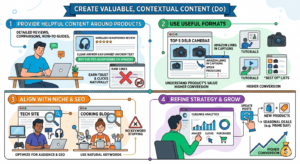
Do provide helpful content around products. Don’t just litter pages with raw links. For instance, in a blog reviewing wireless headphones, embed your affiliate link in relevant anchor text like “buy the XYZ headphones on Amazon”. Surround links with detailed reviews, comparisons or how-to guides so visitors understand the product’s value. Useful content (tutorials, “best of” lists, detailed comparisons) naturally earns trust and clicks. For example, a “Top 5 DSLR Cameras” post that embeds Amazon links in captions under each camera image (with specs and pros/cons) will convert much better than a bare list of URLs.
Do optimize for your audience and SEO, but avoid spam. Use natural keywords in your text and headings so search engines and users find you, but never keyword-stuff just for Amazon traffic. Always align products with your niche: a tech site should focus on electronics, a cooking blog on kitchenware, etc. Update old posts with fresh products or seasonal deals (e.g. Prime Day items) to keep content current. Over time, analyze which articles get clicks or purchases (via Cuelinks analytics) and refine your strategy: emphasize topics and formats (review vs. list vs. tutorial) that yield higher conversion.
Disclose Affiliate Relationships Clearly (Do)
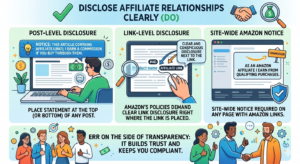
Do include clear, prominent disclosures. Both the FTC and Amazon require that readers know you earn commissions. Place a disclosure statement at the top (or bottom) of any post with affiliate links, and next to the links themselves. For example: “This article contains affiliate links; I earn a commission if you buy through them.” Amazon’s policies specifically demand a link-level disclosure that is “clear and conspicuous” (e.g. “#ad” or “(affiliate link)”) right where you place a link. They also require the site-wide notice, “As an Amazon Affiliate I earn from qualifying purchases,” on any page with Amazon links. Failure to disclose is a common violation, so always err on the side of transparency: it builds trust and keeps you compliant.
Use Approved Cuelinks Tools (Do)
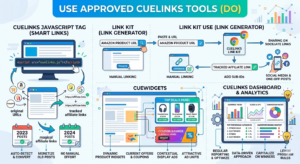
Cuelinks offers tools to streamline linking and boost earnings:
- Cuelinks JavaScript tag: Once you add Cuelinks’ JS code to your site, it automatically detects Amazon (and other merchant) URLs in your content and converts them to your tracked affiliate links. This “Smart Links” approach means old posts get monetized too, with no manual effort. Cuelinks assures this script won’t hurt SEO and you simply maintain your original Amazon URLs, so links remain active (they use the canonical product page).
- Link Kit (Link Generator): If you prefer manual linking or share links on social media, use Cuelinks’ Link Kit or Chrome extension. Just paste a product or merchant URL and it returns an affiliate link. This also lets you add sub-IDs for tracking. It’s great for one-off posts or non-website channels. For example, when promoting a deal on Twitter, use Link Kit to generate and shorten the affiliate URL quickly.
- CueWidgets: Create dynamic product widgets or deal banners with CueWidgets. For instance, you can display a “Top Deals” panel or a coupon banner on your blog sidebar. CueWidgets pulls in current offers and coupons from Amazon (and other stores) into attractive ad units. Placing a CueWidget below your post or in empty content slots can entice users to click on hot products without manual linking. This contextual display advertising blends naturally with content.
- Cuelinks Dashboard & Analytics: Regularly review Cuelinks’ reporting to optimize. The unified dashboard shows total clicks, EPC (earnings per click), conversion rates and earnings for all your affiliates. Use these metrics to find underperforming content (maybe refresh it or remove dead links) and capitalize on winners. For example, if you see a particular category (say fitness gear) driving most sales, focus more posts there. The data-driven approach ensures you “learn program rules” and improve over time.
Promote on Allowed Channels (Do & Don’t)
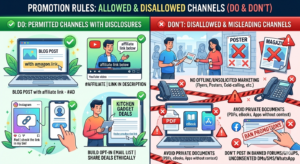
Do use permitted digital channels with disclosures. You can place affiliate links on your website, blog, approved social media, YouTube, or in opt-in emails and SMS texts. For social platforms, follow their rules: e.g. on YouTube clearly mention affiliate links in descriptions or on-screen text, and use “#ad” or “#affiliate” hashtags in captions. On Instagram, you might put a link in your bio and note “link in bio” in the post (with #ad). Always disclose in each channel (Instagram captions, video descriptions, tweets, etc.) so the audience is informed.
Do build an opt-in email list and share deals ethically. According to Amazon policy, you may email affiliate links as long as recipients have expressly opted in. For example, a subscriber newsletter promoting a sale on kitchen gadgets can include your Amazon link, provided every subscriber agreed to receive offers. (Unsolicited bulk emails are prohibited.) Always make unsubscribing easy and follow anti-spam laws (e.g. CAN-SPAM).
Don’t use disallowed or misleading channels. Amazon forbids offline or unsolicited marketing of affiliate links. This means no placing Amazon links in printed flyers, posters, magazines, podcasts (unless explicitly allowed), or cold-calling. Similarly, posting affiliate links in forums or Facebook groups that specifically ban promotions is a breach. If someone has not opted in, don’t send them affiliate SMS/WhatsApp messages or put links in personal DMs. Also avoid “private documents”: don’t put affiliate URLs in PDFs, eBooks, or apps without clear context; these are essentially unpublished distributions. Stick to public, user-consented channels where your disclosures are visible.
Avoid Misleading or Forbidden Practices (Don’t)
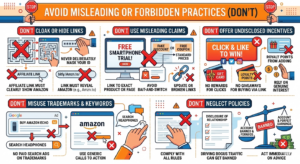
Don’t cloak or hide affiliate links. Amazon’s rules explicitly ban “cloaking, hiding or obscuring” any special link. In practice, this means your affiliate link must clearly show it goes to Amazon. If you shorten links (e.g. Bitly), ensure the URL still reveals Amazon (for example, Amzn.to links are known to point to Amazon). If using a shortener makes it unclear, that violates policy. In short: never deliberately mask your affiliate ID or use multiple redirects that prevent tracing the click source. Cuelinks’ tools handle link generation for you, so use them instead of risky URL tweaks.
Don’t provide misleading links or claims. Always link to the exact product or page you describe. Never promise a free gift or special discount that isn’t real, or label a generic link “free coupon” if it just leads to a normal product page. For example, if you’re writing about a smartphone, don’t hyperlink text like “free smartphone trial” to a paying product. Misrepresenting products or bait-and-switching violates trust (and can breach Amazon’s participation requirements). Also avoid duplicate or broken links: if a product is no longer available, update or remove that link promptly to avoid frustrating users.
Don’t make undisclosed incentives. Never reward clicks or enforce “like and share to win” schemes on your content that include affiliate links. Amazon prohibits offering any consideration for using Special Links. That means no giveaway that requires someone to buy via your link, no loyalty points for clicks, and no “gift card for clicking”. Just rely on genuine interest in your content and products.
Don’t bid on prohibited keywords or misuse trademarks. You may not use Amazon’s trademarked terms (like “Amazon”, “Kindle”, or any product names) as keywords in paid search ads. For example, running a Google AdWords campaign for “Buy Amazon Echo” and leading directly to Amazon would violate policy. Also avoid using Amazon logos or marks in your website or ads without permission. Stick to generic calls to action (“buy headphones here”) rather than Amazon-specific branding.
Don’t neglect Cuelinks and Amazon policies. Cuelinks expects honesty too. Its terms remind publishers to “comply with all rules… including those regarding the disclosure of a material relationship”. In practice, that means you should never steal merchant descriptions or plagiarize reviews. Always write your own content and be truthful about your experience or opinion of products. If Amazon or Cuelinks advises removing certain content (e.g. a discontinued item), act on it immediately. Account managers at Cuelinks can help with questions: it’s better to ask than to assume. Remember that violating either Amazon’s or Cuelinks’ guidelines (for instance by driving bogus traffic or hiding links) can get you banned and forfeit any earned Commissions from all Countries’ Amazon Affiliate Programs.
Summary: Ethical Scaling with Cuelinks
In summary, scaling your Amazon affiliate business globally via Cuelinks means working smart and honestly. Use Cuelinks’ automation (JS tag, Link Kit, CueWidgets) to streamline your workflow and data tracking. But pair that with high-quality, niche-focused content and full transparency about your affiliate relationships. Always align with Amazon’s global operating agreement and program policies (e.g. no cloaking, no spam) and with Cuelinks’ publisher terms (not misrepresenting affiliates). When you follow these dos and avoid the don’ts, you build trust with your audience and create a sustainable affiliate revenue stream that complies with Amazon’s global rules and Cuelinks’ platform rules alike.

Sahil Ajmera is content writer with more than 7 years of work experience in field of Affiliate Marketing, Digital Marketing, etc. He loves saving money on everything. His aim is to get readers exactly what they are looking for and that too without wasting much of their time. Whatever he is writing on, you are sure to find a way to earn & save good!


Comments are closed.