

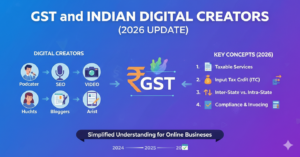
Goods and Services Tax (GST) is India’s unified indirect tax on goods and services, introduced in 2017 to replace older taxes like excise, VAT and service tax. It is a destination-based value-added tax, meaning it is levied where the service is consumed. Digital creators: bloggers, YouTubers, affiliates and influencers provide advertising or promotional services, which fall under GST. In fact, the GST law specifically classifies online content and advertising services (Online Information and Database Access or Retrieval Service, OIDARS) as taxable services. That means earnings from affiliate links, ad revenue, or sponsored content are subject to GST just like any other business income.
Who Must Register for GST?
Small creators can be exempt if their turnover is low, but the current threshold is ₹20 lakh per year for most states (₹10 lakh in certain “special category” states). In other words, once a blogger or influencer’s total income from all sources (affiliate commissions, ads, sponsorships, etc.) exceeds ₹20 lakh in 12 months, they must register for GST. Even below that, registration is still required if any of these apply: (1) the creator provides services across state lines (inter-state supply), or (2) they supply OIDARS from outside India to Indian clients. For example, if an Indian blogger earns commission from an out-of-state e-commerce sale, GST registration is mandatory even if annual income is under ₹20L. Likewise, foreign-based creators selling services to India must register if revenue exceeds ₹20L.
GST Rates on Affiliate, Ad and Promotion Income
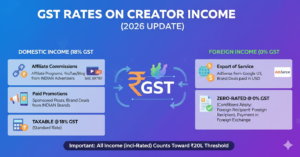
Most creator incomes are taxable at the standard 18% rate of GST. This includes commissions from affiliate programs, advertising revenue, and paid promotions. For instance, when an influencer charges a brand for a sponsored post, that is a promotional service at 18% GST. Similarly, affiliate commissions which are essentially referral services, attract 18% (under SAC 997157 for commission agents). Ad revenue (e.g. YouTube or blog ads) is treated as business income and also taxed at 18% if the advertiser is in India.
However, income earned from foreign sources (e.g. AdSense from Google US or brand deals paid in USD) is generally treated as an export of service. Exported services are zero-rated (0% GST), provided conditions are met (service provider in India, foreign recipient, payment in foreign exchange). In practice, this means a blogger’s AdSense earnings from overseas are not subject to GST (0% rate), although one must register and report them to claim this treatment. (In all cases, the total income: even zero-rated: counts toward the ₹20L threshold.)
Filing Returns and Penalties
Registered creators must file regular GST returns. Typically this means monthly GSTR-3B (summary of sales and tax) by the 20th of the following month, and GSTR-1 (detailed sales) by the 11th (or 13th) of the next month. (Smaller taxpayers may use the QRMP quarterly scheme.) If these returns or payments are late, a penalty of ₹50/day (₹25 CGST + ₹25 SGST) applies for each delayed day (up to a statutory cap).
Failure to register or pay due GST can incur heavier fines. The law prescribes a penalty of 10% of the tax due (minimum ₹10,000) if someone with GST liability fails to register or pay. For deliberate fraud or evasion, the penalty can rise to 100% of the tax evaded. (Note: For completeness, India’s income tax rules also impose TDS: typically 10% under section 194H: on many advertising/affiliate payments.)
How Cuelinks Handles GST?
In practice, platforms like Cuelinks treat Indian publishers as service providers. When publishers earn commissions or ad revenues via Cuelinks, they invoice Cuelinks (the aggregator) for the earned amount. An Indian publisher who is GST-registered must add 18% GST to that invoice (forward charge). Cuelinks then pays out this invoice amount to the publisher (after standard deductions). The Cuelinks terms note that payouts are made “net of statutory deductions” such as TDS, which implies that GST is treated as part of the invoice value rather than an extra charge borne by Cuelinks. In short, the publisher is responsible for charging and remitting GST on their earnings. If a publisher were unregistered or based outside India, Cuelinks (as the service recipient) might have to handle reverse charge GST according to law, but Indian publishers are expected to register and charge GST themselves.

Cuelinks’ own support articles reiterate that bloggers/affiliates fall under OIDARS and that GST applies to their service income. They explicitly state that any turnover over ₹20L, or any interstate or foreign-based supply, triggers mandatory GST registration. Cuelinks also requires publishers to raise invoices (minimum ₹500 for Indian accounts) for payouts, and notes that GST was applied to all invoices after July 2017.
Examples of Common Scenarios
- Affiliate commission (domestic). A blogger links to an Indian e-commerce site via Cuelinks and earns ₹2,00,000 commission. They must invoice Cuelinks ₹2,36,000 (₹2,00,000 + 18% GST). They charge 18% because it’s a service provided to an Indian business.
- Sponsored post (cash payment). An influencer charges ₹25,00,000 to an Indian brand for a campaign. They issue an invoice of ₹29,50,000 (₹25,00,000 + 18% GST). The brand pays the full amount and claims the GST as input credit.
- Barter promotion. A micro-influencer receives products worth ₹3,00,000 in exchange for a review. Even though no cash changes hands, GST law treats this as a taxable supply of service. The influencer must invoice the brand ₹3,54,000 (₹3,00,000 + 18% GST) on the product’s market value, and remit the ₹54,000 GST.
- AdSense/Foreign earnings. A YouTuber earns $1,000 (approx. ₹75,000) from Google US for Indian-viewer ads. This is an export of service (provider in India, recipient in USA, payment in forex). It is zero-rated: the YouTuber may invoice ₹75,000 with 0% GST. The GST on this “export” is 0%. (However, they must still count it toward turnover and can file for GST registration to claim refunds of input credits.)
Each creator’s situation may vary, but the safe rule is: register for GST once you cross ₹20L (₹10L in select states) or do any interstate/foreign business, and charge 18% on your service income. Keep good records, file timely returns, and claim input credits on your business expenses. Staying compliant means smoother operations and no surprises during tax audits.

Sahil Ajmera is content writer with more than 7 years of work experience in field of Affiliate Marketing, Digital Marketing, etc. He loves saving money on everything. His aim is to get readers exactly what they are looking for and that too without wasting much of their time. Whatever he is writing on, you are sure to find a way to earn & save good!


Comments are closed.