

Affiliate marketing is a performance-based partnership in which you promote a merchant’s products or services via unique tracking links and earn a commission on resulting sales or leads. By 2026, affiliate marketers are increasingly using AI-powered tools to streamline every part of this process. AI affiliate marketing means leveraging artificial intelligence and machine learning to automate, optimize and scale your affiliate campaigns. In practice, this ranges from using AI to generate high-quality content to applying machine learning for smarter targeting, analytics, and automation.
Today, the majority of affiliate professionals use AI tools: about 78-80% of affiliates now rely on AI in their work. AI enables you to spend less time on repetitive tasks (like tagging links or manually writing posts) and more time on strategy. For example, one affiliate program reduced a 12-hour weekly linking task to under 1 hour after automating with AI-based workflows. In this guide, we’ll explain how AI transforms affiliate marketing and show beginners how to get started. We’ll cover step-by-step workflows, key strategies (from content creation to analytics), and the top AI tools and platforms to try in 2026.
Table of Contents
What Is AI-Powered Affiliate Marketing?
In basic affiliate marketing, you pick products or services to promote, create content (blogs, social posts, videos), and share affiliate links. AI-powered affiliate marketing uses artificial intelligence to supercharge each step. AI tools can analyze data to predict customer behavior, personalize recommendations, and automatically adjust campaigns for better results. In short, AI can automate tasks like writing content, researching keywords, and crunching analytics: helping you scale your efforts without doing everything manually.
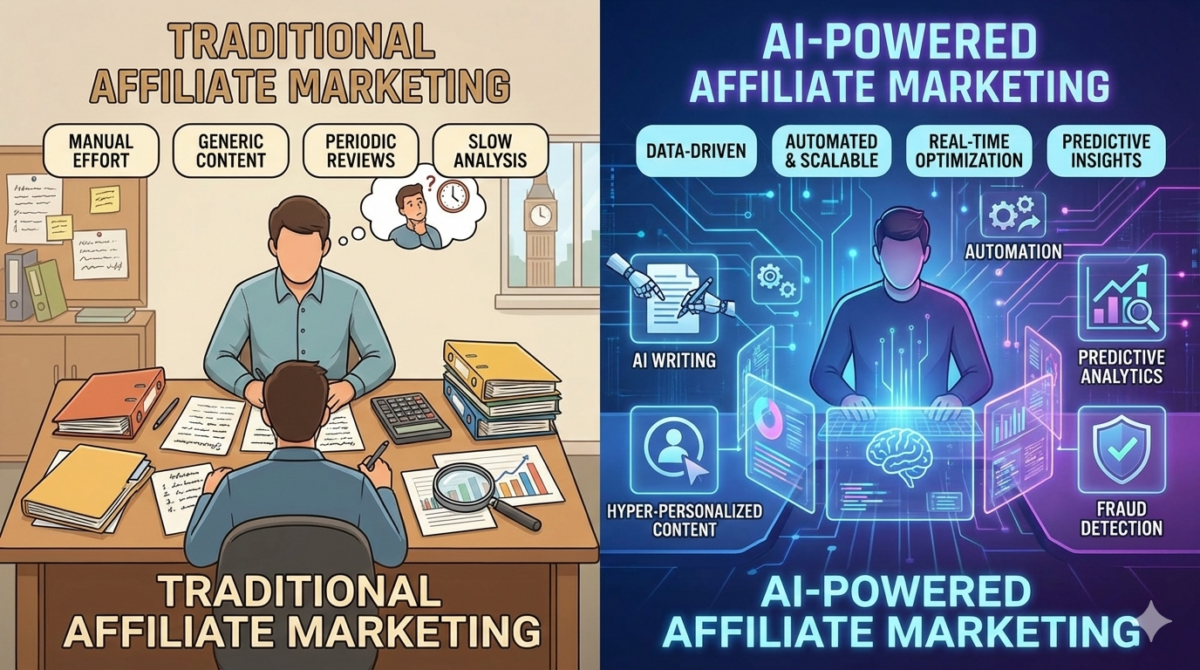
Key benefits include higher productivity and smarter decisions. For example, AI tools can generate SEO-optimized blog posts or ad copy in minutes, or personalize your campaigns for different audience segments. By doing the heavy data-lifting, AI helps affiliates focus on strategic work and relationship-building. The table below contrasts traditional vs AI-powered affiliate marketing to illustrate the differences:
- Traditional Affiliate Marketing: Manual product selection, generic content for a broad audience, periodic reviews, and time-consuming data analysis.
- AI-Powered Affiliate Marketing: Data-driven product picks, hyper-personalized content at scale, real-time campaign optimization, automated fraud detection, and predictive analytics.
In practice, successful AI affiliates use multiple tools for different tasks. For example, they might use an AI writing assistant to draft blog posts, a smart SEO tool to refine keywords, an AI video creator for ads, and analytics software to track performance. As one industry summary notes, affiliates rarely rely on a single solution: instead they use AI tools to “create content (texts, visuals, videos, UGC)…, automate analytics and routine tasks (campaign reports, competitor monitoring), and optimize campaigns (faster A/B testing and scaling).” In other words, AI becomes a strategic partner in content, analysis, and optimization.
Why Use AI in Affiliate Marketing?
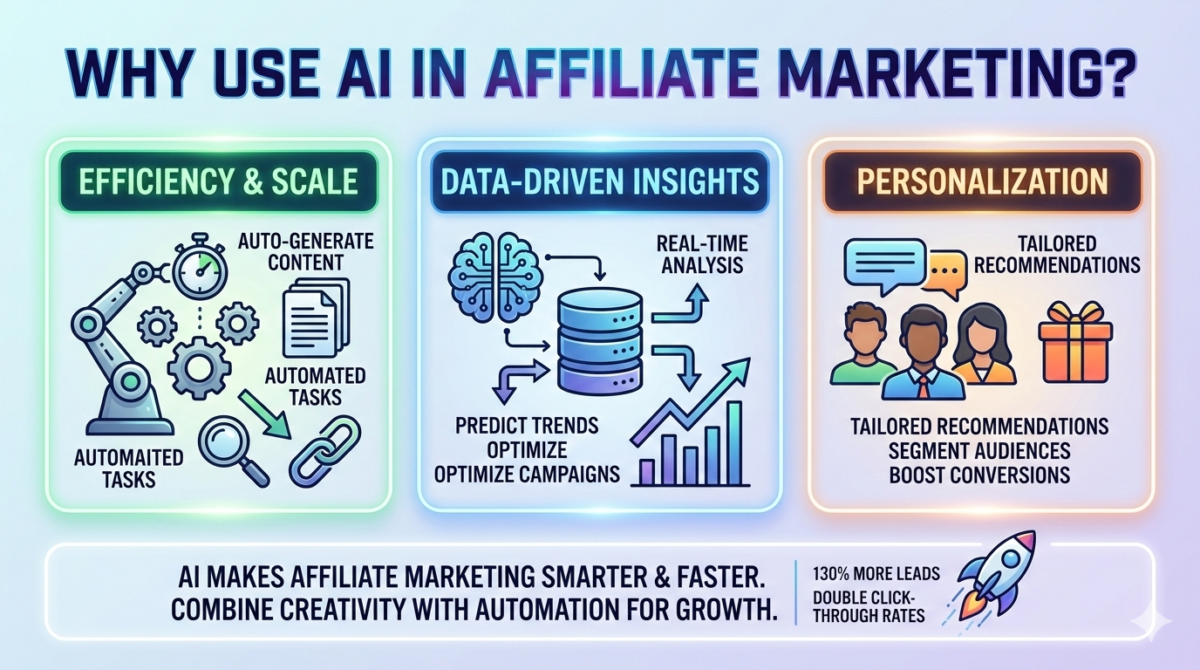
AI matters because affiliate marketing has become highly competitive. Manual workflows can’t scale to modern demands: for example, basic keyword stuffing or one-size-fits-all ads no longer cut it. AI offers three key advantages:
- Efficiency & Scale: AI handles repetitive tasks at machine speed. Instead of spending hours on keyword research or tagging links, AI tools can generate lists of relevant keywords, write multiple content drafts, and insert affiliate links automatically. Affiliates now use AI to generate hundreds of content pieces without adding staff.
- Data-Driven Insights: AI analyzes large datasets in real time. It can predict trends (like which products will become popular) and continuously optimize bids and budgets. For example, AI-powered ad platforms can rebalance your ad spend across channels automatically to maximize ROI.
- Personalization: Modern consumers expect tailored recommendations. AI can dynamically segment your audience and personalize content. For instance, by using AI-driven targeting, one affiliate marketing tool boosted conversions by 19% in a month simply by showing customized offers to high-intent customers. Another study finds personalized AI-generated creatives can roughly double click-through rates compared to generic ads.
In short, AI makes affiliate marketing smarter and faster. According to recent research, businesses using AI in marketing see roughly 130% more leads and 36% more closed deals in the first year. In 2026 and beyond, the affiliate marketers who thrive will be those that combine human creativity with AI automation: letting tools crunch the data while they focus on strategy and relationships.

Beginner Workflow: Step-by-Step with AI
A simplified workflow for a beginner affiliate marketer using AI might look like this:
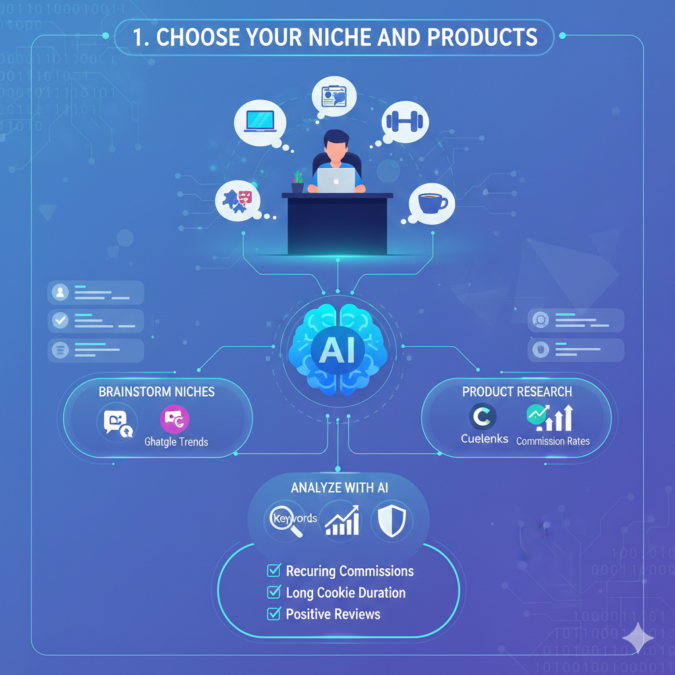
- Choose Your Niche and Products. Pick a niche you understand and products that fit your audience. Even here, AI can help: use tools like ChatGPT or Google Trends to brainstorm trending niches and products with demand. Once you have a shortlist, research affiliate programs (e.g. via networks like Cuelinks or vendor sites) and check commission rates. Look for recurring commissions, long cookie durations, and positive reviews. AI-powered analytics (like keyword tools) can also tell you which product keywords have strong search volume and low competition.
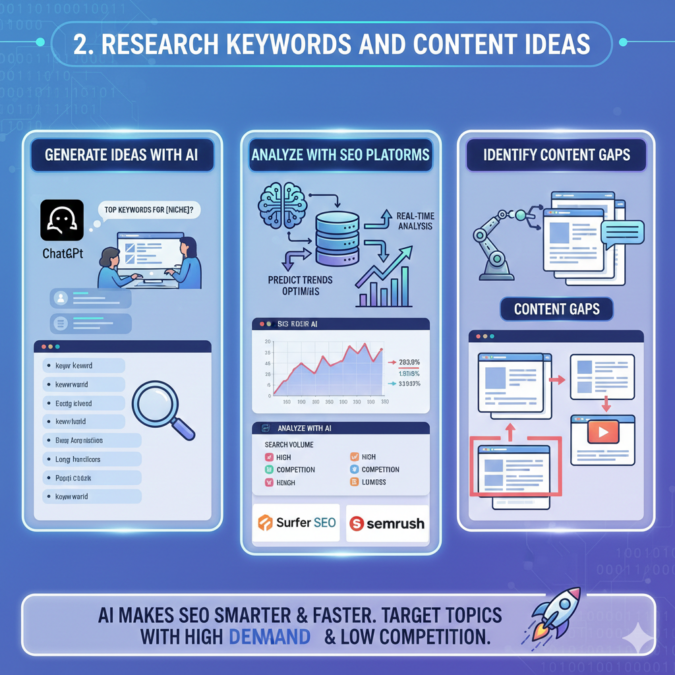
2. Research Keywords and Content Ideas. Affiliate success depends on SEO, so keyword research is crucial. Use AI writing assistants or SEO platforms to generate keyword lists. For example, you can ask ChatGPT for “top keywords related to [product/niche]”. Pair that with an SEO tool (like Surfer SEO or SEMrush) to get actual search volumes and competition data. AI tools can also analyze top-ranking pages and suggest content gaps. This step ensures you know what topics and phrases to target.
3. Create Content with AI. High-quality content is the heart of affiliate marketing. AI tools can write and produce content quickly: use Jasper, Copy.ai, ChatGPT or similar to draft blog posts, product reviews, emails, social posts, and ad copy. For example, Jasper AI can produce long-form articles in multiple languages, while Copy.ai excels at short persuasive copy. When you generate content, always add your authentic perspective: AI drafts are a starting point so edit for accuracy, add personal anecdotes or data, and ensure your affiliate links are naturally included. Tip: Always disclose affiliate links clearly to maintain trust.
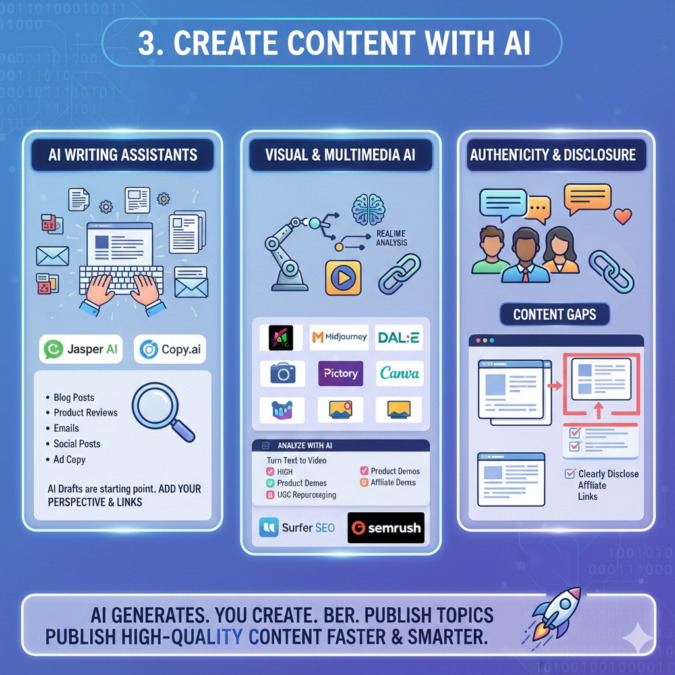
Don’t forget visual and multimedia content: AI can help here too. Tools like Midjourney, DALL·E or Canva’s AI features can generate banners, infographics, and images for your site. For video content (which is booming: short-form video drives huge engagement), use AI video generators like Pictory, Synthesia, or InVideo. These let you turn blog text or scripts into polished videos without filming. For example, an AI video tool can create a professional product demo video from a script in just minutes. Visual UGC (user-generated content) is also on the rise: many brands now ask customers to generate content, so consider encouraging reviews or testimonials and repurposing them with AI.
4. Publish and Optimize. Once content is ready, publish it on your blog, social channels, or ad platforms. Use AI-powered SEO tools to optimize each piece. For instance, Surfer SEO analyzes your draft against top-ranking pages and suggests adding specific keywords, images, or headings to improve your content score. Google’s own AI-driven SEO features (like Google AI-generated snippets) reward content that matches search intent. Make sure titles, meta descriptions, and headings are keyword-rich. An AI assistant can even write meta descriptions and title tags for you, saving time.
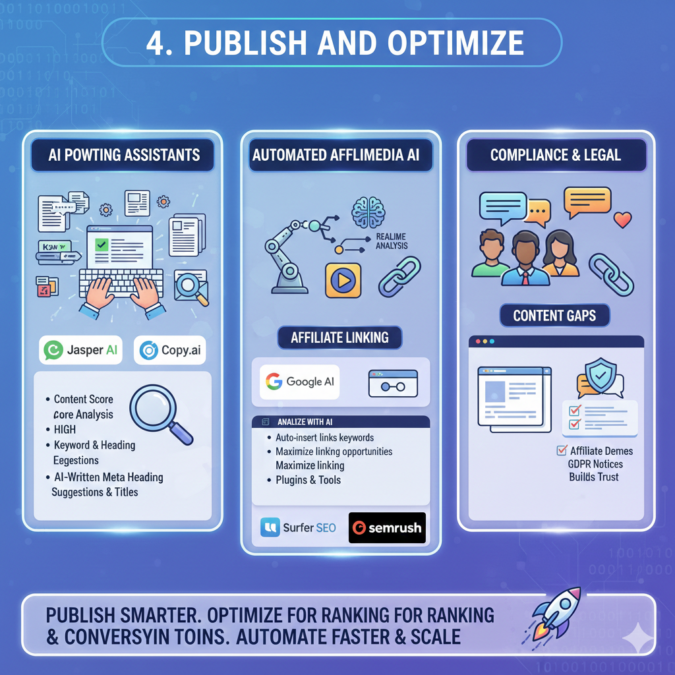
Also, employ automated linking if possible: some affiliate tools (or browser plugins) can automatically insert your affiliate links into relevant keywords on your site. This ensures you don’t miss any linking opportunities. Finally, double-check that your affiliate disclaimers and GDPR notices are in place.
5. Promote Your Content. Use AI to boost traffic. For paid ads, tools like AdCreative.ai and Arcads can automatically generate multiple banner or video ad variations and suggest the ones likely to get the best clicks. For social media, AI scheduling tools (such as Hootsuite’s AI features or Buffer’s content suggestions) can plan posts at optimal times. You can also use chatbots on your site or social profiles: ChatGPT-based chat widgets or platforms like ManyChat can interact with visitors, answer FAQs, and even guide them to products, 24/7.
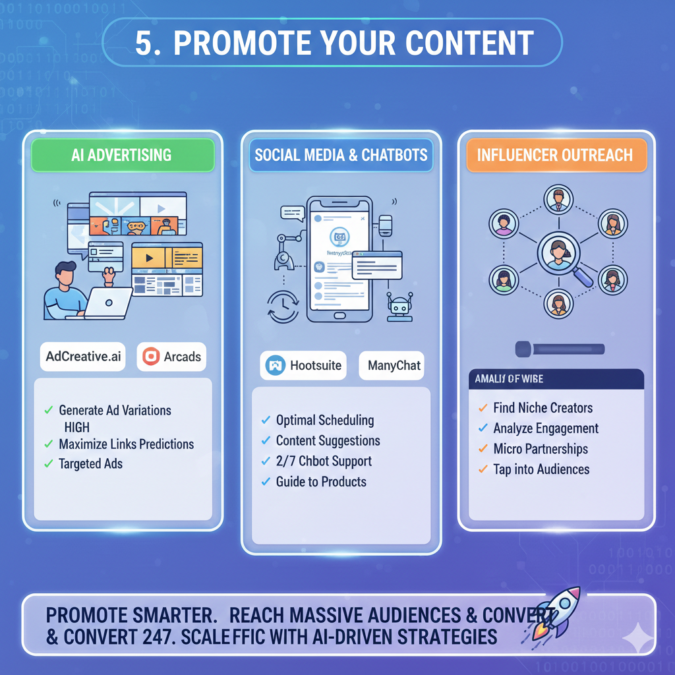
Collaborate with influencers or UGC creators using AI-driven platforms. For example, Influencity uses AI to find social creators in your niche by analyzing millions of profiles. By partnering with micro-influencers who have genuine engagement, you can tap into ready-made audiences.
6. Track Results and Optimize. Use analytics tools to measure performance. Google Analytics 4 now includes AI insights that highlight trends and anomalies in your data. Specialized affiliate analytics platforms like Hyros or Scaleo use AI to track every touchpoint and predict which visitors will convert. Set up goals for clicks and sales, and let AI tools constantly monitor them.
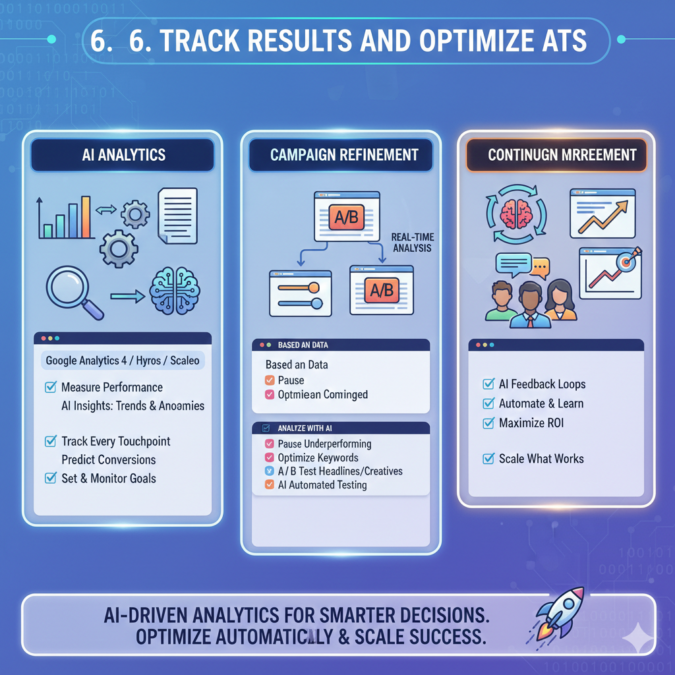
Based on the data, refine your campaigns: pause underperforming links automatically, double down on the best keywords, and A/B test new headlines or creatives. AI can help here too: some tools even automate A/B test assignments and learn which variants win. The end goal is continuous improvement via AI feedback loops.
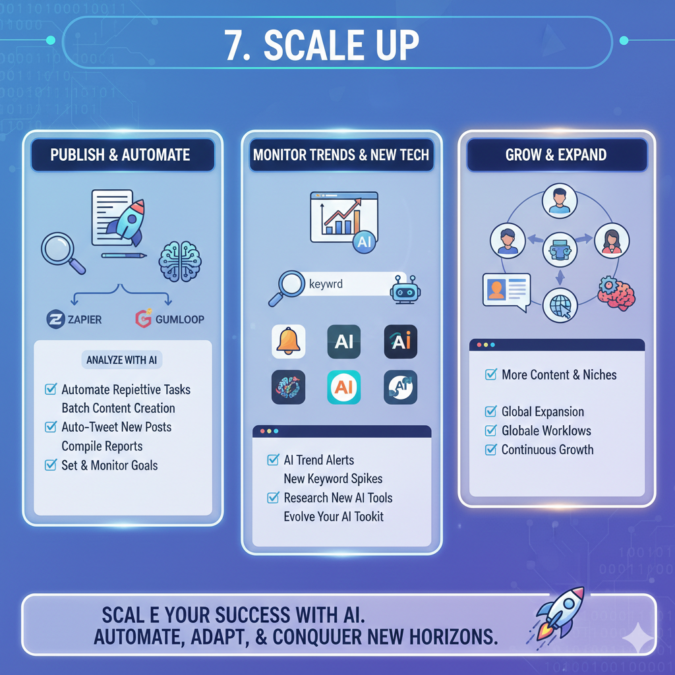
7. Scale Up. Once you have a proven process, scale it with AI. Publish more content using the same AI writing and SEO tools, perhaps even spinning off into related niches. Use automation platforms like Zapier or Gumloop to batch repetitive tasks (e.g. automatically tweet each new post or compile weekly reports). Keep monitoring trends with AI: for instance, set up alerts when new keywords spike in your niche. As the industry evolves, stay curious about new AI tools: gradually build your AI toolkit and try what fits your workflow.
By following these steps, even a beginner can build an efficient AI-powered affiliate marketing machine. AI does not replace the need for good ideas or genuine effort, but it significantly lowers the barrier to entry and lets you focus on the creative aspects of marketing.
Top AI Tools and Platforms to Try
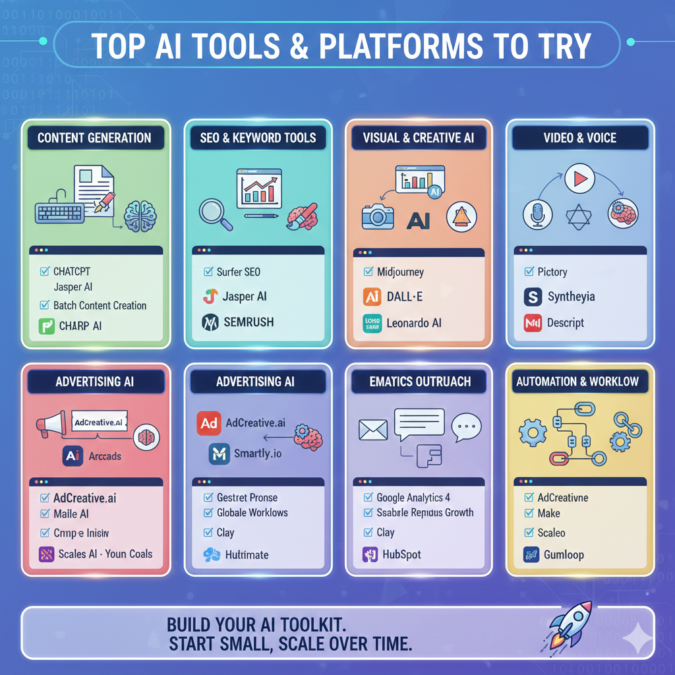
Here are some leading AI tools across different categories (platform-agnostic, not a complete list):
- Content Generation: ChatGPT/Claude (general-purpose content and prompts), Jasper AI (long-form and multi-format writing), Copy.ai (quick ad copy and short-form text), Writesonic, Rytr, Simplified. Also consider niche tools like Eesel AI Blog Writer for fully generated SEO blog posts.
- SEO & Keyword Tools: Surfer SEO (on-page content optimization), Ahrefs and SEMrush (with new AI insights and keyword suggestions), Frase and Clearscope (AI for content briefs), and Nightwatch (AI rank tracking and keyword discovery).
- Visual & Creative AI: Midjourney, DALL·E or Stable Diffusion (AI image generation), Canva (now with AI design features), Leonardo AI (batch image/video creation), Flair AI for marketing designs.
- Video & Voice: Pictory, Synthesia, InVideo, Crayo for quick video creation without filming, Descript for podcast editing and voiceovers, Lumen5 for turning blogs into videos.
- Advertising AI: AdCreative.ai (auto banner and ad copy generation), Arcads.ai (AI-powered video ad creation), Albert and Smartly.io (automated campaign management).
- Email & Outreach: GetResponse or Mailchimp (AI-assisted subject lines and personalization), Clay (AI automation for outreach and list building), HubSpot with AI email drafts.
- Analytics & Tracking: Google Analytics 4 (AI insights and attribution), Hyros and Voluum (advanced affiliate tracking and ROI prediction), Scaleo (tracking with AI rules), Affilimate (aggregates data from multiple networks).
- Automation & Workflow: Zapier, Make (Integromat) and Pabbly Connect to link your apps; Gumloop (visual AI workflow builder); Notion AI or Coda AI for managing affiliate plans and content briefs.
- Chatbots & Assistants: ChatGPT or Claude (via API or widgets) on your site, ManyChat and Chatfuel for social chatbots, HIX AI, Merlin AI browser extensions for quick content tweaks.
Each tool has strengths, and many offer free tiers or trials. For example, Leonardo AI and Midjourney have free plans for testing. Start with a few that match your immediate needs (e.g. content writing or SEO) and expand your stack over time.
Real-World Examples
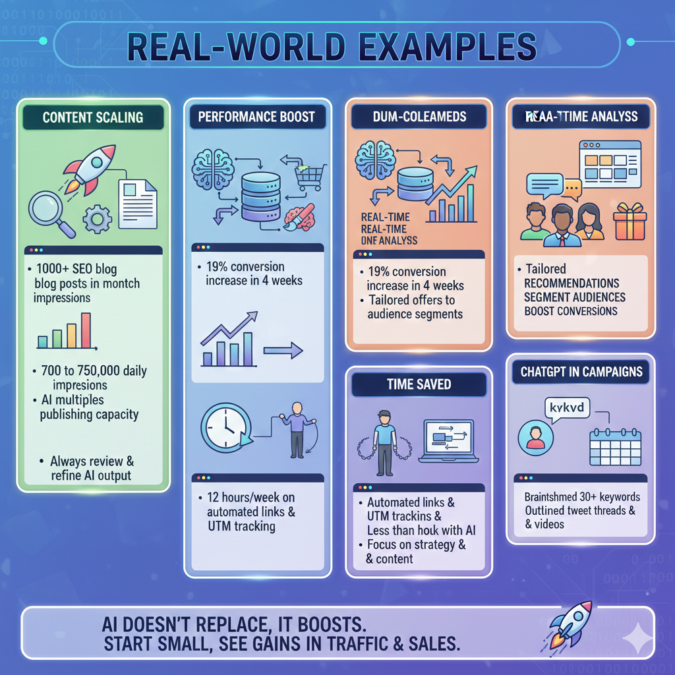
To see AI affiliate marketing in action, consider these examples:
- Content Scaling: A small affiliate team used an AI blog-writing tool to crank out 1000+ SEO blog posts in a few months. Their daily search impressions grew from about 700 to over 750,000 by leveraging AI-generated content. This illustrates how AI can multiply your publishing capacity. (Of course, quality control is key: always review and refine the AI output.)
- Performance Boost: One home-fitness brand connected an AI analytics tool (Hyros) to their store and email list. By automatically targeting high-intent buyers, they increased conversions by 19% in four weeks. AI identified which audience segments were most likely to buy and tailored the affiliate offers accordingly.
- Time Saved: A fashion affiliate was spending 12 hours per week just updating links and tracking UTMs manually. After automating those tasks with AI scripts and tools, the time dropped to less than 1 hour weekly: freeing them to focus on content and strategy.
- ChatGPT in Campaigns: An email marketing affiliate treated ChatGPT as a collaborator to plan promotions. They asked “Erica” (ChatGPT) to list 30 relevant keywords and even helped outline tweet threads and video content. This shows how even a beginner can use AI as a brainstorming partner to generate ideas and content roadmaps.
These cases highlight a common theme: AI doesn’t replace the affiliate’s role, but boosts it. Beginners can start small: e.g. using AI to write one blog post or generate a few ad ideas: and gradually see gains in traffic and sales.
Tips for Getting Started
- Start Small: Don’t try to automate everything at once. Pick one task (like writing a blog post or researching keywords) and experiment with an AI tool.
- Use Free Trials: Many tools offer free plans (e.g. midjourney has a free image quota) or trials. Test several to see which fits your style.
- Verify and Tweak: AI output can have errors or look generic. Always fact-check, add your voice, and optimize the text/images before publishing.
- Combine Tools: A single all-in-one tool rarely does everything. For instance, you might use ChatGPT for drafting text but Surfer SEO to refine it. Use multiple tools in tandem for best results.
- Stay Ethical: Disclose affiliate links and avoid “black-hat” tactics. AI should enhance user value: don’t rely on tricks.
- Keep Learning: AI tech evolves rapidly. Follow industry news (we’ve cited some trends here) to discover new AI features as they come out.
Conclusion
AI is revolutionizing affiliate marketing by making powerful tools accessible to everyone: including beginners. By combining AI-generated content, data-driven targeting, and automated workflows, new affiliates can compete with larger players without a huge team. In this 2026 landscape, your edge as a beginner is to embrace AI as a teammate. Focus on niches you care about, let AI do the heavy lifting on routine tasks, and always infuse your unique perspective into the content. With consistent effort and smart use of AI, you can build and scale an affiliate marketing business faster than ever.

Sahil Ajmera is content writer with more than 7 years of work experience in field of Affiliate Marketing, Digital Marketing, etc. He loves saving money on everything. His aim is to get readers exactly what they are looking for and that too without wasting much of their time. Whatever he is writing on, you are sure to find a way to earn & save good!