

CPC
Platform where tracking is available


Categories
Home & Kitchen
Cookie Duration
30 minutes
Deeplink
Yes
Incentive / cashback
No
Social media
No
Your cookie duration basically
is how long a website will remember
this information.
is how long a website will remember
this information.
This term is used when you
want to redirect user to a
specific merchant page
instead of the home page.
want to redirect user to a
specific merchant page
instead of the home page.
Your cookie duration basically is how long
a website will remember this information.
a website will remember this information.
This refers to whether you can
give incent / rewards / cashback
to your users for completing an
action.
give incent / rewards / cashback
to your users for completing an
action.
This refer to promoting campaign
on your Social media channel.
Note: the campaign should be
promoted organically and not via
any kind of social media ads.
on your Social media channel.
Note: the campaign should be
promoted organically and not via
any kind of social media ads.
The Home Depot Affiliate Payout Categories
Category
Payout
CPC (Dynamic)
Join Cuelinks
To unlock category wise payout

Generate Your The Home Depot Affiliate Link
Media Allowed/Disallowed
Allowed Media
Text Link
Banner
Disallowed Media
Deals
Coupons
Cashback, Reward Points, Incentives, Charity
Email (Text)
Custom Email (Text)
Email (HTML)
Custom Email (HTML)
POP Traffic
Native Ads
Social Media
Facebook Ads
SEM - Brand Keyword(s)
SEM - Generic Keyword(s)
SEM - Brand + Generic Keyword(s)
Countries Allowed
 Canada
 United States
 Cayman Islands
 Puerto Rico
Important Information for The Home Depot Affiliate Program
Similar Campaigns

This Home Depot affiliate program (U.S. and Canada) is run via the Cuelinks platform (one of the Home Depot affiliate companies). The commission model is Dynamic-CPC (performance-based) with a base rate of $0.0016 (₹0.15) per click (Cuelinks says upto ₹0.15/click, but this max rate is for beginner affiliates only). It offers high commission rate on sales of select home-decor, medium on appliances, and low on other items. Cookies last 24 hours (sale) and 30 minutes (click), and payments are issued monthly (around the 15th, covering sales two months prior) via ACH or check. There is no signup fee; affiliates need an active website/blog in the home-improvement niche and must be approved by Cuelinks and Home Depot’s team. Home Depot provides affiliates with a daily product data feed, banners, text links and deep-linking tools. Important exclusions apply: no commissions on gift cards, installation/custom orders, in-store purchases, etc. Notable pros include Home Depot’s #1 brand status, vast product range (200,000+ online items) and high average order values (often >$300 (source: iWriter’s Home Depot Affiliate Program Review)), and dedicated affiliate support. Key cons are the very low base rates on most products, and the very short cookie window, which means affiliates must drive high traffic and quick conversions. In late 2025 Home Depot also launched a new “Creator Portal” for influencers, integrating affiliate links and tools into a centralized platform.
These rate-levels can change by Home Depot’s discretion or by specific campaigns. (For example, some accessory categories or special promotions may occasionally have bumped rates.) Home Depot explicitly excludes non-commissionable items: gift cards, assembly/installation services (unless part of the separate PPL program), custom-manufactured products, select special orders, and any in-store purchase.The affiliate cookie lasts 1 day (24 hours) for sale and 30 mins for click. If the referred customer places an order within that day, the affiliate gets credit. By contrast, the Home Depot installation/referral program uses a 30-day cookie. Attribution is last-click within the cookie period.Home Depot’s high average order value (~$300+) and reputable brand imply decent conversion rates for well-targeted traffic. Besides, Home Depot’s affiliate program averages ~1.9% conversion. However, because the cookie window is so short and base rates are low, affiliates typically need high traffic volumes or to focus on higher-commission categories to achieve meaningful income.
These tools help affiliates integrate Home Depot offers into content. For example, a blogger could automatically populate a “Top Tools of the Month” post using the data feed, or an influencer could share story links via Cuelinks links. Affiliates are responsible for refreshing their links if any redirect or deep-linking rules change.
In short, treat Home Depot’s brand with care. Any suspicious or high-risk marketing can result in commissions being withheld. As one case study noted, Home Depot even ousted a coupon extension affiliate due to fraud risks.
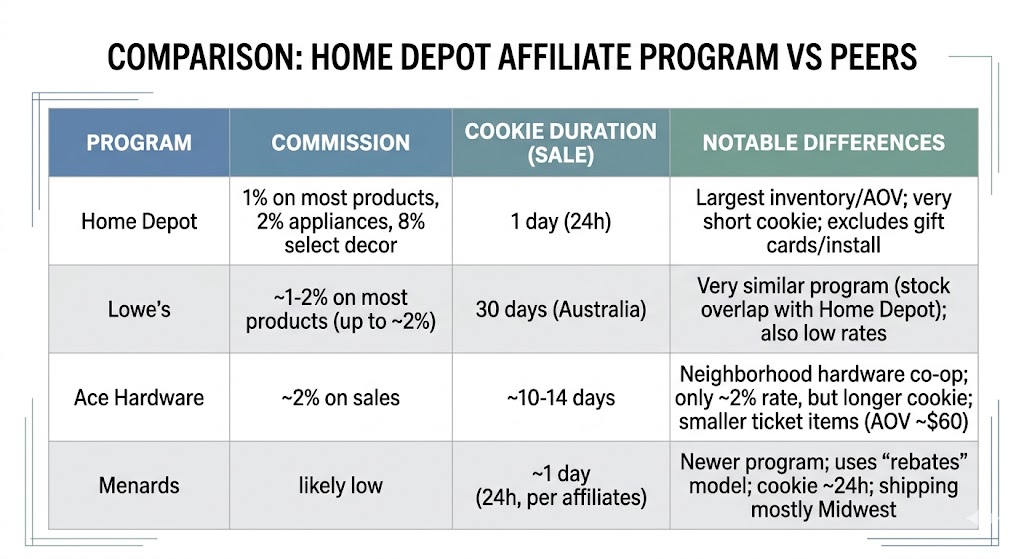
Note: On Cuelinks, the Home Depot affiliate campaign primarily runs on a Dynamic-CPC model, meaning affiliates earn per qualified click. Category-level commission differences (in above table) influence EPC rather than direct per-sale payouts.
Home Depot Affiliate Program Overview
The Home Depot program is a performance-based cost-per-click (Dynamic-CPC) affiliate program run on the Cuelinks platform & network. Affiliates earn a fixed amount of qualifying (clicks should ideally result in sales) clicks to HomeDepot.com. There is a separate installation services affiliate program paid per lead, which uses a 30-day cookie. Eligible traffic sources are primarily content sites, blogs, YouTube and social accounts: especially those focused on home improvement, DIY, or decor. Home Depot’s online store covers 17 departments (Tools, Appliances, Kitchen, Outdoor, Paint, etc.), and essentially any online product is affiliate-eligible except the exclusions noted above.- Network/Platform: Cuelinks. Affiliates create links and track performance via the Cuelinks dashboard.
- Geography: Primarily U.S. (continental US plus Alaska/Hawaii) and Canada.
- Affiliate Type: Retail consumer goods (home improvement). The program is Dynamic-CPC; the installation/referral program (for professional installation services) is structured as PPL (pay-per-lead, ~$20-$200 per lead).
Enrollment Requirements and Approval Process
Joining the program is free. Affiliates must apply through the home depot’s affiliate company, Cuelinks (platform/network). Required information typically includes: name, address, website/blog URL, email (preferably professional/domain-linked, not a free Gmail/Yahoo), and details of promotional methods. Home Depot looks for existing websites (or social channels) with a home-improvement or decor focus and real traffic. Approval criteria emphasize brand-safe, family-friendly content and evidence of an ability to drive traffic (some applicants have been declined for poor content or lack of focus). Tips for approval: have high-quality content (DIY tutorials, reviews, etc.), a clear marketing plan, and link your email to your domain. Besides, your Cuelinks account manager will always be there to guide you so don’t hesitate to ask anything! Once approved, you can immediately access marketing materials and your affiliate ID/link via the Cuelinks dashboard.Home Depot Affiliate Program Commission Structure
Dynamic-CPC Commissions are tiered by category.- Low commission on other products (including mobile orders and store pickup).
- Medium on appliances.
- High on a selection of home décor and furniture items.
These rate-levels can change by Home Depot’s discretion or by specific campaigns. (For example, some accessory categories or special promotions may occasionally have bumped rates.) Home Depot explicitly excludes non-commissionable items: gift cards, assembly/installation services (unless part of the separate PPL program), custom-manufactured products, select special orders, and any in-store purchase.The affiliate cookie lasts 1 day (24 hours) for sale and 30 mins for click. If the referred customer places an order within that day, the affiliate gets credit. By contrast, the Home Depot installation/referral program uses a 30-day cookie. Attribution is last-click within the cookie period.Home Depot’s high average order value (~$300+) and reputable brand imply decent conversion rates for well-targeted traffic. Besides, Home Depot’s affiliate program averages ~1.9% conversion. However, because the cookie window is so short and base rates are low, affiliates typically need high traffic volumes or to focus on higher-commission categories to achieve meaningful income.
Tracking, Attribution & Cookie Duration
Cuelinks provides robust tracking and reporting. Each affiliate link click sets a 24-hour cookie (sale). If the user checks out within that period, the sale is attributed to the affiliate. Home Depot does not offer double-cookie or view-through attribution (only click-to-sale). Returns or cancellations can adjust credited commissions (Cuelinks holds payments in the following month to allow for verification). Home Depot’s policy is last-click wins, so only the last affiliate link clicked within 24 hours gets the commission. Affiliates can use Cuelinks’ dashboard to view real-time performance metrics, conversion data, and past sales.Payments, Thresholds, and Tax Obligations
Commissions are paid out monthly. Cuelinks processes Home Depot affiliate payments every Friday of each month for the sales closed two months prior (the extra delay accounts for order verification and returns). Payment methods include ACH (direct deposit) or mailed check. The minimum payout threshold on Cuelinks is $50 for direct deposit and $100 for check. (Cuelinks requires affiliates to maintain at least these amounts of balance before issuing payment.)Affiliates must submit appropriate tax information to Cuelinks (account manager can guide you). U.S.-based affiliates will complete a W-9; foreign affiliates complete a W-8BEN. Cuelinks withholds or reports taxes per U.S. law when issuing payments (especially if a U.S. entity). The affiliate must also accept Cuelinks’ and Home Depot’s terms of service to participate.Promotional Tools and Resources
Home Depot furnishes a variety of marketing materials to affiliates:- Product Feed: A daily product data feed is provided (via Cuelinks) containing SKUs, descriptions, prices, images, and link tags. Affiliates can use this for dynamic content (e.g. price comparison tables, data-driven widgets, or content feeds).
- Banners & Creatives: Home Depot offers banner ads, homepage creatives, seasonal graphics, and text link banners for various departments. These can be generated or downloaded from the Cuelinks portal.
- Deep Links: Cuelinks’ link-builder lets affiliates create custom deep links to any page on HomeDepot.com (products, categories, or search results). This means you can direct users to specific items you review or recommend.
- APIs: While not publicly documented, Cuelinks’ Link API and product APIs can be used by large affiliates to pull link or product data programmatically (subject to Cuelinks access).
- Account Support: Home Depot provides affiliate managers or support contacts via the Cuelinks’ platform to help answer questions, obtain exclusive creatives, or learn about promotions.
These tools help affiliates integrate Home Depot offers into content. For example, a blogger could automatically populate a “Top Tools of the Month” post using the data feed, or an influencer could share story links via Cuelinks links. Affiliates are responsible for refreshing their links if any redirect or deep-linking rules change.
Home Depot Affiliate Marketing on Pinterest (popular promotion medium)
Using The Home Depot affiliate program on Pinterest can be a highly effective strategy for driving traffic and conversions, especially in the home décor, DIY, and renovation niches. Pinterest’s visual-first format allows affiliates to showcase Home Depot products such as furniture, tools, lighting, and garden items through aesthetically appealing pins, idea boards, and step-by-step project guides. By creating content like “DIY patio makeover” or “budget kitchen upgrades,” affiliates can naturally integrate product links and inspire users who are already in a planning mindset. Consistency, keyword-rich pin descriptions, and seasonal trend targeting (like summer outdoor setups or festive décor) can significantly boost visibility and clicks, making Pinterest a strong channel for scaling Home Depot affiliate earnings.Program Policies and Prohibited Practices
Home Depot’s affiliate program has strict compliance rules. In general, you must follow Cuelinks’ advertising policies plus any Home Depot-specific guidelines. Key restrictions include:- No Deceptive Practices: Affiliates may not engage in spam, cookie-stuffing, or misleading marketing. For example, sending unsolicited email (spam) or using hidden affiliate links (iframe or auto-click scripts) is prohibited.
- Content Restrictions: All content must be family-friendly and relevant to Home Depot’s brand. Explicit, offensive or controversial content (pornography, hate speech, etc.) is disallowed. Home Depot also discourages political or religious messaging around its brand.
- Trademark and Branding: Affiliates may use Home Depot’s logo/brand assets only as provided through approved channels. Bidding on Home Depot trademarks (e.g. in search ads) is typically disallowed unless explicitly permitted. Do not misrepresent affiliation (e.g. “official site”) beyond normal disclosure.
- Pricing/Offers: Affiliates should not advertise prices incorrectly or imply false discounts. Unauthorized coupon distribution (sharing coupon codes not supplied by Home Depot) is usually prohibited. (In fact, Home Depot reportedly removed certain coupon affiliates when misattributions occurred.) Only use discounts and offers promoted via official channels.
- Promotion Channels: Affiliates must generally promote via content sites, blogs, or social media. Some programs restrict coupon/deal sites or incentivized traffic. Home Depot’s Cuelinks contract requires pre-approval for traffic sources like email, PPC, or paid social, so read the Cuelinks guidelines carefully.
- Compliance: Affiliates must follow the FTC’s endorsement rules (see below) and any instructions from Home Depot. Cuelinks, as an home depot affiliate company, has automated checks and reserves the right to deduct commissions or terminate accounts if rules are violated.
In short, treat Home Depot’s brand with care. Any suspicious or high-risk marketing can result in commissions being withheld. As one case study noted, Home Depot even ousted a coupon extension affiliate due to fraud risks.
Review: Pros and Cons for Affiliates
Pros:- Top Brand & Market Leader: Home Depot is the largest home-improvement retailer with huge name recognition. That means strong conversion (trust) and large search volume for products.
- Broad Product Range: Over 200,000 online items across all categories: tools, appliances, decor, etc, so affiliates have endless niches to target. This also means high average order values (often >$300), boosting commission per sale.
- Dedicated Support/Materials: The program provides a full product feed, banners, and a real affiliate manager. Cuelinks’ tracking is reliable and reporting is robust.
- No Category Limits: Unlike some retailers, almost every Home Depot category pays commission (except excluded items). You can promote anything from furniture to paint to power tools.
- Reputation and Loyalty: Home Depot often offers sales, free shipping promotions, and has a large pros/DIY customer base, which can help conversions.
- Low Commission Rates: Most products pay low commission. Only a select few home-decor items (high-margin categories) are on high commission. That means affiliates need very large volumes or must carefully target high-commission niches.
- Very Short Cookie (24h/sale): The cookie is just one day, far shorter than many competitors. Customers who don’t buy immediately (or who navigate away) will not be credited. This puts pressure on affiliates to get instant conversions.
- US and Canada only Shipping: HomeDepot.com ships primarily in the U.S. (plus limited Alaska/Hawaii) and Canada. International traffic won’t convert outside North America and Canada.
- Market Saturation: The home improvement affiliate space is competitive (Lowe’s, Amazon, Wayfair, etc.). Home Depot’s low rates make it less attractive than some (e.g. Amazon pays higher percentages on decor, though its cookie is also 24h).
- Policy Strictness: As a major brand, Home Depot enforces policies strictly. Affiliates must constantly update links and comply with detailed rules, which some find burdensome.
- No Recurring/High Margin Opportunities: Unlike, say, software affiliates, Home Depot is straight retail. Commissions don’t recur (no subscription products) and profit margins on many items are thin, capping payout potential.
Performance Data & Publisher Insights
Conversion rates on Home Depot’s site are estimated around 1.8-2.0%, which is fairly solid for e-commerce. However, real-world affiliate case studies emphasize that volume is key: e.g. one analysis showed that at 2% commission, an affiliate would need tens of thousands of visitors per month to earn a few hundred dollars (source: iWriter’s Home Depot Affiliate Program Review). In practice, the Home Depot program often rewards affiliates with established audiences (DIY bloggers, YouTubers, Instagram DIY channels) who can drive many engaged clicks.Affiliates report mixed experiences. Some highlight strong performance when promoting high-ticket decor or appliances on sale, while others note that generic product links with low commission yield very small checks. The short cookie means that some publishers bundle Home Depot links with limited-time deals or emphasize “buy now” calls-to-action.Home Depot Affiliate Program vs Peers
Note: On Cuelinks, the Home Depot affiliate campaign primarily runs on a Dynamic-CPC model, meaning affiliates earn per qualified click. Category-level commission differences (in above table) influence EPC rather than direct per-sale payouts.
Best Practices & Tips for Affiliates
- Target High-Commission Categories: Focus on home decor, furniture, or seasonal big-ticket items that pay high commission. Use tools (data feed, Cuelinks’ reports) to identify products with higher margins. For general tools/appliances, leverage sales/discounts to compensate for the medium-level commission rate.
- High-Quality Content: Create in-depth, helpful content (product reviews, how-to guides, project articles) that naturally incorporates Home Depot links. Detailed DIY or renovation tutorials often yield better conversions. Prioritize evergreen content (e.g. “How to choose a paint color”) with embedded affiliate links.
- SEO and Keywords: Optimize your site for relevant keywords (e.g. “[product name] Home Depot review”) so that searchers find your content. Higher organic traffic can offset low rates. Use keyword tools to target long-tail terms in home improvement.
- Leverage the Feed: Use the daily product feed to keep content fresh. For example, auto-update “Top Tools on Sale” pages or blog posts with live pricing and availability. This also helps ensure your links remain correct (Cuelinks deep links + SKU tags).
- Multi-Channel Promotion: Promote on platforms suited to the product. For decor and DIY, use visual channels like Pinterest and Instagram (with affiliate links in pins/Instagram stories). For tools and how-tos, create YouTube videos or blog posts. Always accompany social posts with a disclosure (#ad) and a link to a full disclosure page.
- Email Marketing: If permitted by Cuelinks/Home Depot, include affiliate links in email newsletters. Always clearly disclose the affiliate relationship in the email (e.g. “This email contains affiliate links” at top or bottom) to comply with FTC.
- Use Timely Deals & Events: Home Depot often runs sales (black Friday, holiday, spring clearance). Plan content around these events to capture deal-oriented buyers. Promoting seasonal projects (e.g. gardening in spring) with links can boost conversions.
- Optimize Calls-to-Action: Encourage immediate clicks given the 24h cookie. Phrases like “Shop now at Home Depot” or “Click to check price” can help. But balance urgency with helpful advice. Avoid clickbait; instead, promise real value (tips, best-of lists, comparisons).
- Monitor and Iterate: Regularly review performance metrics. Identify which links/products convert or not. Double down on top performers and retire poor ones. Split-test different headlines or link placements to see what yields higher EPC.
- Maintain Compliance: Always abide by Home Depot/Cuelinks policies. Update links if program rules change. Register on Cuelinks’ network site to see any affiliate newsletters or new creative assets. Ensure all promotions adhere to guidelines (see Prohibited above).
- Build Trust with Audience: Disclose clearly and be transparent (see below). Only recommend products you believe in. Over time, trust and repeat visitors can help overcome the low rates. Consider also comparing Home Depot products or bundling with other retailer links to give readers choice.
- Leverage Account Support: Reach out to your affiliate manager for exclusive coupons or promotions for your audience. Join any Home Depot affiliate Facebook groups or newsletters to stay updated on new tools or contests.
FTC Disclosure & Compliance Guidance
By law, affiliates must disclose their relationship with Home Depot. The FTC requires clear, conspicuous affiliate disclosures to prevent deceptive marketing (source: Federal Trade Commission’s Disclosures 101 for Social Media Influencers guide). Practically, this means:- Put a statement like “Some of the links on this page are affiliate links. If you click and buy, we may earn a commission” at the top (or near any affiliate link).
- Use plain language; hashtags like #ad or #affiliate are commonly used on social posts but also consider writing out that you earn commissions.
- Disclosures should be hard to miss (not in tiny font or hidden behind “read more”). For example, a blog post should have the disclosure before the first affiliate link or at the very beginning of the article. Videos or social posts should verbally and visually disclose the partnership.
- Never imply the affiliation is anything other than paid. Avoid terms like “friend” or “partner” as a euphemism. Simply stating “We receive a commission for purchases made through links” is best.
- Do not insert the disclosure only in an “About” page or end-of-post- it must be where the reader sees it in context.
FAQs Homedepot Affiliate Marketing Program
Is the Home Depot Affiliate Program legit?
Yes, the Home Depot Affiliate Program is completely legitimate. It is run through a trusted affiliate network like Cuelinks, and backed by a well-established global retailer operating since 1978. Thousands of affiliates actively promote Home Depot products and earn commissions, which confirms its credibility.
Why is the Home Depot Affiliate Program on Cuelinks, based on the Dynamic-CPC commission model?
On Cuelinks, the Home Depot campaign is offered as a Dynamic CPC (Cost Per Click) model, meaning you earn per click rather than per sale. This model is used because:
- It reduces dependency on conversions (you earn even if users don’t purchase).
- Commission rates are dynamic, meaning they can change based on traffic quality and performance.
- Advertisers optimize payouts based on how well your traffic converts into actual sales
If I am outside of the US and Canada, can I join the Home Depot Affiliate Program?
Yes, you can join from outside the US and Canada, especially via platforms like Cuelinks. However:
- The Home Depot primarily operates in North America, so most traffic and conversions come from US/Canada audiences.
- Your success will depend on whether your audience is relevant to those regions.
- Some campaigns may restrict traffic geographically (e.g., US-only targeting).
Why should I join the Home Depot Affiliate Program on Cuelinks?
Joining via Cuelinks offers several advantages:
- Easy onboarding: No need for separate approvals for each merchant.
- Multiple monetization models: Includes CPC campaigns like Home Depot, which are beginner-friendly.
- Unified dashboard: Track clicks, earnings, and performance across campaigns.
- Deep linking support: Generate affiliate links for specific products/pages easily.
- Global-friendly payouts: Convenient payment options for Global affiliates.