

Overview
- The Problem: YouTube’s native Amazon product tagging feature is restricted by strict eligibility gates (e.g., subscriber thresholds, geographic lockouts), fragile technical integrations, and one-to-one channel limits.
- The Cuelinks Solution: Cuelinks is an affiliate aggregation network that allows creators of any size and location to instantly generate trackable affiliate links for Amazon and over 2,500 global brands without approval barriers.
- Key Strategies Covered:
- Optimizing long-form video descriptions using verbal and visual CTAs alongside timestamp chapters.
- Navigating the YouTube Shorts link ban through channel profile links (Link in Bio) and Related Video bridges.
- Protecting affiliate tracking cookies from third-party coupon aggregators by integrating in-house coupon codes.
Table of Contents
Intro
The integration of e-commerce directly into digital video content has fundamentally altered the monetization models available to independent publishers and video creators.
The development of the YouTube Shopping affiliate program, and specifically its highly anticipated Amazon product tagging feature, was initially heralded as a paradigm shift.
The objective was to construct a frictionless purchasing environment where viewers could click an on-screen tag, review product details, and complete a transaction without ever leaving the video player environment.
However, the operational reality of this ecosystem has proven to be fraught with severe eligibility hurdles, fragile technical infrastructure, and highly restrictive regional rollouts.
For a substantial majority of the global creator economy, the native Amazon product tag simply does not function or remains entirely inaccessible.
In the face of these structural limitations, the reliance on advanced affiliate aggregation networks has become an indispensable strategy.
Platforms such as Cuelinks offer a robust, universally accessible infrastructure that systematically bypasses YouTube’s internal tagging limitations.
By leveraging optimized tracking URLs routed through a centralized analytical dashboard, creators can efficiently monetize their traffic across Amazon and an expansive portfolio of thousands of other global marketplaces.
This article analyzes the systemic failures of the native YouTube Shopping integration, details the architectural and financial advantages of utilizing Cuelinks, and provides a strategic framework for maximizing affiliate revenue through optimal link placement, conversion psychology, cookie protection, and multi-brand diversification.
YouTube’s Amazon Product Tagging Limitations
The underlying premise of the YouTube Shopping affiliate program is seamless integration, designed to emulate the highly successful, closed-loop commerce systems seen on platforms like TikTok Shop.
Eligible creators are theoretically able to tag products from Amazon’s catalog directly in their long-form videos, Shorts, and livestreams. When a viewer interacts with this tag, a picture-in-picture or split-screen checkout process is initiated.
By removing the navigational friction of leaving the application, the system ostensibly increases conversion rates. However, this system is governed by a labyrinthine set of dual-layer eligibility requirements that actively exclude a vast segment of digital publishers.
Stringent Eligibility Gates and Geographic Restrictions
To even access the product tagging feature, a channel must first overcome strict YouTube Partner Program (YPP) thresholds. While the subscriber requirement for the shopping feature was recently reduced from 10,000 to 500 subscribers in select markets, this reduction is not universally applicable.
The geographic availability remains severely constrained. As of current deployments, the program is fully operational only in a handful of regions, including the United States, India, and partially in the United Kingdom via third-party network integrations (such as Awin), leaving vital e-commerce markets across the European Union and the Nordics entirely unsupported.
Beyond geography and subscriber counts, rigid channel categorization poses a significant barrier. Channels designated as “Made for Kids,” those possessing a substantial amount of child-directed content, or channels associated with Official Artist classifications and music partners (including labels, publishers, and distributors like VEVO) are strictly prohibited from utilizing the Shopping affiliate program.
Consequently, creators reviewing educational toys, family-friendly video games, or utilizing heavily licensed music backgrounds frequently find the tagging feature disabled, cutting them off from their primary revenue source.
YouTube Partner Program x Amazon Associates Program
The technical bridge connecting Google’s content delivery systems and Amazon’s retail infrastructure is notoriously fragile.
To utilize the tagging feature, a creator must already be enrolled and fully active in the Amazon Influencer Program (AIP) or the Amazon Associates Program (AAP). Following this, the YouTube channel must be explicitly linked to the Amazon Storefront portal.
This linking process is subject to a strict one-to-one ratio: only 1 YouTube channel per Amazon account is permitted to tag Amazon products.
If a media company or individual creator operates a network of channels: for instance, a primary technology review channel, a secondary gaming channel, and a third lifestyle vlog channel: they cannot utilize the same central Amazon account to tag products across all properties.
This artificial limitation forces creators to either abandon monetization on secondary channels or violate terms of service by creating unapproved secondary Amazon accounts.
Furthermore, routine quality checks by YouTube’s automated systems or minor policy infractions on the Amazon side frequently result in the unlinking of these accounts.
Creators routinely encounter notifications stating that their eligibility has been revoked because their Amazon Influencer account was flagged, closed, or inexplicably disconnected from YouTube Studio.
Fixing these errors often requires navigating a convoluted support pipeline, necessitating manual emails containing channel URLs and Storefront links to dedicated Amazon support addresses.
The Illusion and Failure of Auto-Tagging Algorithms
In an attempt to alleviate the manual labor associated with affiliate marketing, YouTube introduced an auto-tagging feature, wherein internal algorithms scan recent uploads to automatically identify and tag eligible Amazon products based on visual recognition and semantic keyword analysis.
However, this automated system operates as a volatile black box. Publishers report that tags are frequently updated, removed, or entirely misattributed following routine algorithmic quality checks.
If the system misidentifies a product: for example, tagging a base-model smartphone when the creator is reviewing the “Pro” variant, the creator loses the commission on the intended item.
Concurrently, the viewer is presented with an irrelevant purchase option, which degrades the trust between the audience and the publisher and permanently damages the channel’s perceived commercial authority.
The Cuelinks Solution: Amazon Product Links Monetized & Managed Effortlessly
Given the gatekeeping, regional lockouts, and technical instability inherent in YouTube’s native Amazon tagging, professional publishers require a system that offers autonomy, absolute reliability, and expanded earning potential.
Cuelinks operates as a premier affiliate aggregation network, bridging the gap between content creators and thousands of merchants without requiring individual program approvals for each brand.
Less Restrictions & Easy Link Generation
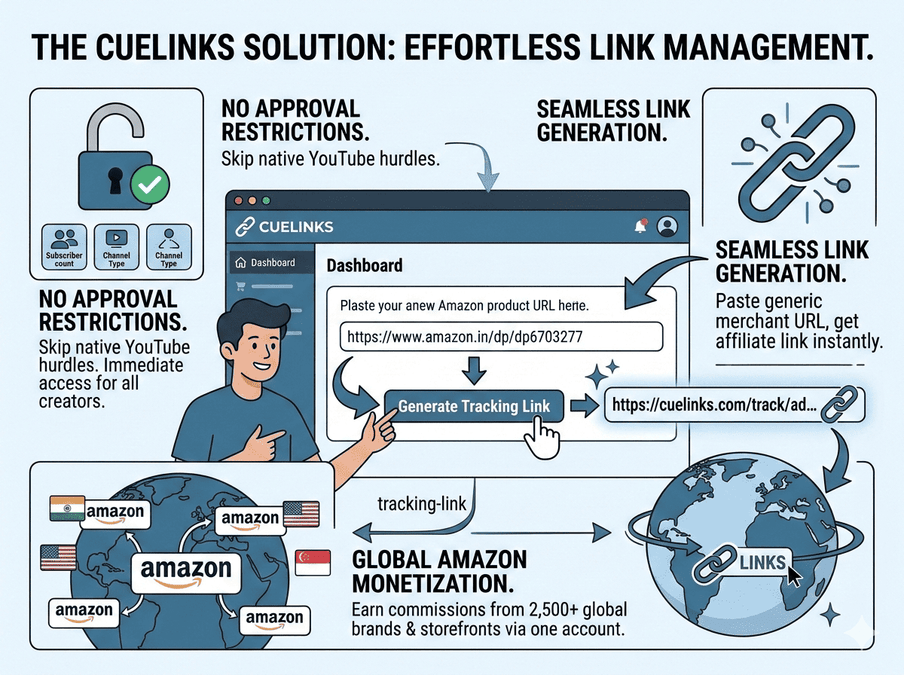
Unlike the native YouTube Shopping integration, which is siloed strictly to authorized channels meeting complex criteria, Cuelinks operates on a universal, decentralized link-generation model.
Any creator, regardless of subscriber count, channel niche, or geographic location, can register for a Cuelinks account and immediately gain access to the Amazon India Affiliate Program, alongside numerous global counterparts (Amazon US, Amazon Singapore, etc.).
The platform supports comprehensive website-less onboarding. This means creators operating solely on YouTube, Instagram, Facebook Groups, Telegram channels, or free blogging platforms are readily accepted into the ecosystem.
When a creator wishes to promote an Amazon product, they are not required to navigate the convoluted Amazon SiteStripe tool, nor do they need to worry about API disconnections between Google and Amazon.
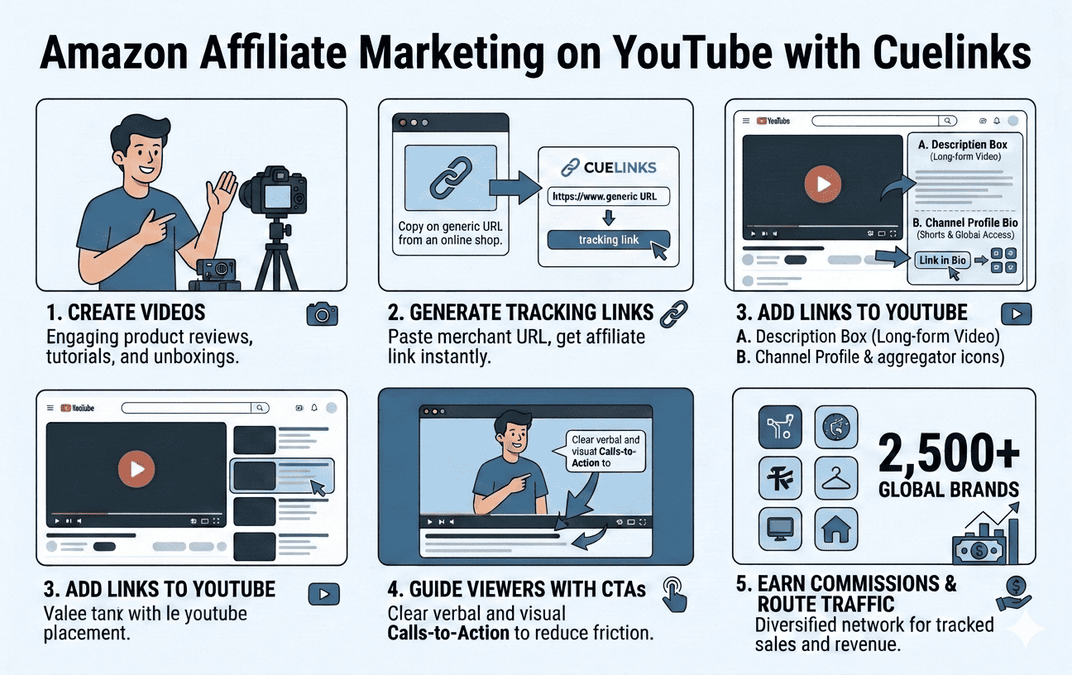
Instead, the creator simply copies the standard Amazon product URL, pastes it into the Cuelinks link generator, and instantly receives a customized, trackable affiliate link. This optimized URL can then be deployed across any digital surface on the internet.
Strategic Link Placement and Access on YouTube
While native product tags offer the distinct advantage of existing directly within the video player’s user interface, Cuelinks relies on the placement of traditional tracking URLs.
To maximize click-through rates (CTR) and overall conversions, creators must engineer the spatial mechanics of the YouTube interface, adapting their placement strategies to the distinct, contrasting ecosystems of long-form videos and YouTube Shorts.
The product tag is inherently easier for viewers to access; therefore, the creator must utilize behavioral psychology to reduce the friction of finding and clicking a description link.
Monetizing Long-Form Videos
For traditional, horizontally oriented long-form videos, the description box remains the primary real estate for affiliate links. To ensure these links are fully clickable, the channel must have “Advanced Features” enabled within YouTube Studio (achieved via phone verification and establishing sufficient channel history).
Furthermore, the URL must be formatted strictly with the https:// or http:// prefix; otherwise, YouTube’s text parser will render it as plain, unclickable text, destroying the conversion funnel.
Passive placement of these links is insufficient. The primary critique of traditional affiliate links is accessibility. An on-screen tag requires a single tap. An affiliate link requires the viewer to actively search for the description box, expand it, and locate the correct hyperlink among a sea of text.
This user experience (UX) friction inevitably lowers conversion rates. To combat this, content creators must engineer their videos to seamlessly funnel attention toward the off-screen links through specific visual and verbal cues.
The Power of Highly Specific Verbal CTAs
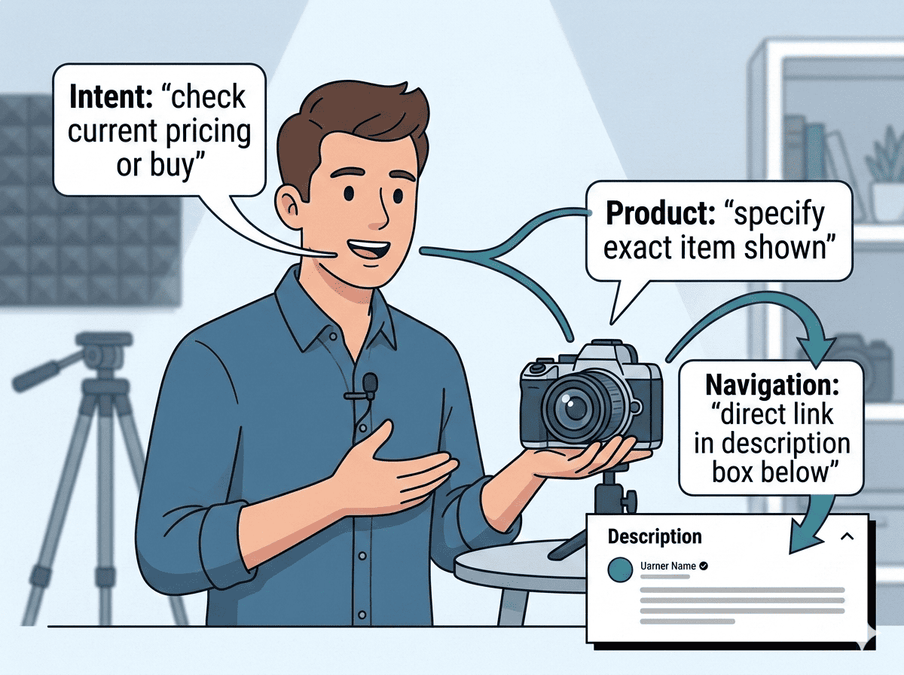
The most direct method to drive traffic is a highly specific, seamlessly integrated verbal Call-to-Action (CTA). The language used must bridge the gap between the on-screen product and the off-screen link.
A creator should actively avoid vague statements such as “link below.” Instead, specific phrasing should be utilized. For example, during a product demonstration, the creator should state: “If you want to check out the current pricing or buy this exact product, I have placed the direct link for you in the description box below.”
This phrasing accomplishes 3 psychological goals: it establishes intent (checking price/buying), specifies the exact item, and provides precise navigational instructions.
Persistent Visual Anchors and Lower-Third Banners
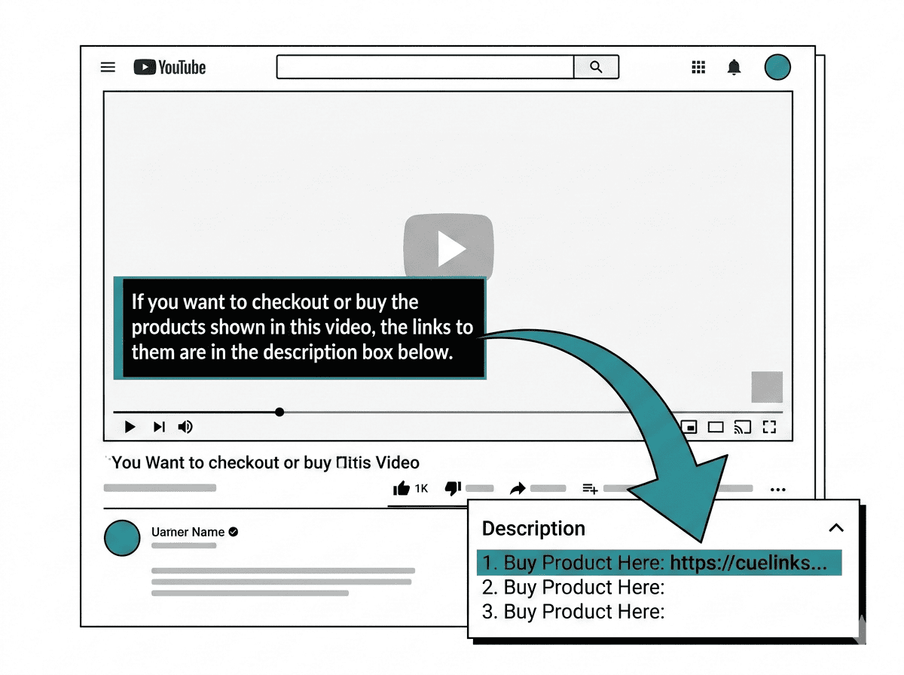
While verbal CTAs are highly effective, they are transient. If a viewer skips past that specific ten-second window of the video, the instruction is entirely lost. To replicate the persistent visibility of a YouTube Shopping tag, professional creators employ static visual anchors.
A highly recommended structural strategy is the implementation of a static bottom banner: a lower-third graphic overlay that remains visible throughout the entirety of the video or during specific product review chapters.
This banner should feature high-contrast text stating: “If you want to checkout or buy the products shown in this video, the links to them are in the description box below.”
This persistent visual cue serves as a constant reminder of the purchasing pathway. It does not interrupt the viewing experience but remains in the viewer’s peripheral vision, ensuring that whenever the impulse to purchase arises during the video, the viewer immediately knows where to navigate without requiring further instruction.
Aligning Timestamp Data to Reduce Cognitive Load
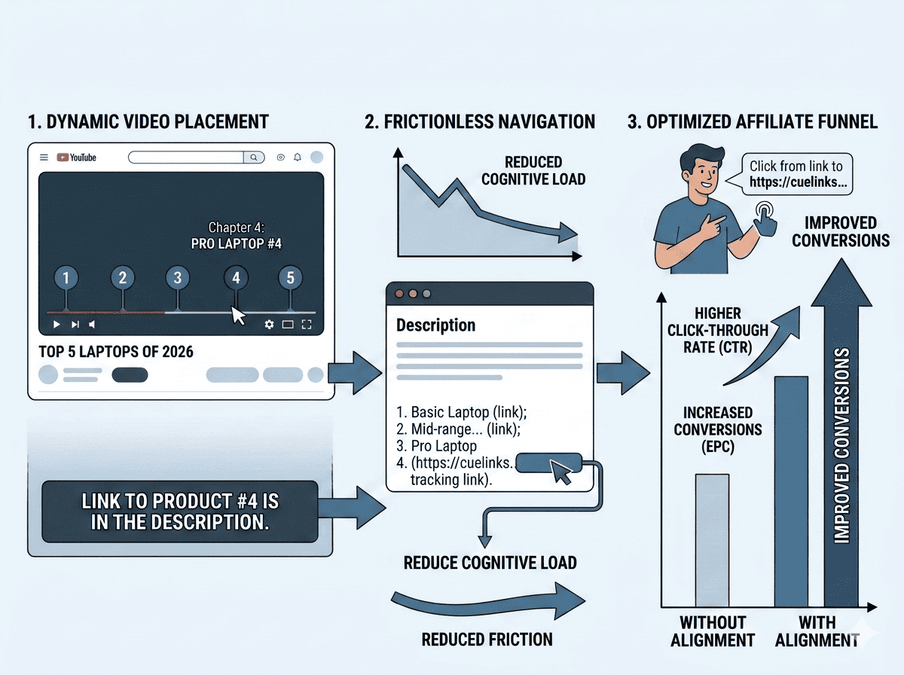
For long-form listicles or compilation videos (e.g., “Top 10 Laptops of 2026”), matching the viewer’s current interest with the correct link is vital for conversion rate optimization.
Creators should utilize YouTube’s timestamp chapter feature, clearly aligning the on-screen product with a specific, numbered link in the description.
If the viewer is watching the segment on product number 4, the persistent banner should dynamically update to read: “Link to Product #4 is in the description.”
This meticulous attention to UX minimizes the cognitive load required to identify the correct URL, directly translating to higher EPC metrics.
Navigating the YouTube Shorts Link Ban
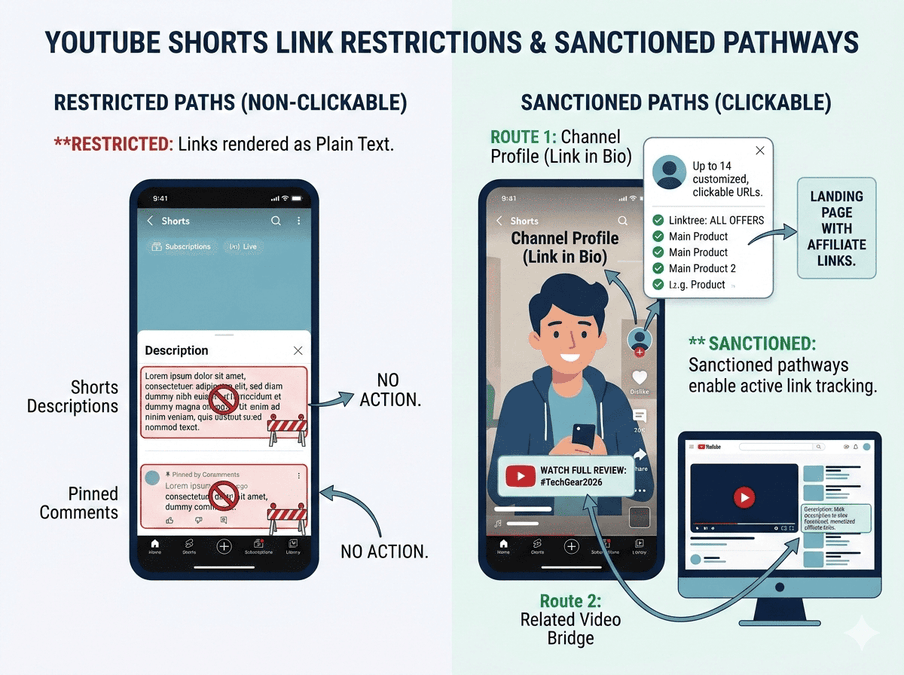
The strategic landscape for short-form content was entirely disrupted on August 31, 2023. In response to a massive influx of spam, malware distribution, and deceptive routing orchestrated by bad actors, YouTube permanently disabled all clickable URLs within the descriptions and comment sections of YouTube Shorts.
Any web address placed in a Short’s description now renders as plain text, heavily penalizing affiliate marketers who previously relied on impulsive, high-volume clicks generated directly from the rapid-fire Shorts feed.
Attempting to bypass this restriction by using URL shorteners, altering domain parameters, or utilizing clever formatting is entirely ineffective.
The restriction is applied at the surface level of the user interface by YouTube’s code, not based on the validity of the destination URL. Therefore, creators utilizing Cuelinks must pivot to YouTube’s sanctioned pathways for short-form traffic routing.
| Link Surface in YouTube Shorts | Native Clickability Status | Strategic Action Required |
| Shorts Description Box | Non-Clickable (Plain Text) | Do not promise direct taps. Use for SEO keywords only. |
| Shorts Comment Section | Non-Clickable (Plain Text) | Avoid pinning URLs here; they will not convert. |
| Channel Profile (Link in Bio) | Clickable | Route traffic to profile; use a link aggregator (e.g., Linktree). |
| Related Video Bridge | Clickable (In-App Routing) | Connect the Short to a monetized long-form video. |
1. The Channel Profile Link (Link in Bio) Strategy
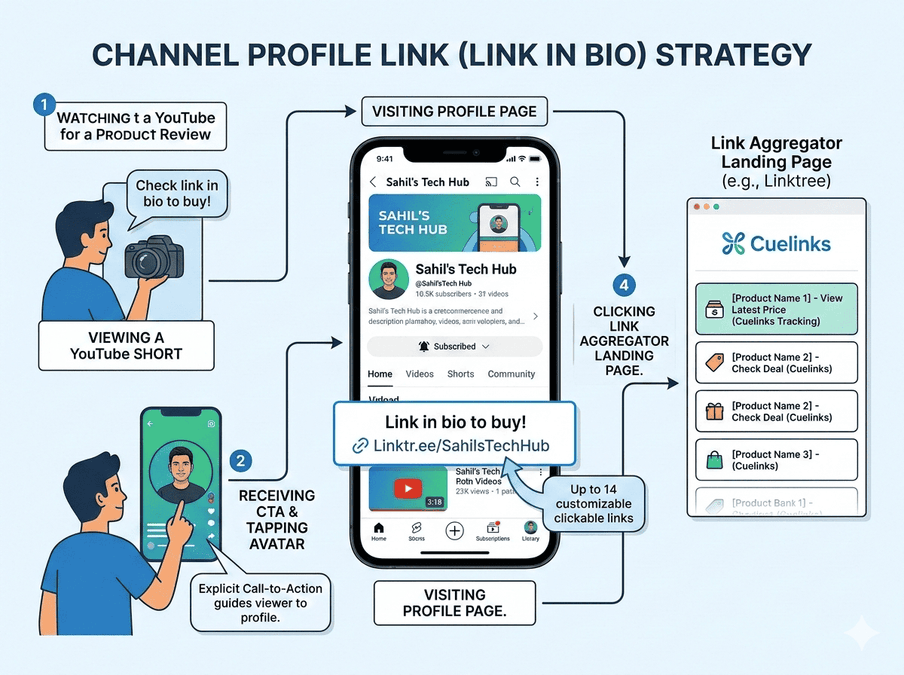
YouTube allows creators to place up to 14 customizable, clickable links directly on their channel profile page, prominently displayed adjacent to the Subscribe button.
Creators can place a direct Cuelinks URL here, or more efficiently, utilize a link aggregator (such as Linktree) to house multiple affiliate offers in a single, mobile-optimized landing page.
The strategic workflow requires the creator to explicitly instruct the Shorts viewer to tap the channel avatar, navigate to the main profile, and click the link in the bio.
2. The Related Video Bridge Architecture
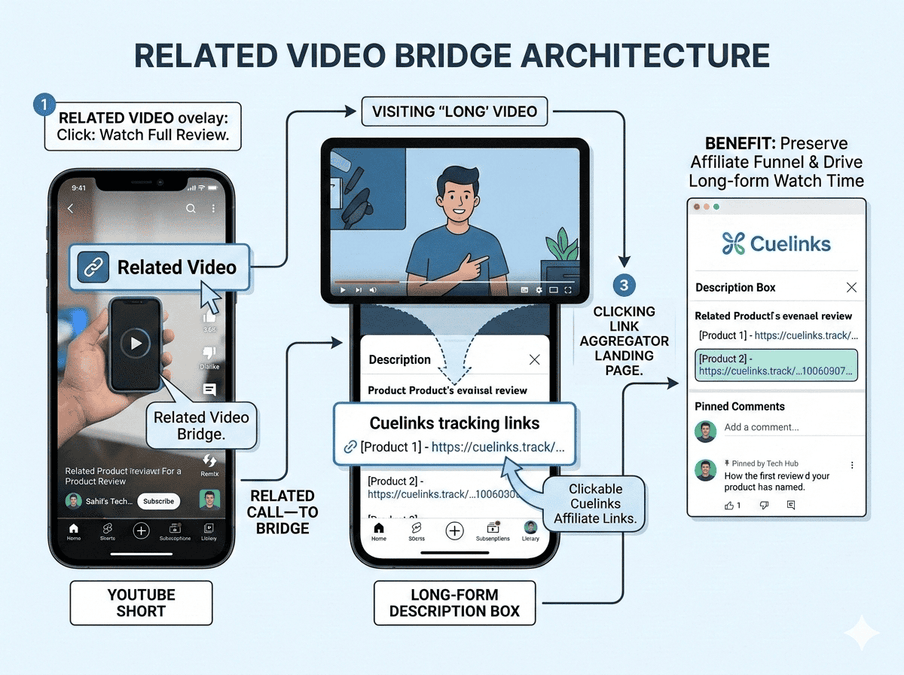
In September 2023, as a concession for removing description links, YouTube introduced the “Related Video” feature for Shorts.
Within YouTube Studio, a creator can link a specific Short directly to a long-form video on their channel. This connection appears as a clickable, branded play button overlay situated above the Short’s title.
The optimal affiliate strategy involves creating a highly engaging, high-retention Short that serves as a trailer or teaser, prompting the viewer to click the “Related Video” link to watch the full, in-depth review.
Once the viewer is bridged to the long-form video, they can freely access the clickable Cuelinks URLs stationed in that video’s description and pinned comments.
This not only preserves the affiliate funnel but also drives valuable watch time to the channel’s long-form library, simultaneously boosting AdSense revenue.
Furthermore, as of October 2024, Shorts can run up to 3 minutes in length, allowing for much deeper product demonstrations before prompting the viewer to bridge to the main video or channel page.
Consumer Psychology, Coupon Codes, and the Vulnerability of the Tracking Cookie
In the highly competitive landscape of affiliate marketing, conversion rates are heavily influenced by perceived value. Providing viewers with an immediate financial incentive to purchase is a proven mechanism for increasing sales volume.
However, the interplay between discount hunting and the architecture of affiliate tracking cookies introduces a critical vulnerability that creators must actively manage to prevent revenue leakage.
Affiliate Cookie and the Halo Effect
When a viewer clicks a Cuelinks-generated Amazon URL, they are redirected to the merchant’s site, and a tracking script deposits an alphanumeric text file: a cookie, into their web browser. For the Amazon affiliate program, this tracking cookie has a standard lifespan of exactly 24 hours.
If the user completes a purchase of any eligible item on the platform within that 24-hour window, the tracking system reads the cookie, identifies the referring creator, and attributes the commission.
This system creates a highly lucrative phenomenon known in the industry as the “Halo Effect.” A consumer might click an affiliate link intending to view a ₹500 book or a cheap smartphone case, but subsequently proceed to add ₹5,000 worth of household groceries and a ₹10,000 appliance to their digital cart.
Because the initial browsing session was triggered by the creator’s link, the creator earns a percentage commission on the entire ₹15,500 basket. This basket-building behavior is a massive driver of unexpected, high-yield revenue.
The Coupon Code Dilemma and Cookie Overwrite
The vulnerability in this system arises precisely at the point of checkout, driven by consumer psychology. When a viewer reaches the final checkout page on a merchant site and sees an empty field labeled “Promo Code” or “Apply Coupon,” standard consumer behavior dictates that they will pause the transaction. The viewer will then open a new browser tab and search search engines for terms like “Amazon coupon codes” or “Flipkart discount codes.”
The moment the viewer visits a third-party coupon aggregator site (such as RetailMeNot, Honey, Coupondunia, or other regional equivalents) and clicks on a revealed coupon code, that aggregator site deposits its own affiliate cookie into the user’s browser. In the hierarchy of affiliate tracking architecture, the standard protocol is “last-click attribution.” The most recent cookie always takes absolute precedence.
Consequently, the coupon site’s cookie instantly overwrites the video creator’s original 24-hour cookie. When the user returns to the merchant tab, applies the code, and completes the purchase, the commission is awarded entirely to the massive coupon aggregator. The video creator, who did all the hard work of educating the consumer and driving the initial traffic, earns absolutely nothing.
Strategic Mitigation: In-House Coupon Integration
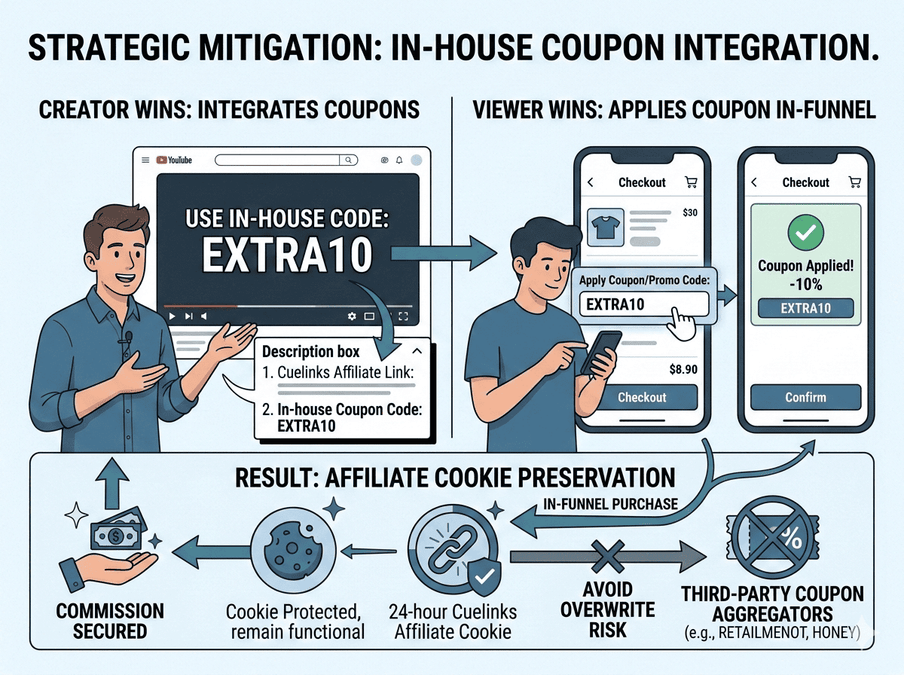
To protect their commissions, creators must eliminate the viewer’s incentive to leave the purchasing funnel in search of discounts. If there are known Amazon coupon codes, platform-wide bank offers (e.g., “10% off with HDFC cards”), or specific merchant discounts available, the creator must provide them directly within the video content and the description box alongside the Cuelinks URL.
By actively stating in the video, “Make sure to use the specific coupon code displayed on the screen right now, or check the description box for current bank offers to get an extra 10% off at checkout,” the creator satisfies the viewer’s psychological desire for a discount.
The viewer receives the necessary code directly from the creator, proceeds through the Cuelinks URL, applies the code at checkout, and completes the purchase without ever initiating a secondary search.
By doing so, the integrity of the 24-hour cookie is maintained, the viewer’s trust in the creator is solidified, and the commission is securely tracked back to the creator’s Cuelinks dashboard.
Expanding the Monetization Horizon: Diversification Across 2,500+ Global Brands
While Amazon commands a massive share of global e-commerce, relying solely on a single retailer exposes a publisher to severe structural risks, including sudden algorithm changes, unilateral commission rate reductions, and arbitrary account bans.
One of the most severe limitations of the native YouTube Shopping tag is its exclusivity to a mere handful of integrated platforms (primarily Shopify, Google Merchant Center, and Amazon).
Cuelinks fundamentally alters this restrictive paradigm by acting as a gateway to over 2,500 global brands and marketplaces. This expansive directory allows creators to rapidly diversify their income streams, hedge against single-platform volatility, and cater to the highly specific regional and niche preferences of their audience.
Strategic Cross-Selling and Thematic Linking
Access to a 2,500+ brand directory allows for advanced cross-selling strategies that are impossible with a single-tag system. A tech creator reviewing a high-end smartphone can provide a primary Cuelinks Amazon link for the device, but simultaneously provide a Cuelinks Flipkart link as a secondary price-comparison option.
Furthermore, they can include links to complementary services, such as device insurance through Star Health (offering massive flat payouts up to ₹3600 per sale) or high-end audio peripherals via specialized brands like Bowers & Wilkins (up to 9% per sale).
This multi-brand approach ensures that the creator is monetizing the entirety of the viewer’s commercial intent, rather than just the segment that happens to align with Amazon’s catalog.
The Cuelinks tracking script automatically handles the complex backend routing, ensuring that clicks to Myntra, Ajio, and Amazon are all recorded flawlessly within the exact same analytical interface.
How much will you Earn via Amazon Products (India) with Cuelinks
The Indian e-commerce market is characterized by immense volume, massive smartphone penetration, and razor-thin margins in the consumer electronics sector.
Consequently, the commission rates reflect Amazon’s internal strategic priorities. High-margin luxury and lifestyle goods command the highest percentages, while heavily commoditized electronics yield fractions of a percent.
The following table details the base commission rates for the Amazon India Affiliate Program, routed through Cuelinks (accounting for standard network variations). Note that these represent the base rates before the Cuelinks revenue share (where the publisher retains 75-95%) is applied.
| Product Category (Amazon India) | Base Commission Rate (Per Sale) |
| Bill Payments | 19.01% |
| Watches | 3.80% |
| Apparel & Accessories, Luxury Beauty, Shoes, Toys & Games | 3.74% |
| Baby, Health & Beauty, Pet Supplies, Grocery | 2.98% |
| Musical Instruments, Wireless Accessories | 2.54% |
| Computers, Electronics, Home Entertainment, Large Appliances | 2.22% |
| Sports & Outdoors, Home, Luggage, Furniture, Kitchen & Housewares | 1.52% |
| Bicycles & Heavy Gym Equipment, Tyres & Rims | 1.58% |
| Amazon Fresh, Pantry | 1.27% |
| Select Mobiles (Micro-Tiers) | 0.63% to 2.0% |
| Select Audible Memberships, Gold/Silver Coins, Video Game Consoles | 0% |
| Other Categories | 3.17% |
Note: Commission Rates are subject to change depending on Amazon and Cuelinks’ affiliate partnership T&Cs so check Cuelinks’ Amazon campaign pages for latest rates
Final Synthesis
The evolution of video commerce relies heavily on removing the friction between a viewer’s inspiration and their point of purchase. While native solutions like YouTube’s Amazon product tagging represent a theoretical ideal of seamless integration, the practical execution is severely marred by stringent eligibility gates, geographic lockouts, and fragile technical infrastructure.
For the vast majority of digital publishers, relying solely on proprietary, single-platform integrations is a mathematically flawed strategy that leaves immense revenue potential entirely untapped.
Platforms like Cuelinks provide the necessary architectural resilience for the modern creator economy. By aggregating over 2,500 global merchants into a singular, decentralized tracking environment, creators bypass platform-specific eligibility requirements and gain immediate access to a diversified, high-yield monetization portfolio.
Adapting to this methodology requires a refined approach to content design and user experience engineering. It requires utilizing persistent visual banners and explicit verbal cues to guide viewers to description links, mastering the constraints of YouTube Shorts through strategic profile routing and Related Video bridges, and carefully managing consumer behavior to protect affiliate tracking cookies from third-party coupon aggregators.
Ultimately, sustained financial success is not dictated by access to exclusive beta features, but by the strategic mastery of fundamental affiliate mechanics. By combining optimized link placement, consumer psychology, and the expansive merchant directory provided by aggregator networks, YouTubers can architect a robust monetization system that is highly resistant to algorithmic changes and mathematically optimized for long-term revenue generation.
Note: Image credits to Google Gemini