
Which are the Best Free Traffic Sources for Affiliate Marketing?
The best free traffic sources for Affiliate Marketing are:
- Blogging (SEO / Organic Search)
- YouTube & Shorts
- TikTok (short-form video)
- Instagram (organic)
- Facebook Groups & Pages
- Quora (Q&A)
- Email marketing
- Content Repurposing
- Guest Posts & Podcast Interviews
- Niche Forums & Communities (beyond Reddit/Quora)
- Own Podcasts
- Collaborations & Micro-Influencers
- Viral Content Strategies
- AI platforms (AIO): the next big step!
Looking for free traffic sources for affiliate marketing in 2026? You don’t need ads to make your first ₹10,000: you need the right organic channels. In this guide, you’ll discover 15 proven free traffic sources (SEO, social, communities, and AI-driven traffic) along with a step-by-step plan to start generating affiliate sales without spending money!
Free (organic) traffic is crucial for affiliate marketers because it builds sustainable, compounding streams of targeted visitors without ad spend. Unlike paid ads, free traffic costs time and effort but yields credibility and long-term ROI.
Top sources include SEO, social platforms (YouTube, TikTok, Instagram, Facebook, Pinterest), community Q&A (Quora, Reddit, forums), email lists, content repurposing, guest posting, collaborations, and viral campaigns.
Each channel has unique tactics, content formats, and timelines. For example, SEO (blogging) can take approx 3-6 months to rank, while short-form video (TikTok/Reels) can deliver traction in weeks.
The most successful affiliates diversify across multiple free channels, track conversions (with UTMs and analytics), and repurpose content to maximize effort.
This article details each free traffic source (with tactics, formats, KPIs, pros/cons) and provides a 6-month plan for a budget-free affiliate launch. The goal is practical, actionable steps to attract and convert free traffic into affiliate sales.
Getting traffic is just step 1. Earning from it is where the real game begins!
Instead of manually joining multiple affiliate programs, use Cuelinks (13+ Yrs Experienced Affiliate Marketing Platform & Network | 1500+ Programs) to monetize all your traffic sources in one place.👉 Join Cuelinks for free and monetize your free traffic effortlessly!
Table of Contents
What Actually Is Free Traffic and Why It Matters?
Free (organic) traffic = visitors earned without paying for ads. It’s earned through SEO, social content, communities, etc. Free traffic matters because it “compounds over time”: a single blog post or YouTube video can bring clicks for years.
It also builds credibility: appearing in Google search or a TikTok feed “is a position you earned,” which makes affiliate recommendations more trustworthy. The work to create free content has no ongoing cost, so profit margins stay high.
However, free channels take consistent effort and time: expect 3-6 months to see steady SEO traffic, while social videos might gain views in weeks.
Free traffic’s pros: zero ad spend, sustained yield, high credibility, and higher conversion when the audience opted in.
Cons: slow ramp-up, ongoing content creation required, platform dependence.
Risk is low (no cost per click), but don’t rely on just one source as algorithms change. Track each source with UTMs/analytics to see which converts (e.g. affiliates track “earnings per click” by channel).
1. Organic Search (SEO)
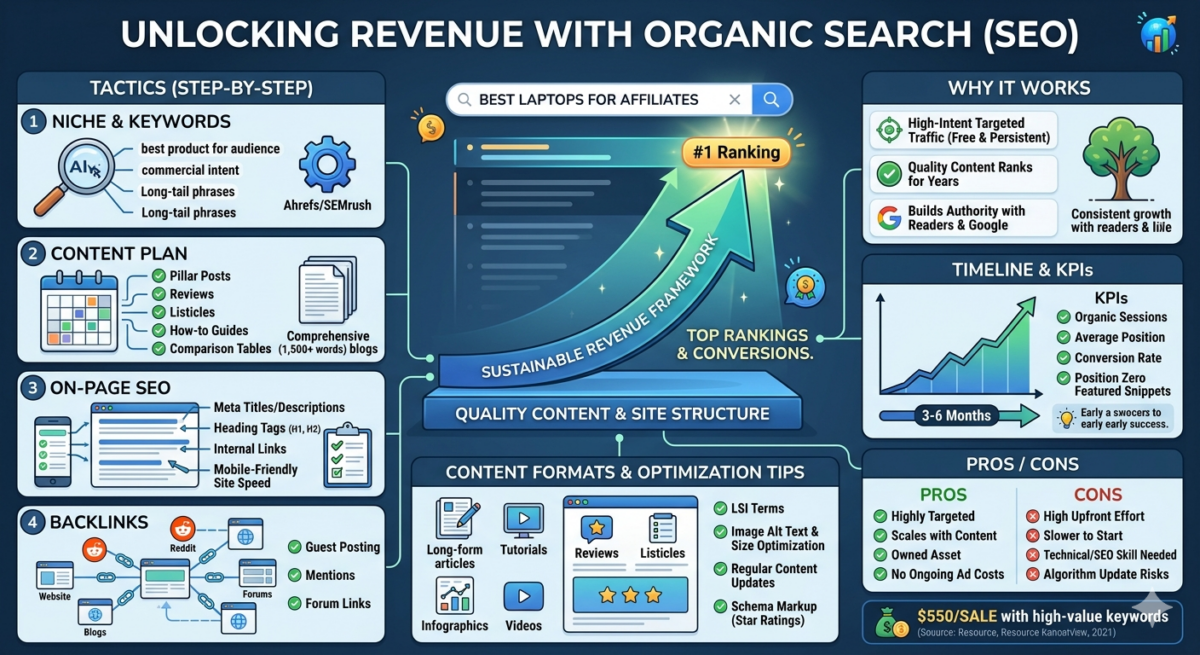
Description: Creating optimized blog/website content so search engines (Google/Bing) rank your pages for keywords related to your niche. SEO attracts visitors actively searching for solutions (high purchase intent): a prime affiliate audience.
Why it works: High-intent, targeted traffic is free and persistent. Quality content “can rank for years, sending consistent clicks”. More content builds authority (both with readers and Google). SEO is a long-game but it “creates a sustainable framework for driving revenue” when done right.
Tactics (step-by-step):
- Niche & Keywords: Pick a clear niche and identify buyer-intent keywords (e.g. “best [product type] for [audience]”). Use tools (Google Keyword Planner, Ubersuggest, Ahrefs, SEMrush) to find high-volume, low-competition terms. Focus on long-tail phrases (“how to [solve problem]”) that indicate commercial intent.
- Content Plan: Create an editorial calendar of topics. Prioritize “pillar” posts that answer key audience questions or product comparisons. Aim for comprehensive blog posts (1,500+ words) that include the target keyword naturally, with related subtopics and images. Example formats: reviews, “best of” lists, how-to guides, and comparison tables.
- On-Page SEO: Optimize meta titles/descriptions (include keyword early), use headings (H1, H2) with variations of the keyword, include internal links, and ensure mobile-friendly site speed. Write high-quality content that genuinely helps the reader (Google values user experience).
- Backlinks: Build authority by earning links. Techniques: guest post on related blogs (see section below), reach out for mentions, or link to your content in niche forums/Reddit answers when relevant. Even internal site backlinks (e.g. popular posts linking to new ones) help.
- Measure: Track keyword rankings and organic traffic using Google Search Console and Analytics. KPIs: pageviews, SERP positions, bounce rate, and affiliate conversion rate (set up goals or track referral clicks). Aim for CTR and time-on-page to improve (watch for “position zero” featured snippets).
Content formats: Long-form articles, tutorials, reviews, listicles. Include infographics and videos embedded on the page for engagement. Repurpose blog content into PDFs or slideshows for shareable content marketing.
Optimization tips: Target one keyword per page. Use related keywords and LSI terms to rank for multiple queries. Optimize images (alt text, size) to improve SEO. Update old posts regularly (add new insights or products) to maintain rankings. Use schema markup (e.g. review stars) to stand out.
Timeline & KPIs: SEO typically takes 3-6 months to rank for competitive terms. Expect initial traffic from low-hanging long-tail keywords within weeks, then progressive growth. Track Organic Sessions, Average Position, and Conversion Rate (affiliate click-through to sale). Early sign of success: appearing in search results (positions 5-10) and slowly climbing.
Pros/Cons: Pros: highly targeted, scales with content, ownership of asset (your site), no ongoing cost. Cons: high upfront content effort, slower to start, requires some technical/SEO skill, algorithm updates can impact traffic.
Examples: The AllianceVO article notes affiliates earning up to $550/sale by choosing high-value keywords.
2. YouTube & Shorts
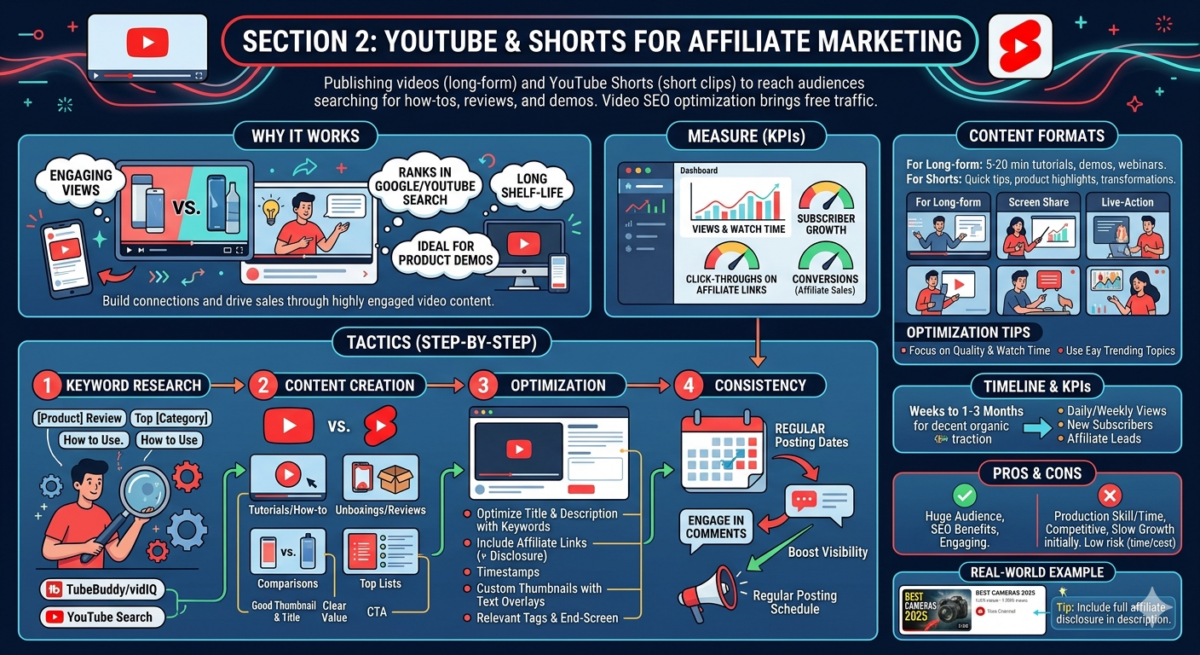
Description: Publishing videos on YouTube (long-form) and YouTube Shorts (short clips) to reach audiences searching for how-tos, reviews, and demos. YouTube is the 2nd-largest search engine, so optimizing video SEO brings free traffic.
Why it works: Video engages viewers and ranks in Google/YouTube search. People often seek tutorials and reviews on YouTube, making it ideal for product demos and affiliate links. A video’s description lets you embed affiliate links and keywords. YouTube content has a long shelf-life: popular videos continue bringing views months later.
Tactics (step-by-step):
- Keyword research: Use YouTube’s search suggestions or tools (TubeBuddy, vidIQ) to find high-demand topics. For affiliates, keywords like “[product] review”, “top [category]” or “how to use [product]” work well.
- Content creation: Plan videos around audience needs. Key formats: how-to/tutorial videos, product reviews/unboxings, comparisons (“vs.”), and top-10 lists. Keep videos engaging: good thumbnail/title, clear value, and CTA. For Shorts (15-60s), show quick tips, teasers, or creative demos that link to a full video or website.
- Optimization: Optimize title and description with keywords. Include affiliate links (with disclosure) and timestamps. Use custom thumbnails with text overlays. Add relevant tags and an end-screen with subscribe and video links. Consider closed captions for accessibility.
- Consistency: Post regularly. YouTube rewards consistent channels. Engage in comments to boost visibility.
- Measure: Track views, watch time, subscriber growth, and click-throughs on affiliate links (via UTM or bit.ly). KPIs: Viewer retention (average view duration), click-through rate (thumbnail CTR), and conversion (affiliate sales from video links).
Content formats:
- For long-form: 5-20 minute tutorials, demos, webinars.
- For shorts: quick tips, product highlights, transformations.
Mix talking-head, screen-share, and live-action demos.
Optimization tips: Focus on content quality and watch time: the YouTube algorithm prioritizes engaged viewers. Include cards linking to other videos or websites. Use playlists for related content. Leverage trending topics (e.g. seasonal products) to ride momentum.
Timeline & KPIs: Visible results in weeks if video topics catch on. Some videos may go viral slowly; often it takes 1-3 months for decent organic traction. KPIs: daily/weekly view count, subscribers gained, leads from affiliate CTAs. Track URL clicks from video descriptions (use UTM parameters).
Pros/Cons: Pros: huge audience, SEO benefits (videos appear on Google), highly engaging. Cons: requires video production skill/time, competitive (need unique angle), slow channel growth initially. Risk is low (only production cost/time).
Examples: Many affiliates credit YouTube with earning commissions. For example, an affiliate niche channel saw thousands of views on a “best cameras 2025” video, leading to steady Amazon affiliate sales. (Tip: include full disclosure in description.)
3. TikTok (Short-Form Video)
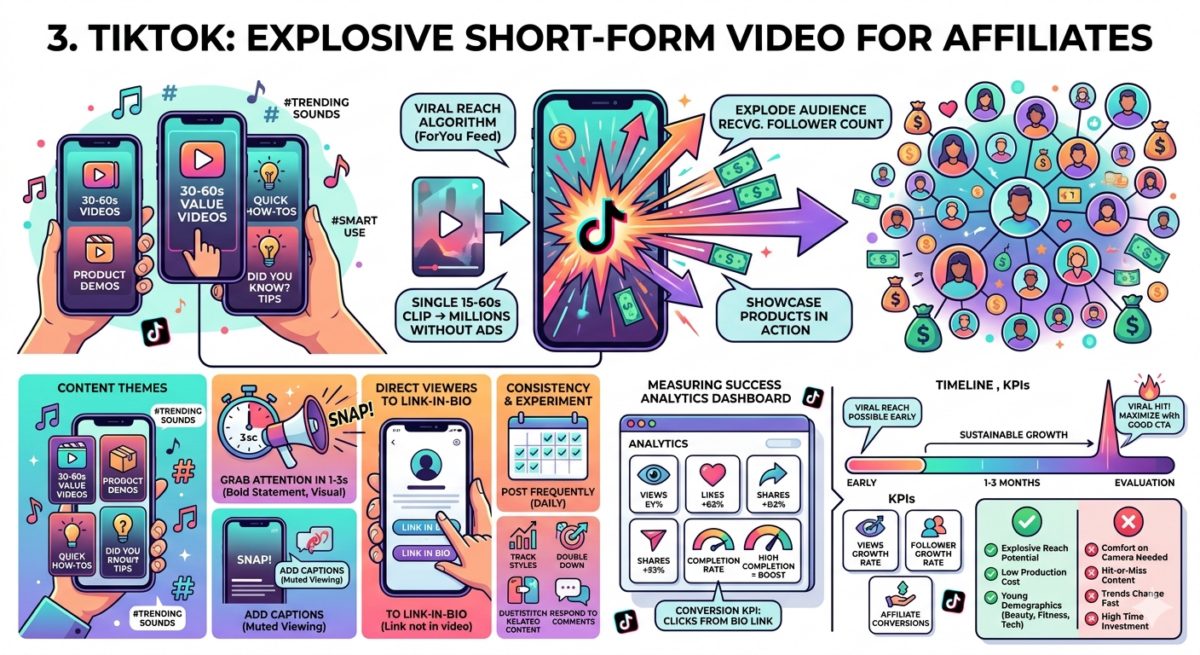
Description: Posting short vertical videos on TikTok to leverage its algorithm’s viral reach. TikTok has ~1B users; its ForYou feed can explode a creator’s audience regardless of follower count.
Why it works: TikTok’s algorithm rewards engaging, short clips that show expertise or entertainment. Affiliates can showcase products in action (quick demos, transformations) that viewers share. Since TikTok values watch-time and shares, a single 15-60s clip can reach millions of targeted users without ads.
Tactics:
- Content themes: Create value-packed short videos (30-60s). Best formats for affiliates: product demos, “day in the life” showing product use, quick how-tos, or “did you know?” tips related to your niche. Use trending sounds and hashtags smartly to boost discoverability.
- Hook early: Grab attention in the first 3 seconds (e.g. a bold statement or catchy visual). Use captions so content is clear with sound off (many watch muted).
- Call-to-action: TikTok allows affiliate links via bio or profile link (not in video itself, so direct viewers to link-in-bio). You might say “Link in bio” or use on-screen text.
- Consistency & Experiment: Post frequently (daily if possible). Track which styles get engagement and double down. Duet/stitch related content or respond to comments in new videos to leverage existing trends.
- Measure: Watch metrics in TikTok Analytics: views, likes, shares, completion rate. Conversion KPI: click-throughs from profile link (use a tracked landing page or UTM).
Content formats: Vertical short videos (15-60s). Mix demo clips, text overlays, voiceover tips. Also leverage TikTok’s templates (polls, countdown stickers) to engage viewers.
Optimization: Use popular hashtags strategically; but niche hashtags ensure relevant reach. Keep videos short/fast-paced to maximize watch-through. Post when your audience is active (evenings). Engage with comments quickly to boost the video in feeds.
Timeline: TikTok can produce results fast. Some creators see viral reach on the first few posts. However, sustainable growth usually takes consistent posting for a few weeks to identify what content “clicks.” Track follower and link clicks over 4-6 weeks.
KPIs: Views, Follower growth rate, Shares, Clicks on bio link, and ultimately affiliate link conversions. A sudden spike in views can indicate a viral hit (aim to maximize that with good CTA).
Pros/Cons: Pros: explosive reach potential, low production cost (phone + creativity), young/skewed demographics for fashion, tech, etc. Cons: requires comfort on camera, content can be hit-or-miss, TikTok trends change rapidly. Viral content is not guaranteed: you need consistent creativity. Risk is low financially but time investment can be high.
Examples: Affiliates in niches like beauty and fitness often go viral on TikTok with before/after demos or hacks. For instance, a fitness affiliate might post a quick “5 exercises with [equipment]” and link to the product bio. (Case study: creator X grew from 0 to 50k followers in 3 months by posting daily workout clips with affiliate gear.)
4. Instagram (Organic)
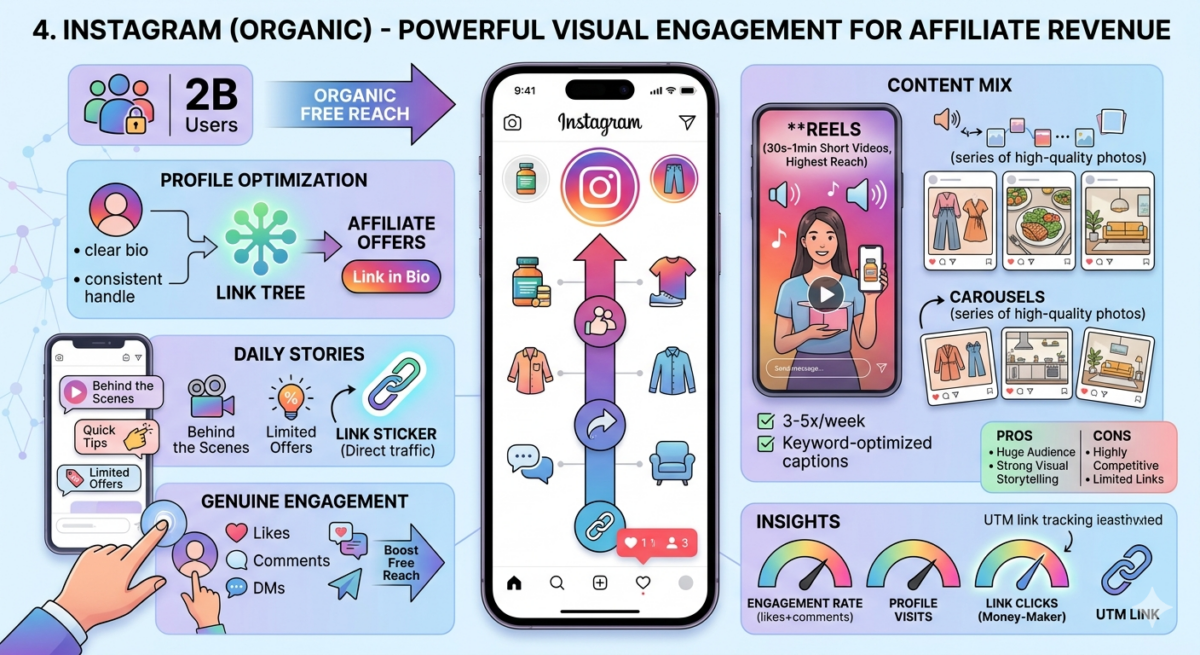
Description: Using Instagram’s features (Reels, posts, Stories, carousels) organically to build an audience and drive traffic. Instagram has ~2B users, with Reels getting the most reach in 2026.
Why it works: Visual niches (fashion, beauty, home decor, food) thrive on Instagram. Engaging reels or carousels attract new followers who click the link in bio. Instagram’s algorithm favors Reels (short videos) and carousel posts. An affiliate can showcase products beautifully (outfits, meals, room tours) and direct users to their link page. Engagement (comments, saves) is key to free reach.
Tactics:
- Profile optimization: Make your bio clear and include a link (a link tree or single sales page). Use a consistent handle/niche.
- Content creation: Post 3-5 times/week combining Reels (30s-1min videos) and carousel posts (a series of images). Show products in use (unboxing, styling, recipes). Write captions that tell a story or answer a question (for keyword optimization and engagement). Use niche-specific hashtags (mix 5-10 with #, e.g. #HomeDecorTips).
- Stories: Share daily behind-the-scenes, quick tips, or limited-time offers. Use “Swipe Up” or sticker links (if eligible) for affiliate content.
- Engage: Like/comment on niche-related accounts, respond to DMs, and engage with followers. The algorithm rewards genuine engagement.
- Measure: Use Instagram Insights (Reach, Impressions, Profile Visits, Website Clicks). KPIs: engagement rate (likes+comments/followers), link clicks, and conversion from bio. Track the traffic from Instagram via UTM in your bio link.
Content formats: Polished short videos (Reels) with text overlays/instructions, high-quality photos in carousel, user-generated content (UGC) if possible. Guides (curated post collections) can highlight products.
Optimization: Post Reels consistently; use trending sounds and challenges. For carousels, ensure the first image is eye-catching. Write captions with keywords/questions. Geotag posts for local reach. Test different hashtags. Analyze post Insights to optimize posting times (usually evenings).
Timeline: Growth on Instagram can be gradual. You might need 1-3 months of consistent posting to build 1k+ engaged followers. However, one viral Reel can spike followers overnight. Monitor weekly follower growth and link traffic.
Pros/Cons: Pros: large user base, strong visual storytelling, high product showcase ability. Reels and carousels still get organic reach. Cons: highly competitive; engagement-driven (shadow bans if overpromo). Limited clickable links (only in bio or Stories for larger accounts). Builds a brand image well.
Examples: Instagram influencers often drive affiliate sales by featuring products in Reels with “link in bio”. For instance, a fitness influencer posts a Reel of a home workout using a particular supplement, mentioning it in caption, and linking in bio. (Instagram affiliate tips: use highlights to “pin” important affiliate content).
5. Facebook Groups and Pages
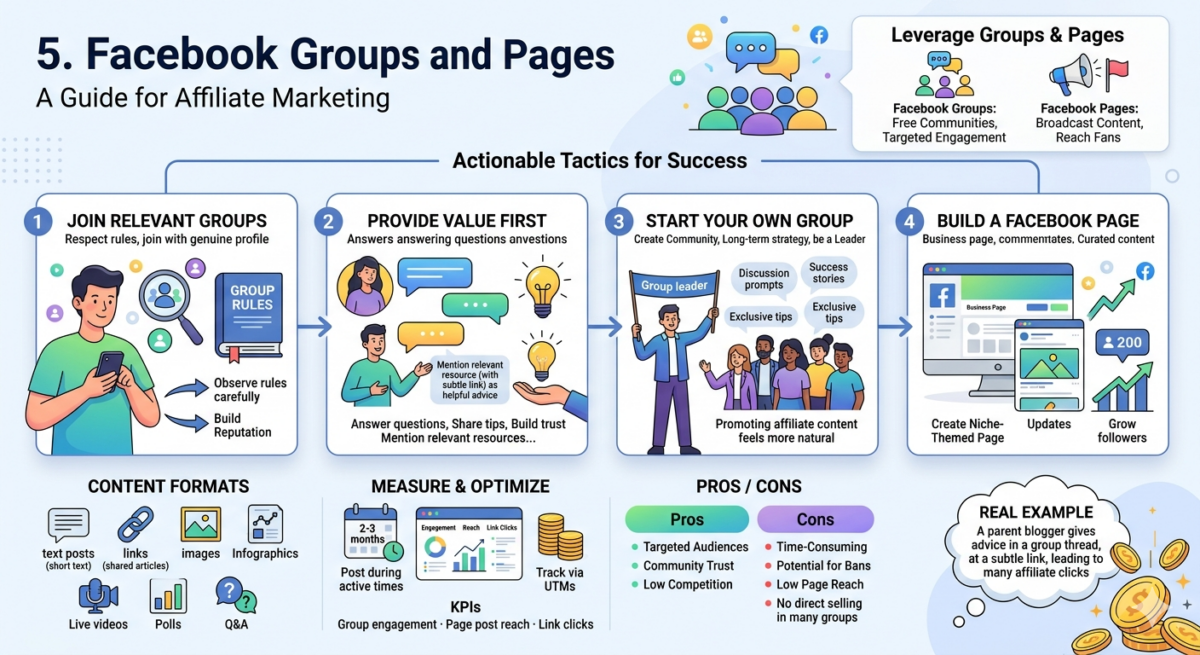
Description: Participating in or creating niche Facebook Groups, plus posting on Facebook Pages, to share content and affiliate links. Groups can be free communities; pages can broadcast content to fans.
Why it works: Facebook Groups gather people by shared interest, offering targeted audience engagement. When helpful, they trust group members. Pages (and now Groups) allow free organic posting of text, images, or links that can drive traffic. Younger audiences may prefer Instagram, but broad niches (e.g. lifestyle, parenting, finance) still engage on Facebook.
Tactics:
- Join relevant groups: Look for active groups in your niche (e.g. “Running Tips” for a fitness affiliate). Join with a real profile (not purely promotional). Observe group rules carefully: many forbid blatant links.
- Engage first: Provide value by answering questions, sharing tips, or posting helpful articles (even if not yours). Build reputation and credibility. For example, answer a group query and at the end mention a relevant blog post (with your affiliate link) as additional resource. This indirect approach is often allowed.
- Start your own group: For long-term strategy, create a community around your niche. Post weekly discussion prompts, success stories, or exclusive tips. You become the leader, so promoting your affiliate content feels more natural to members.
- Facebook Page: Create an affiliate-themed page (e.g. “Healthy Home Solutions”). Post curated content and link blog posts with affiliate products. Use page posts and Story-features for updates. Invite friends and page suggestions to grow a follower base.
- Promote wisely: Use group posting sparingly for promotions. Always prioritize value. If rules allow, share a blog link or “special deal on X” in discussion threads with contextual explanations.
Content formats: Short text posts, link posts (shared blog posts), images or infographics. Live videos or Watch Parties can also engage a group. Use Facebook’s built-in polls or live Q&A in groups to drive engagement.
Optimization: Post during active times (evenings, weekends). Use Facebook Insights on your page to see when fans are online. In groups, test which posts spark comments/shares. Always abide by each group’s policy on self-promotion.
Timeline: Facebook visibility can be quick if posts are engaging, but building trust in a group takes weeks. As a rule, spend 2-3 months contributing before expecting traffic. Watch group post impressions and page reach as KPIs.
KPIs: Group engagement (comments/likes), page post reach, link clicks from page or group shares. Track how many visitors a shared link sends via UTMs.
Pros/Cons: Pros: targeted niche audiences, low competition in some groups, builds community trust. Cons: can be time-consuming, potential for bans if over-enthusiastic, organic reach on pages is low unless content is engaging. Many groups disallow direct selling. Requires consistent engagement.
Example: A blogger joined a Facebook parenting group and contributed advice. After weeks of activity, she shared a gentle product review as part of a comment thread, generating dozens of affiliate clicks.
6. Pinterest
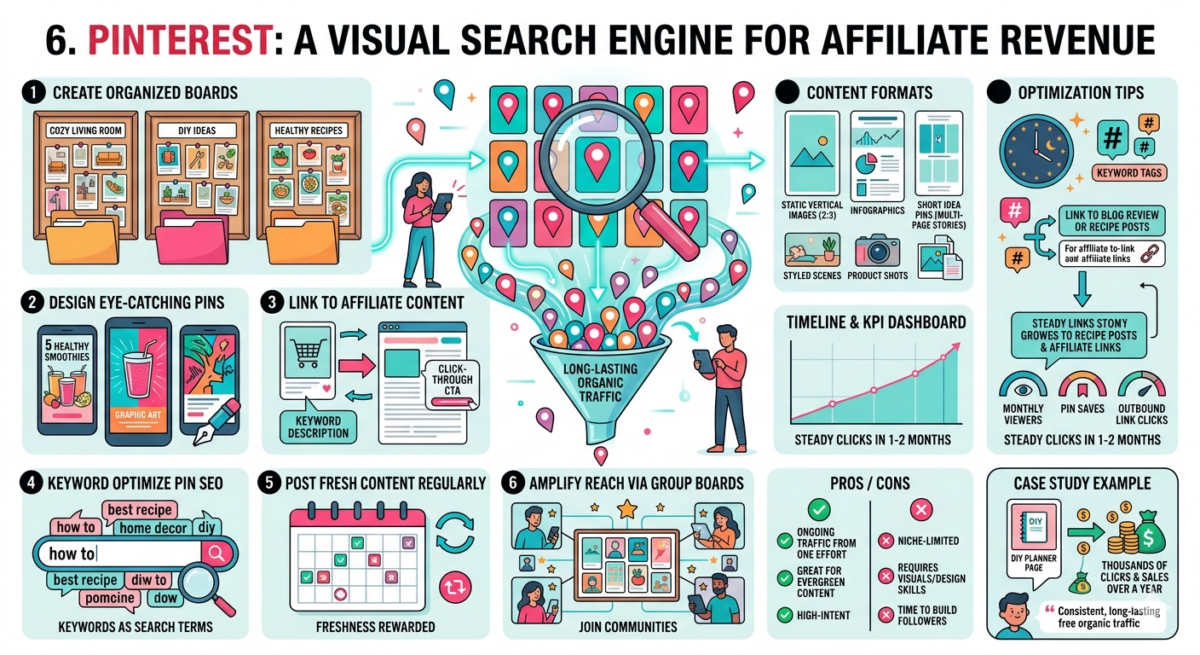
Description: Using Pinterest to pin images (linked to affiliate content) as a long-lasting traffic source. Pinterest acts like a visual search engine.
Why it works: Pins can drive months-to-years of traffic from one post. For visual niches (home decor, fashion, recipes, DIY, wedding), Pinterest is especially powerful. The platform rewards fresh imagery and keyword-rich pin descriptions. Once a pin becomes popular, it continues sending viewers steadily.
Tactics:
- Create boards: Organize boards by category (e.g. “Cozy Living Room Ideas”). Pin 15-20 images per board. Include your pins among others’.
- Design pins: Use tools like Canva to make tall, eye-catching pins. Text overlays on images work well. Include short titles (e.g. “5 Healthy Smoothie Recipes”).
- Link back: Each pin image should link to a blog post or landing page (with affiliate links). The pin description should have SEO keywords and a call-to-action (“click to see recipe”).
- Keyword optimize: Pinterest is largely keyword-driven. Use descriptive pin titles and descriptions, adding relevant keywords (treat keywords like Pinterest search terms).
- Fresh content: Add new pins daily or weekly. Re-pin older content occasionally. Freshness is rewarded.
- Group boards: Join group Pinterest boards (communities) to amplify reach.
Content formats: Static vertical images (2:3 ratio) or infographics. Also try short Idea Pins (multi-page stories). For affiliates, images with product shots, styled scenes, or infographics explaining benefits work well.
Optimization: Pin more in the evenings (peak user time). Use hashtags and keywords in descriptions. If linking to an affiliate product directly isn’t allowed, link to blog reviews or recipe posts that include the affiliate link inside.
Timeline: Pins can get repinned and resurface, so traffic may grow slowly. Many affiliates see steady clicks after 1-2 months of consistent pinning. Monitor impressions, saves, and link clicks in Pinterest Analytics.
KPIs: Monthly unique viewers, saves, outbound link clicks (especially to affiliate landing pages). Use Google Analytics to track sessions from Pinterest (set up source tracking).
Pros/Cons: Pros: ongoing traffic from one effort, great for evergreen content, high-intent (Pinterest searches often indicate planning or purchasing). Cons: niche-limited (not all topics work on Pinterest), requires visuals/design skill, can take time to build a follower base.
Example: A DIY blogger reported that a single “DIY planner page” pin received thousands of clicks over a year, generating affiliate sales of printable kits. WeCanTrack notes “Pinterest drives consistent, long-lasting free organic traffic” in niches like home décor and recipes.
7. Quora (Q&A)
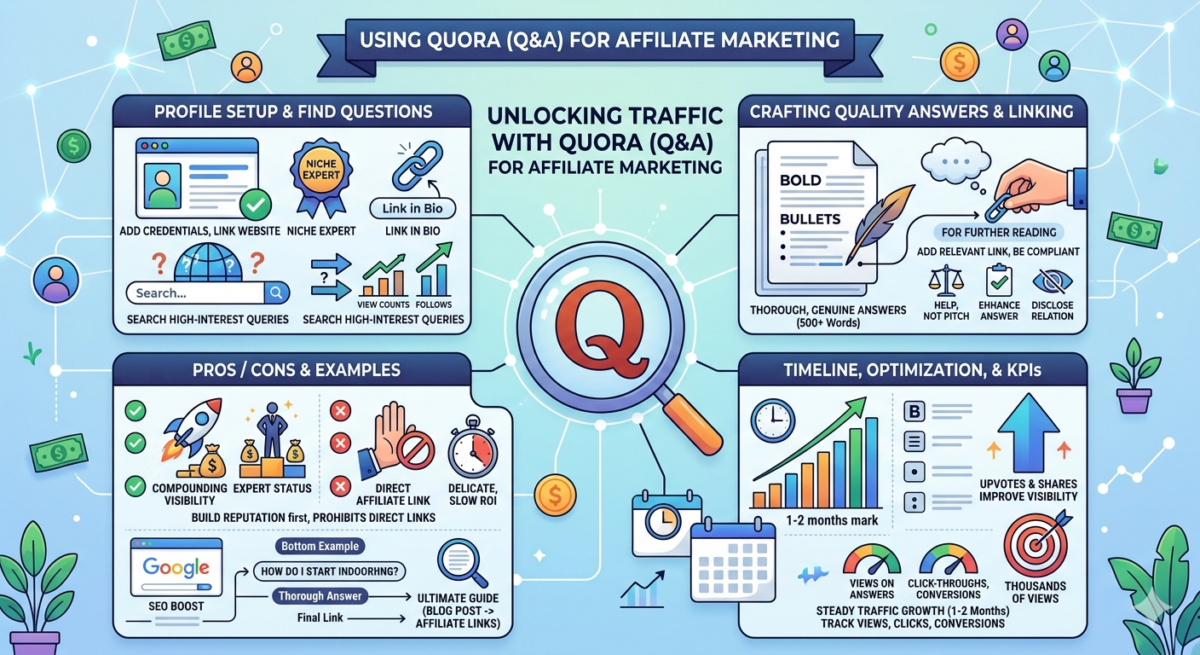
Description: Answering questions on Quora (and other Q&A sites) to provide value and include links to your content where relevant.
Why it works: Quora has millions of niche questions. Thoughtful answers establish you as an expert and can rank in Google’s results for those questions (and even be cited by AI tools). Each answer can funnel readers to your blog or affiliate site.
Tactics:
- Profile setup: Fill out your Quora profile with niche credentials. Include your website link in your bio.
- Find questions: Search Quora for high-interest questions in your niche. Filter by view count or follows to pick trending queries.
- Give thorough answers: Write long, detailed answers (500+ words) that truly help. Use natural language (no keyword stuffing). Explain concepts clearly, and weave in personal experience or examples.
- Include links: When relevant, add one link to your blog or product page for more info. For example, answer “How do I start indoor gardening?” thoroughly, then at the end link to your blog post “Ultimate Indoor Gardening Guide”.
- Be compliant: Quora discourages blatant self-promotion. Ensure your primary goal is to help, not pitch. The affiliate link should enhance the answer (often at the end as a “For further reading” link). Always disclose any affiliate relation if promoting a product.
- Follow-up: Engage with comments on your answers. Upvote other answers (building karma helps your answers be seen).
Content formats: Long-form text answers (with bullet lists or images if needed). You can also repurpose blog images/charts in answers if helpful.
Optimization: Use Quora’s editing features: format answers with bold headings and bullet points for readability. Upvotes and shares improve answer visibility; encourage readers subtly (“If you found this helpful, you may follow me for more tips”).
Timeline: Some answers may get views quickly (days-weeks). Others slowly accrue traffic. Generally, you might see steady clicks from Quora after 1-2 months as Google indexes your answer. Watch traffic by tracking a Quora-specific landing page in your analytics.
KPIs: Views on your answers, click-throughs on your links, and conversions from those clicks. Aim for answers with thousands of views.
Pros/Cons: Pros: Positions you as an expert, low effort (can reuse existing knowledge), compounding visibility (answers stay up indefinitely), SEO boost (Quora answers often rank). Cons: Quora often prohibits direct affiliate links on answers; must be delicate. ROI is usually slower (build reputation first).
Examples: On Quora, affiliates often link to their niche blog posts. For instance, an affiliate writing about finance might thoroughly answer “How can I save $1000 in a month?” and then link to their blog’s budgeting tool (with affiliate links) at the end.
8. Reddit
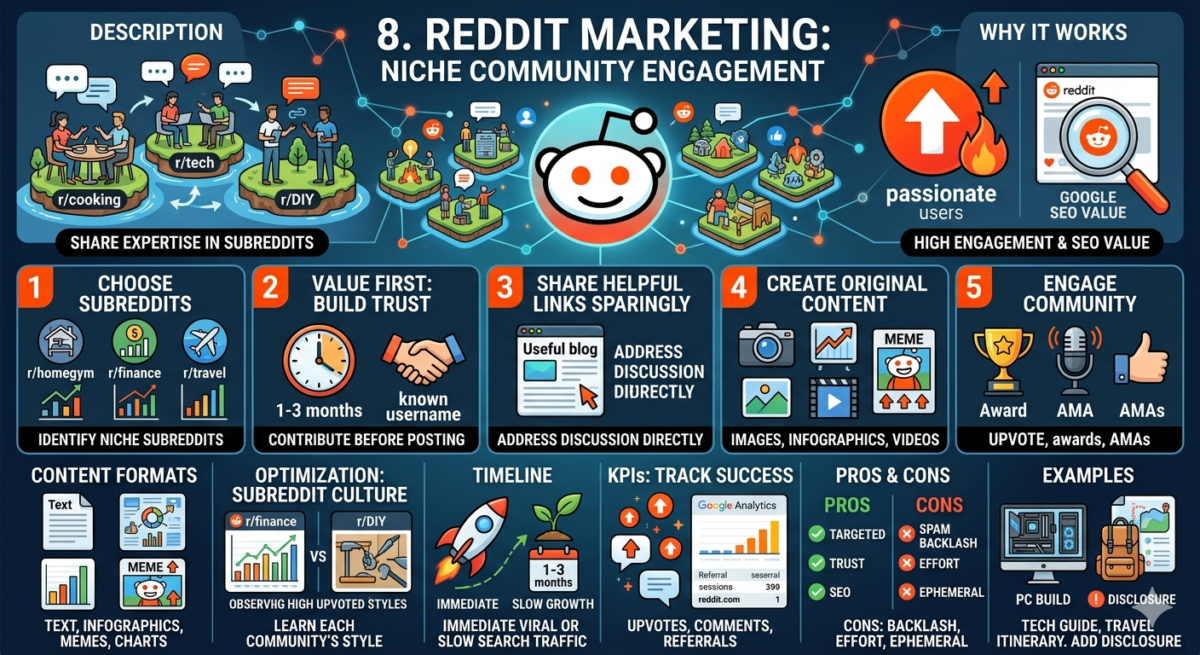
Description: Engaging in subreddit communities by sharing expertise and linking useful resources. Reddit is highly niche: dozens of subreddits exist for almost any topic.
Why it works: Reddit users are passionate and specific. A helpful answer or unique content in a relevant subreddit can drive highly engaged traffic. Additionally, Google often indexes Reddit threads, giving answers extra SEO value.
Tactics:
- Choose subreddits: Identify 5-10 subreddits in your niche (use Reddit search, redditmetrics.com). Check rules: most forbid blatant self-promotion.
- Value first: Before posting any link, contribute with comments/answers. Become a known username. When you do share a link (say, to your blog/article), ensure it directly addresses the discussion and truly helps. For example, in r/homegym, share a personal review of a piece of equipment only after establishing credibility with helpful tips.
- Reddit “soft” links: If a direct link is not allowed, you can mention your brand or content subtly in text and put the full link in your profile or a pinned comment if allowed. Or offer to link if someone asks via DM (some redditors do this).
- Original content: Post images, infographics, or short videos natively if rules allow: unique content that can only be found on your site/app may be okay and brings traffic.
- Community building: Upvote other posts, give awards, and engage in “Ask Me Anything” (AMA) style posts in niche subs if relevant.
Content formats: Text posts with original info or aggregated knowledge. Infographics, charts or meme-style images (if they fit community tone). Some subs allow “link posts” but use sparingly.
Optimization: Each subreddit has its own culture. In technical subs (e.g. r/finance), a detailed, factual post works. In hobby subs (r/DIY), images of completed projects gather upvotes. Observe high-upvoted posts in each sub to learn style. Use Reddit’s own search to find relevant threads for opportunities.
Timeline: Reddit traction can be immediate (if a post goes viral/upvoted) or slow (lurkers gradually find your comment via search). Typically, focus on long-term trust: plan on 1-3 months to get meaningful clicks.
KPIs: Upvotes, comments, and especially referral sessions from reddit.com to your site. Reddit doesn’t easily allow deep analytics tracking (profile links aren’t easily trackable), so rely on Google Analytics referrals “reddit.com”. Focus on subs where your niche yields engagement.
Pros/Cons: Pros: highly targeted, high trust if done right, SEO benefit from indexed answers. Reddit’s demographic often has high spend capability (tech, gaming, etc.). Cons: high risk of backlash for spamming, requires authentic effort. Content is ephemeral (not all posts stay visible long).
Examples: Affiliates sometimes thrive on Reddit. For instance, a tech affiliate might answer a detailed question on r/buildapc with a thorough guide and casually include a link to a blog with affiliate specs. Or a travel affiliate could share a complete itinerary on r/travel with links to gear guides. (Remember: add disclosure if recommending an affiliate product, e.g. “As a heads up, links in my blog post below may earn me a small commission.”)
9. Email List Building (Organic)
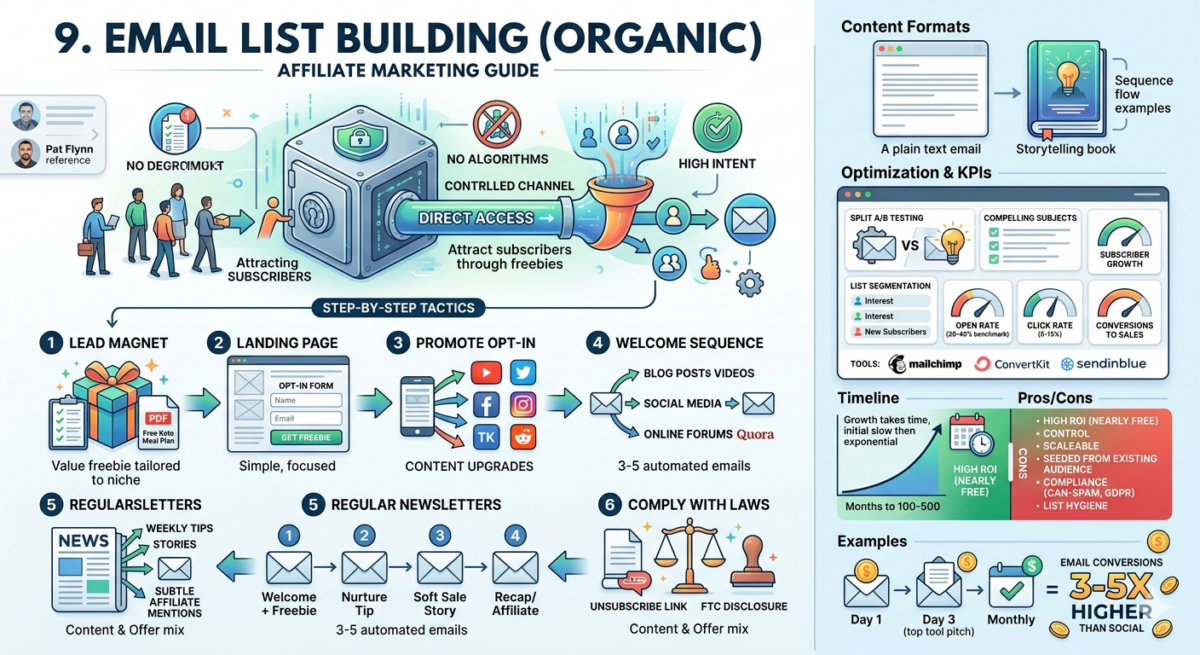
Description: Collecting email addresses through free opt-ins (lead magnets) or sign-ups and sending newsletters or drip sequences that promote affiliate offers.
Why it works: An email list is a channel you control. No algorithm can cut off your access to subscribers. Emails reach an audience that has already expressed interest in your niche, so click/conversion rates are high.
Tactics:
- Lead magnet: Create a valuable freebie tailored to your niche (checklist, guide, mini-course). For example, a keto affiliate might offer a free “7-Day Keto Meal Plan” PDF.
- Landing page: Build a simple opt-in page (using free tools like Mailchimp landing pages or WordPress forms) that highlights the freebie benefits and captures names/emails. Remove distractions (no nav links) to focus on the offer.
- Promote opt-in: Drive traffic to your landing page from all channels (mention it in blog posts, videos, social, and forums). Use content upgrades (e.g. downloadable templates attached to blog posts).
- Welcome sequence: Set up an automated email series (3-5 emails) for new subscribers that provides value and introduces affiliate products. For example: Email 1 = welcome + freebie, Email 2 = niche tip, Email 3 = a story + product suggestion, etc.
- Regular newsletters: Send weekly/biweekly newsletters with content (tips, stories) and subtle affiliate mentions (e.g. “This month’s favorite tool: [product] (affiliate link)”). Mix content and offers.
- Comply with laws: Always include an unsubscribe link and clearly disclose affiliate links per FTC guidelines.
Content formats: Email list is text-rich. Combine storytelling and helpful info in emails. Use plain text or simple HTML. Sequence example: Welcome Email (thank you + freebie + soft pitch), Nurture Email (useful tips + subtle affiliate mention), Soft-sell Email (clear CTA to affiliate product), Recap Email (compare products).
Optimization: Test subject lines and send times (A/B testing can increase open rates). Segment your list by interest if possible (e.g. new vs. active, or category of freebie they chose). Use compelling subject lines that promise value (“Free Keto Guide Inside!”).
Timeline: List building takes time. A small list (~100-500) can be grown in a few months with consistent opt-in offers. Expect slower growth initially, then exponential once content starts circulating. Look for open rates (20-40% as a healthy benchmark) and click rates (5-15%).
KPIs: Subscriber count growth rate, open rate, click-through rate (especially on affiliate links), and conversion to sales from each email. Tools: free tiers of Mailchimp, ConvertKit, or Sendinblue can track these.
Pros/Cons: Pros: very high ROI (nearly free to send), control, easy to scale, direct conversions. Cons: requires an existing audience to seed (use content channels to get first subscribers), compliance obligations (CAN-SPAM, GDPR), and maintaining hygiene (remove unopens occasionally).
Examples: Successful affiliates often say “money is in the list.” For example, an affiliate marketer might send a welcome series promoting a top tool in their niche on Day 3, then a monthly round-up email with affiliate link. Many find email conversions 3-5x higher than social. (Affiliate expert Pat Flynn famously grew his list via content upgrades and has used it to sell products from day 1.)
source: Emercury’s How to Build an Email List for Affiliate Marketing in 2025? guide
10. Content Repurposing
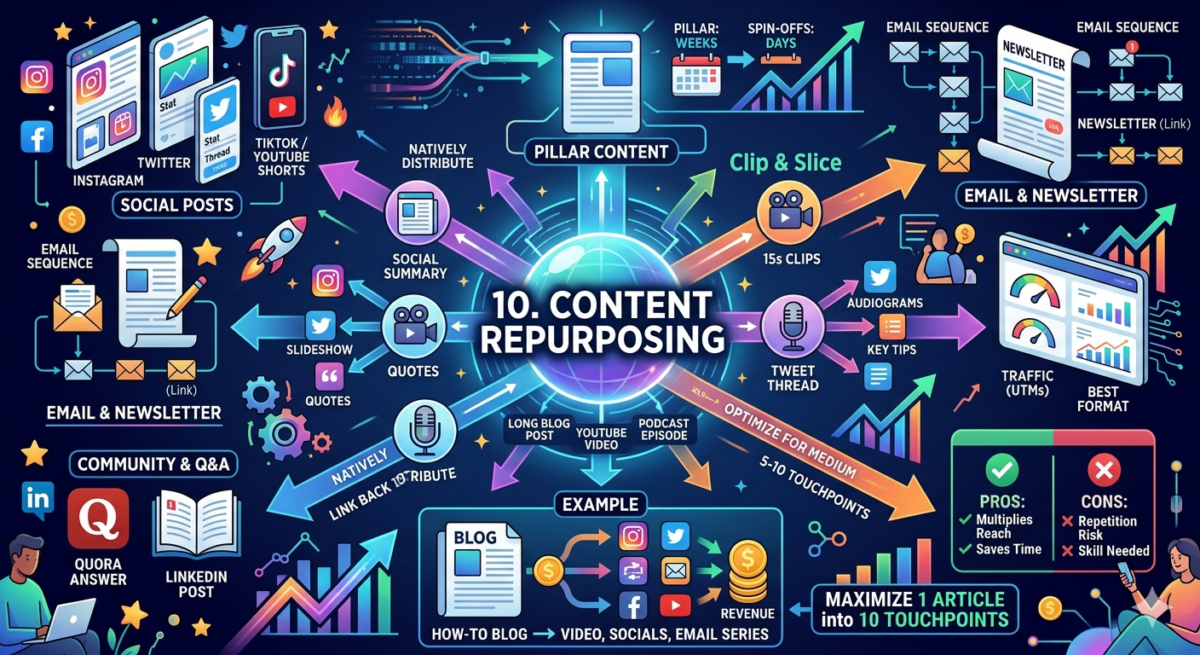
Description: Turning one “pillar” content piece into many smaller assets across channels. E.g. a blog post becomes several social posts, an email series, and a short video.
Why it works: Repurposing multiplies reach and efficiency. Rather than creating unique content for each channel, you extract ideas and reuse them natively. This means you get 5-10 touchpoints from one effort. It ensures that your affiliate message appears in diverse places without extra research.
Tactics:
- Create pillar content: Produce a high-quality, comprehensive piece first (long blog post, YouTube video, or podcast episode). This should cover a topic exhaustively with affiliate links and built-in CTAs.
- Clip & slice: Break the pillar into chunks. For a blog post, create a video summary or slides. From a video, take 15s clips or quotes. From a podcast, make audiograms. Extract quotes for tweetable tips. Use the main points as subtitles or bullet images.
- Natively distribute: Post each repurposed piece on the appropriate platform. E.g., turn a blog tip into an Instagram carousel; tweet a stat; share a short clip as a TikTok/YouTube Short; share the blog link via newsletter or Quora answer. Optimize each for its medium (e.g. vertical format for Insta Reels).
Content formats: The original format plus multiple: short videos, infographics, carousel posts, tweet threads, LinkedIn posts, emails.
Optimization: Ensure each version is tailored (not just copy-paste). For instance, rephrase blog language for conversational social posts. Always link back to the pillar (blog link in Instagram bio, or in email).
Timeline: Repurposing gives quicker expansion. The pillar content might take weeks, but the spin-offs can be done in days, with traffic increasing as soon as any one piece is posted.
KPIs: Measure the traffic each version brings (UTMs again). See which format performs best to refine future repurposing.
Pros/Cons: Pros: saves time (don’t reinvent the wheel), reinforces message (multiple impressions), SEO benefit (internal linking between versions). Cons: risk of being repetitive if mismanaged, requires cross-platform skillset.
Examples: A common model: Write a “how-to” blog post, record yourself explaining it on video, then post the video as a YouTube and also cut it into 5 short TikToks. Turn key steps into an email series. Many affiliates use this method to “maximize 1 article into 10 touchpoints”.
11. Guest Posting & Podcast Interviews
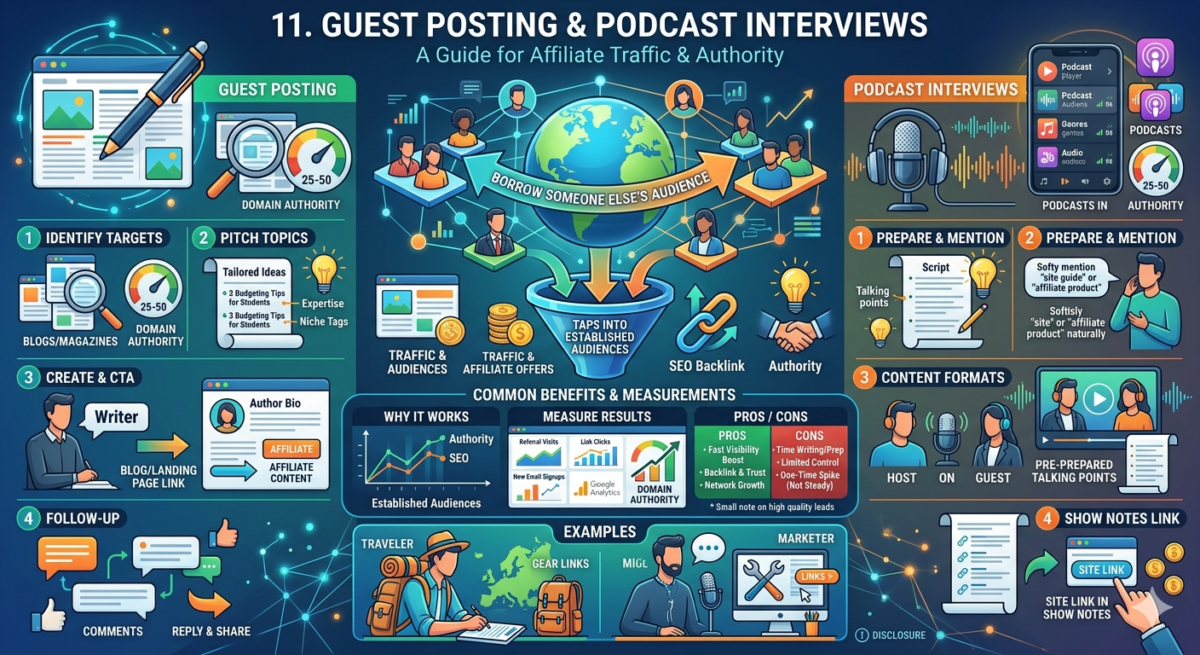
Description: Writing articles for other blogs or appearing on podcasts in your niche. You “borrow” someone else’s audience by contributing content or insights elsewhere.
Why it works: You tap into established audiences and earn a backlink for SEO. Guest posts introduce your brand to engaged readers; podcast interviews let listeners know you as an expert, often with a mention of your site/products. Both build authority and funnel traffic to your site or affiliate offers.
Tactics:
- Identify targets: Look for niche blogs/magazines (sites with similar audience and moderate traffic) and podcasts. Aim for domain authority ~25-50 (big enough audience, not impossible to pitch).
- Pitch topics: Tailor your guest article ideas to the host’s audience. Propose helpful topics (e.g. “3 Budgeting Tips for College Students” to a finance blog). Highlight your expertise and mention you can provide unique content.
- Content and CTA: Write the article (often free) with the same quality you’d give your own site. Somewhere in the author bio or a recommended reading section, include a link back to your blog or landing page with affiliate content. Similarly, on a podcast, weave in a mention of your site or product when relevant, and use show notes for links.
- Follow-up: Engage the audience on that platform (reply to comments on the guest post, share the published link on your social media). Encourage cross-promotion (“If you enjoyed me on [Podcast], check out my blog…”).
Content formats: Blog articles on others’ sites, and interview dialogues on podcasts (audio/video). For podcasts, prepare key talking points and promote a small freebie or guide at the end to capture listeners.
Optimization: Choose podcasts with audiences aligned to your offer. During the podcast, mention the affiliate offer softly (e.g. “I’ve written a guide on that, check my site”). For articles, use a clear, clickable CTA link in your author bio or within the text (if allowed).
Timeline: Getting accepted may take a month (pitching and revisions). Once published, you get an immediate spike of interest. SEO value (backlink juice) shows over weeks to months as Google crawls the new link. Watch referral traffic in Analytics after publication.
KPIs: Referral visits from the host site/podcast notes, clicks on your links, new email signups from those referrals. In the long term, improved domain authority and rankings.
Pros/Cons: Pros: fast visibility boost, backlink and trust signal, network growth. Cons: time spent writing free content or interview prep, limited control over platform style/format. Not a steady traffic stream (one-time spike), but high-quality leads.
Examples: A travel affiliate might guest post on a popular travel blog (“How to Pack Efficiently for Europe”) and include links to recommended gear. Or join a marketing podcast as a guest and mention your affiliate toolkit in the interview, linking in the show notes.
12. Niche Forums & Communities (Beyond Reddit/Quora)
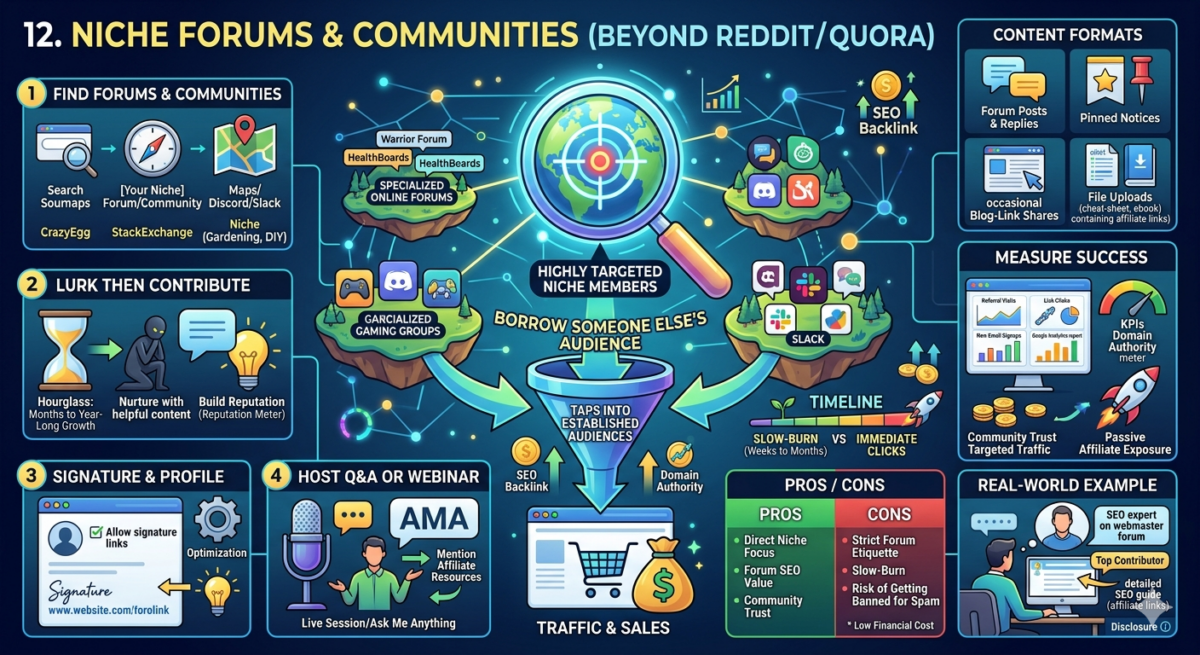
Description: Participating in specialized online forums (e.g. Warrior Forum for marketing, HealthBoards for wellness) or community sites (Discord groups, Slack channels) related to your niche.
Why it works: These communities often have highly targeted members. Sharing expertise or resources there can drive traffic and sales. Some forums allow signature links on every post, giving passive exposure.
Tactics:
- Find forums: Use Google to find “[your niche] forum” or “[your niche] community Discord/Slack”. Examples: CrazyEgg for CRO, StackExchange for certain tech niches, niche-specific forums (gardening, DIY, etc.).
- Lurk then contribute: Like Reddit, first become a member by asking/answering in threads. Provide real value; only after building rep introduce a link. Many forums allow helpful links after multiple posts.
- Signature and profile: If forum policy allows, put your site link or landing page link in your profile or signature. This way, all your posts carry a passive affiliate link.
- Host a Q&A or webinar: If allowed, offer to do an “Ask Me Anything” post or a live session, where you answer questions about your field. This naturally lets you mention affiliate resources.
Content formats: Forum posts, replies, pinned notices (if you have privileges), occasional blog-link shares. In some forums, you can even upload files (like cheat-sheets) or offer mini-ebooks that include affiliate links.
Timeline: Some forums have low traffic; measure over 1-3 months. Others (like large Slack/Discord) can give immediate clicks. Key metric: conversions from “referral” label with forum domain.
Pros/Cons: Pros: direct niche focus, forum SEO value (some threads rank), community trust. Cons: forum etiquette strictness, can be slow-burn. Risk: getting banned for spam. Generally low financial cost.
Example: An SEO affiliate might become a top contributor on a webmaster forum, often linking to their own detailed SEO guide (with affiliate resource links) in answers.
13. Podcasts (Own)
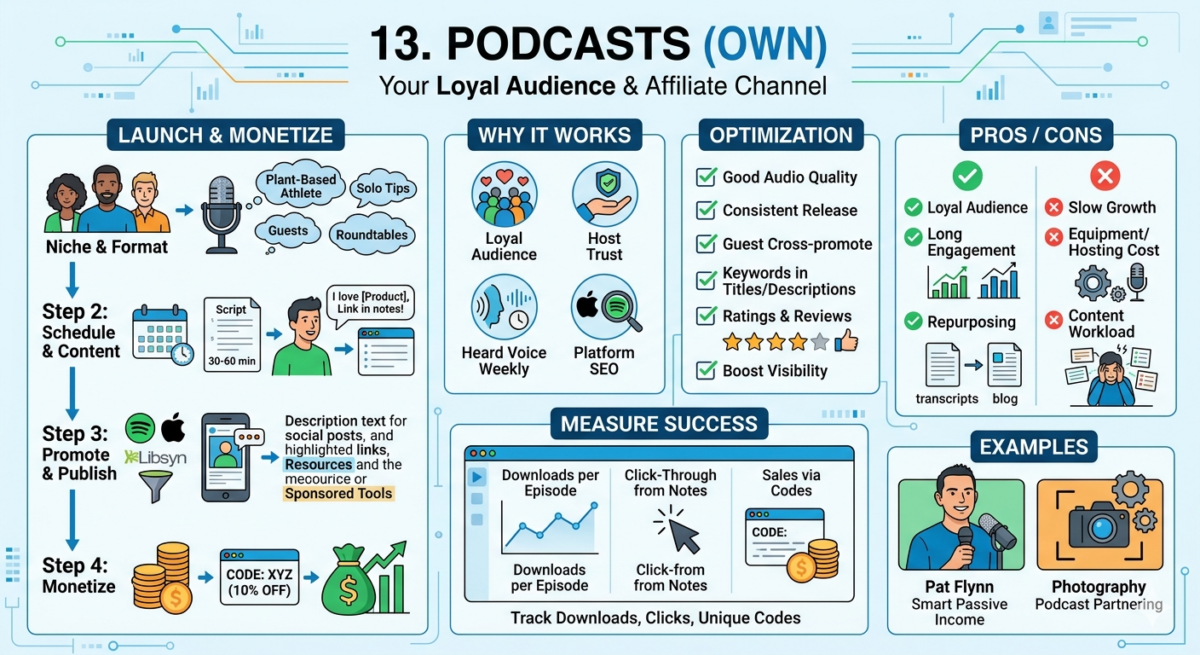
Description: Launching your own podcast on your niche and promoting affiliate products during episodes.
Why it works: Podcasts build a loyal, engaged audience who hear your voice weekly. Listeners trust hosts, so affiliate recommendations can convert well. Podcast episodes show up in Apple/Spotify search, adding another content platform to rank in (SEO benefit).
Tactics:
- Choose topic: Pick a niche theme (e.g. “The Plant-Based Athlete Podcast”). Define the format: solo tips, guest interviews, or roundtables.
- Schedule & content: Plan episodes (30-60 min) each covering tips or product info. In episodes, naturally mention tools you use (“I love [Product], find link in show notes!”).
- Promotion: Publish on major platforms (Anchor, Libsyn, etc. which distribute to Spotify, Apple, etc.). Tease episodes on social. Include affiliate links in episode descriptions or show notes (e.g. as “resources” or “sponsored tools”).
- Monetize: Over time, as listens grow, you can directly mention offers. For example: “This episode is brought to you by [Product]: use our code XYZ for 10% off,” linking to the affiliate.
Content formats: Audio episodes, optionally video recorded (then repurpose to YouTube or shorts).
Optimization: Ensure good audio quality and consistent release schedule. Ask guests to cross-promote. Use keywords in episode titles/descriptions (“affiliate marketing podcast”, etc.). Encourage ratings and reviews to boost visibility on Apple Podcasts.
Timeline: Building a podcast audience takes 3-6 months of weekly episodes. Conversions may start small at first (listeners need trust). Track downloads per episode, click-through from show notes links, and use unique promo codes to gauge sales.
Pros/Cons: Pros: loyal audience, long-content engagement, repurposing (transcripts become blog posts). Cons: slow growth initially, requires equipment/hosting, content creation workload.
Examples: Affiliate podcasters like Pat Flynn (Smart Passive Income podcast) regularly mention affiliate tools and courses. Even small niche podcasts can monetize: e.g. a photography podcast might partner with a gear retailer, mentioning affiliate links in each episode.
14. Collaborations & Micro-Influencers
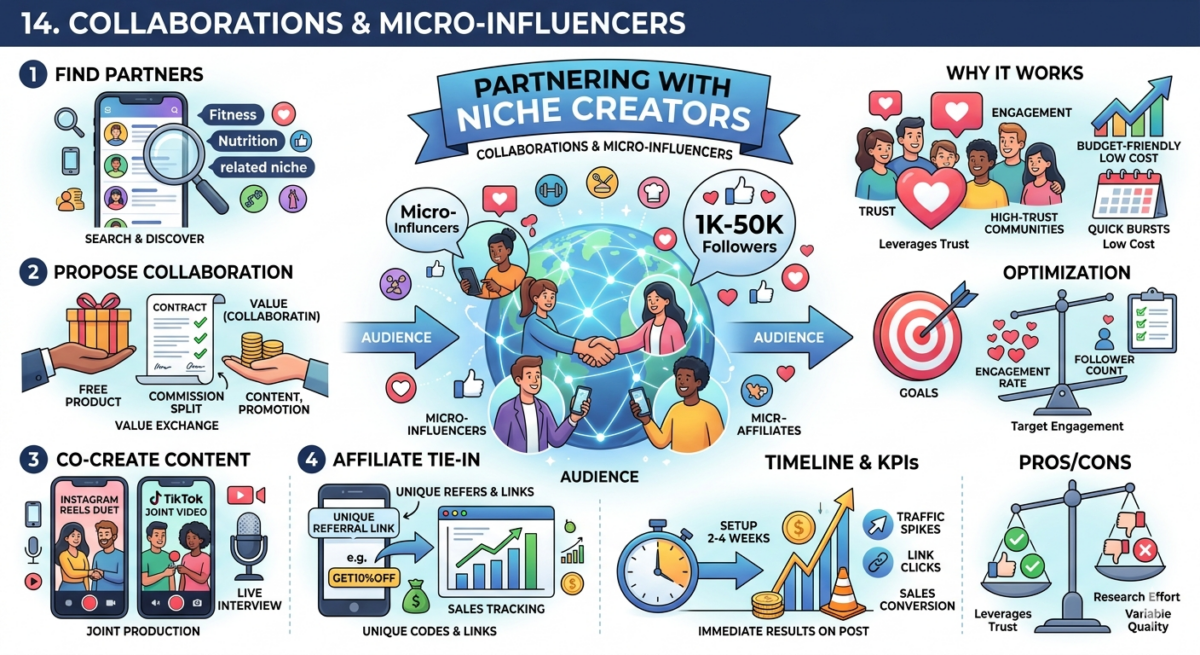
Description: Partnering with micro-influencers (small, niche accounts with 1K-50K followers) or cross-promotion with other affiliates to reach new audiences.
Why it works: Micro-influencers have highly engaged, trust-driven communities. Collaborating (guest posts, shout-outs, Instagram/TikTok duets) lets you tap their audience at low cost. They often accept free product samples or small commissions, making this a budget-friendly strategy.
Tactics:
- Identify partners: Find micro-influencers in related niches (e.g. a nutrition influencer for a fitness offer). Use Instagram/TikTok search, influencer platforms (Collabstr), or Google (site:instagram.com “#yourNiche”) to discover them.
- Propose collaboration: Offer value: free product to review, affiliate commission splits, or content exchange (“I’ll feature you on my blog, you feature me in Stories”). Ensure the audience overlap is real.
- Co-create content: Do Instagram Reels duets, live stream interviews, or guest blog for each other. For instance, record a joint TikTok where each tries a product.
- Affiliate tie-in: Equip influencers with unique referral links or codes (tracked by your affiliate program or linking platform). Track sales from each collaborator.
Optimization: Choose influencers with high engagement (comment/like rate) over sheer follower count. Vet their audience for authenticity. Always have clear campaign goals (e.g. reach 10K new impressions, or X sales).
Timeline: Influencer campaigns can drive quick spikes in traffic/sales (if a post goes out). Expect outreach and setup to take 2-4 weeks, then immediate results upon posting. Track clicks by influencer and conversion by unique UTM codes or coupon codes.
Pros/Cons: Pros: leverages trust (peer recommendation), quick bursts of traffic, scalable by adding more influencers. Cons: requires research/outreach effort, influencers may expect compensation (time or freebies), results vary by influencer quality.
15. Viral Content Strategies
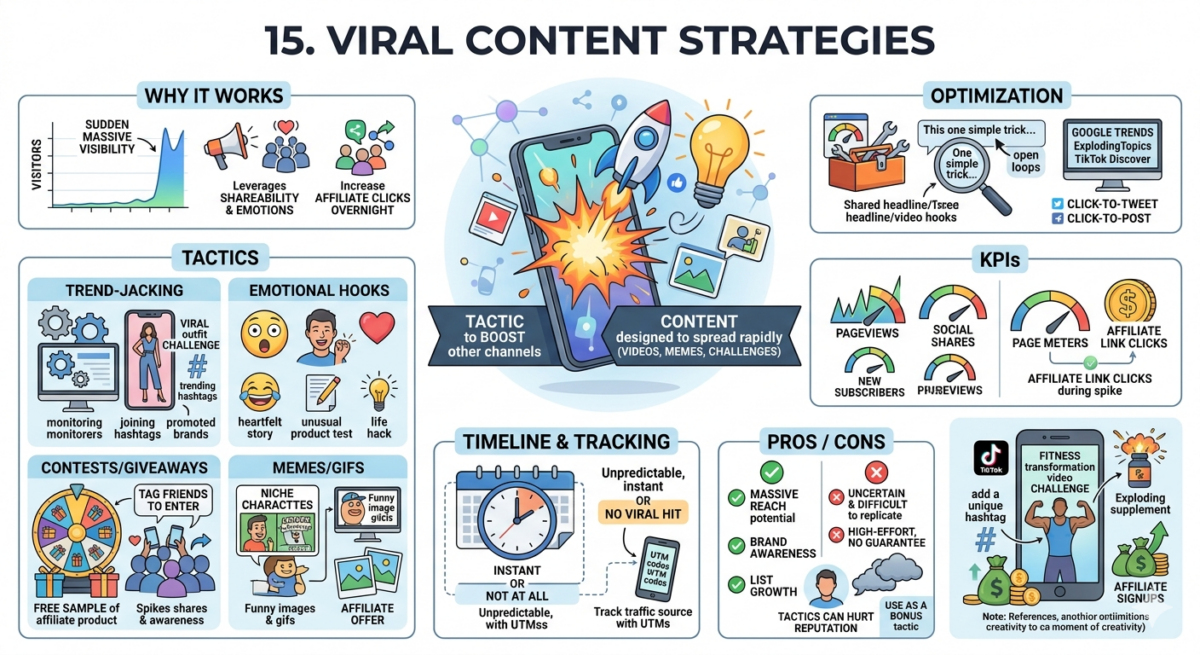
Description: Creating content designed to spread rapidly (videos, memes, challenges) to get sudden large exposure. This is less a “channel” and more a tactic to boost any of the above.
Why it works: A viral hit on social or via email can send thousands of visitors in a short time. It leverages shareability and emotions to tap broad networks. If executed ethically, it can dramatically increase affiliate clicks overnight.
Tactics:
- Trend-jacking: Monitor trending hashtags, memes, or challenges on TikTok, Instagram, or Twitter, and put a spin related to your niche. E.g. a fashion affiliate might join a viral outfit challenge using brands they promote.
- Emotional hooks: Content that surprises, amuses, or deeply resonates (e.g. a heartfelt story or a funny twist) is more likely to be shared. Think unusual product tests or “life hack” videos.
- Contests/Giveaways: Run a contest where participants must share content or tag friends to enter. You can offer a free sample of an affiliate product (budget permitting) or a related prize. This can spike shares and awareness.
- Memes/GIFs: Create niche-relevant memes that go viral. On a blog or in social, a humorous meme linked to an affiliate offer can draw viral attention.
Optimization: Use emotion analytics and trending monitoring tools (Google Trends, ExplodingTopics, TikTok Discover) to spot viral ideas early. Craft headline/video hooks that beg to be shared (“This one simple trick changed my [niche] results”: or create an open loop). Make sharing easy (click-to-tweet, click-to-post).
Timeline: Viral is by nature unpredictable. It can happen instantly (a post going viral in hours) or not at all. Always have tracking in place (UTMs) so if a post unexpectedly takes off, you capture the traffic source.
KPIs: Viral success is measured in spikes: surge in pageviews, social shares, and new subscribers. Also, watch affiliate link clicks during the spike.
Pros/Cons: Pros: massive reach potential, brand awareness, list growth. Cons: very uncertain, difficult to replicate reliably, can be high-effort with no guarantee. Risk: some viral tactics (clickbait, sensationalism) can hurt reputation if done badly. Use viral strategy as a bonus on top of steady channels, not as the sole plan.
Example: A fitness affiliate created a viral “transformation video challenge” on TikTok: participants posted their results using an affiliate supplement with a unique hashtag. This exploded in participation, greatly boosting affiliate signups (not an official case study, but similar to “campaigns leveraging creativity” highlighted by TripleWhale).
Comparison of Free Traffic Sources
| Source | Effort | Scalability | Time-to-Results | Conversion Potential | Risk (algorithm changes) |
| SEO (blog) | High | High (compounds) | Medium (3-6 mo.) | High (targeted traffic) | Low (owned asset) |
| YouTube | Med-High | High | Medium (weeks-mo.) | Medium-High | Low (platform changes) |
| TikTok | Med | Med-High | Fast (days-wks) | Medium | Med (trend-driven) |
| Med-High | Med | Medium (wks-mo.) | Medium | Med | |
| Facebook Groups/Pages | Med | Medium | Medium (wks-mo.) | Medium-Low | Med (policy changes) |
| Med | High (evergreen) | Slow (mo.+) | Medium | Low | |
| Quora/Forums | Low-Med | Low-Med | Slow (mo.+) | Medium | Low |
| Low-Med | Medium (niche) | Medium (wks-mo.) | High (if engaged) | Med | |
| Email List | High | High (unbounded) | Slow to start | Very High (warm traffic) | Very Low (owned) |
| Repurposing | Medium | High | Fast (reuses content) | Medium-High | Low |
| Guest Posts/Podcasts | Medium | Medium | Medium (weeks-mo.) | Medium-High | Low |
| Podcasts (own) | High | Medium | Medium (mo.+) | Medium-High | Low |
| Influencer Collabs | Medium | Medium-High | Fast (days-wks) | Medium-High | Low-Med |
| Viral Content | High | High (potential) | Unpredictable | Variable | High (can’t force it) |
Legend: Effort scales up with needed content creation. Time-to-Results: quick (days), medium (weeks), slow (months). Conversion potential is general; email and SEO tend to yield higher EPC (earnings per click). Risk refers to dependency on external algorithms: low risk if you “own” (website, email), higher if on social platforms.
🔥 AI Optimization (AIO): The Next Free Traffic Source
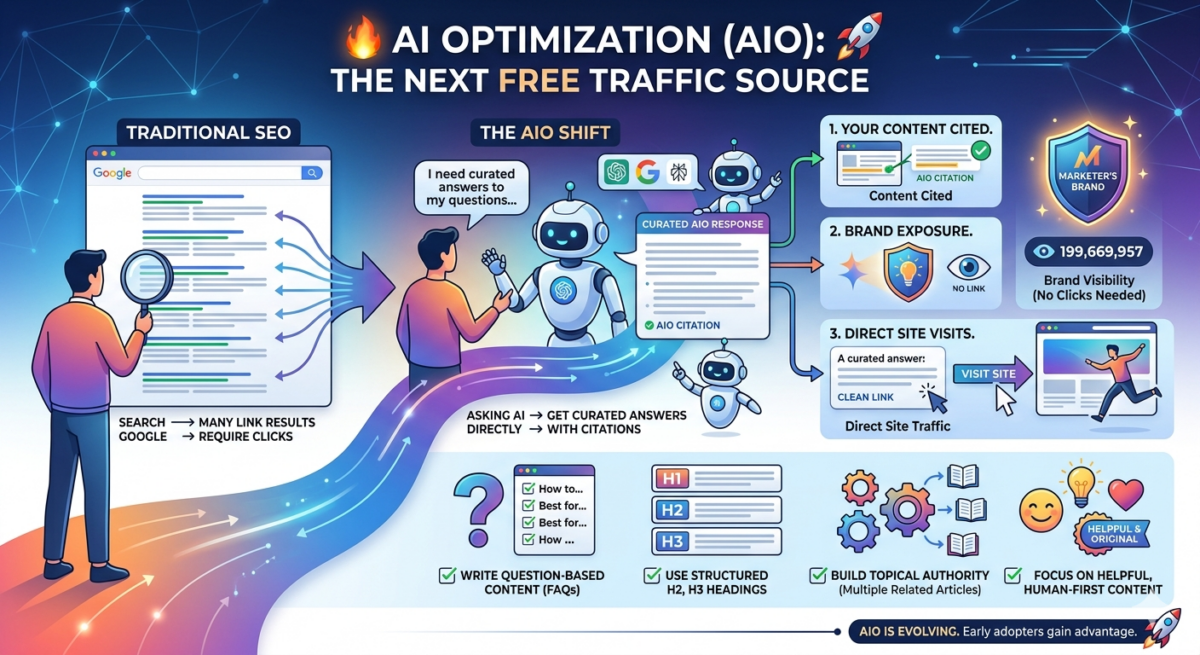
AI tools like ChatGPT, Google Gemini, and Perplexity AI are changing how users discover content. Instead of searching on Google, users now ask questions directly to AI, and get curated answers. This creates a new opportunity for affiliate marketers:
- Your content can be referenced by AI tools
- You gain brand exposure without clicks
- In some cases, users visit your site directly
How to optimize for AIO:
- Write clear, question-based content (FAQs)
- Use structured headings (H2, H3)
- Build topical authority (multiple related articles)
- Focus on helpful, human-first content
👉 While AIO is still evolving, early adopters can gain a strong advantage.
6-Month Tactical Plan (No Budget)
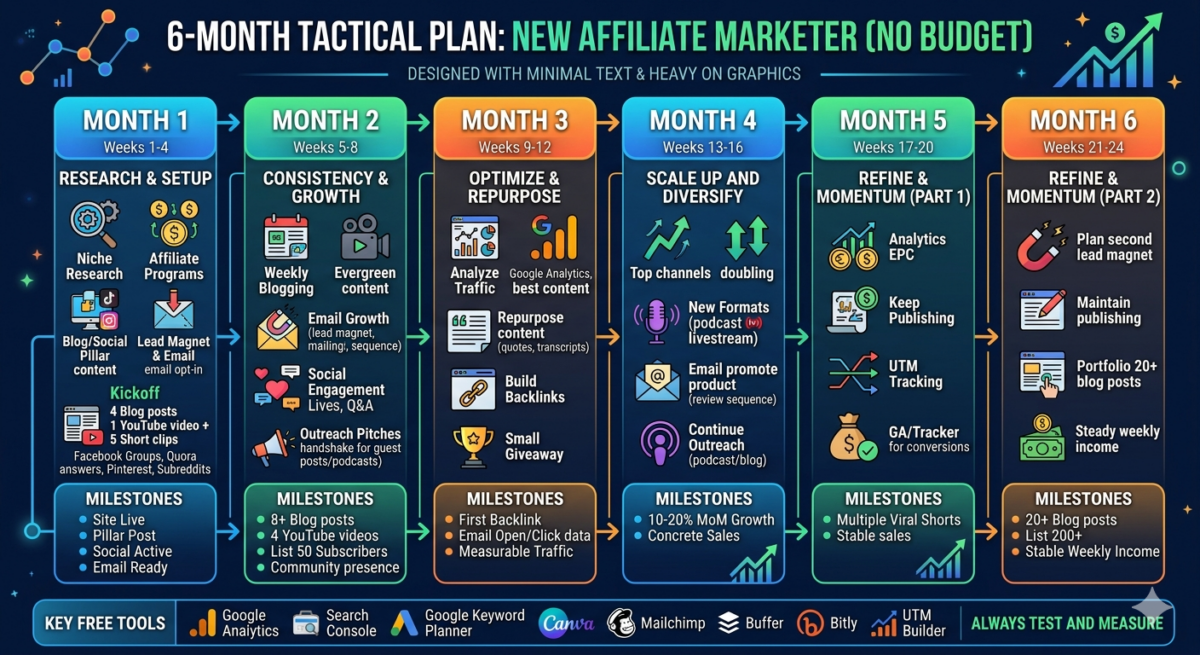
Below is a week-by-week plan for a new affiliate marketer:
- Weeks 1-2: Research & Setup
- Pick your niche and affiliate program(s). Research audience needs and trending topics.
- Set up a blog/website (free WordPress host if needed) and social profiles (TikTok, Instagram, YouTube) reflecting your niche.
- Create foundational pieces: one or two pillar blog posts (SEO-optimized) and accounts on Quora, Reddit, Facebook Groups.
- Design a lead magnet (e.g. a free guide) and set up a Mailchimp (or similar) account and basic opt-in landing page.
- Milestones: Domain/site live; 1 pillar blog post; social profiles active; email opt-in ready.
- Weeks 3-4: Content & Audience Kickoff
- Publish 2 more blog posts targeting relevant keywords (long-tail, buyer-intent). Share them on social, Quora, and niche forums (without spam).
- Shoot first videos: a 5-10min YouTube tutorial and several TikTok/Instagram Reels clips repurposed from it. Add affiliate links in descriptions/bio.
- Join 3-5 Facebook Groups; introduce yourself (if allowed) and comment on existing threads with helpful tips. Start answering questions on Quora.
- Begin pinning content on Pinterest (even repins) and commenting on related subreddits.
- Milestones: 4 blog posts live; 1 YouTube video + 5 short clips; first email sent to any signups; engaged in 3 online communities.
- Weeks 5-8: Consistency & Growth
- Continue blogging (1 post/week) and video creation (1 YouTube + 3 Shorts/Reels per week). Focus on evergreen topics.
- Grow email list: promote lead magnet via blog/YouTube/Quora. Send out a welcome email sequence (3 emails) to new subscribers.
- Ramp up social engagement: post daily on TikTok/Instagram; respond to comments; start using Instagram Lives or TikTok Q&A.
- Outreach for guest content: pitch 2 blogs/podcasts for guest spots; collaborate with one micro-influencer on a short video or joint live.
- Milestones: 8+ blog posts, 4 YouTube videos, email list (even 50 subscribers); first guest post or podcast recorded; consistent presence in forums.
- Weeks 9-12: Optimize & Repurpose
- Analyze traffic: use Google Analytics and social insights. Identify which content performed best. Double down on those topics/formats.
- Repurpose high-performing content: e.g., break a blog post into email series or quote graphics, turn video into a blog transcript for SEO.
- Build backlinks: write 1 guest blog for a related site; leave comments on industry blogs; share your content on free article sites (Medium, LinkedIn).
- Launch a small giveaway/contest (no budget: prize could be an exclusive guide) via social/email to boost engagement.
- Milestones: First backlink received; email open/click data; measurable traffic lift from repurposed posts.
- Weeks 13-16: Scale Up and Diversify
- Double down on top channels: if TikTok is working, post more there; if SEO brings organic readers, keep writing new posts and improving old ones.
- Experiment with new formats: e.g. start a short podcast episode or livestream to test audience response.
- Use email to promote an affiliate product in-depth (e.g. a mini-review sequence). Track sales conversions from those emails.
- Continue outreach: try to get featured on 1 more podcast or large blog; increase Pinterest pinning.
- Milestones: Observe 10-20% month-over-month audience growth; concrete affiliate sales from at least one channel.
- Weeks 17-24: Refine & Momentum
- Review analytics: Which sources yield the best EPC (earnings per click)? Focus effort there.
- Keep publishing: maintain 3-4 pieces of content (blog/video/email) per week across channels.
- Implement UTM tracking on all links (in social bios, email, ads) to attribute which post drives sales. Use Google Analytics or a tracker like wecantrack for affiliate conversions.
- Plan a second lead magnet or new freebie if needed to grow the email list further.
- Milestones: Portfolio of 20+ blog posts, multiple viral or top-performing short videos, email list of 200+, and stable weekly affiliate income.
Throughout, use free tools: Google Analytics/Search Console (SEO tracking), Google Keyword Planner/Ubersuggest (keywords), Canva (graphic creation), Mailchimp/ConvertKit (email), Buffer/Tailwind (free scheduling), and a free link shortener (Bitly) or UTM builder for tracking. Always test and measure results.
You’ve learned how to get free traffic: Now it’s time to monetize it!
Whether you’re using SEO, social media, forums, or community platforms, traffic alone doesn’t make money: Smart monetization does!With Cuelinks, you can instantly convert your existing traffic into revenue by automatically turning your links into affiliate links across 1000+ brands.
👉 Sign up for Cuelinks for free and start earning from your traffic today!
SEO Keyword Research & Tracking
- Tools: Use Google Keyword Planner (free with a Google Ads account) or free tiers of Ahrefs/SEMrush to find keywords. Also use free tools like AnswerThePublic or ChatGPT to brainstorm long-tail ideas. Focus on search intent: informational (How-to), navigational, or transactional (including product names, “buy”, “best” etc.).
- Intent mapping: Chart keywords by intent and difficulty. Prioritize low-competition, high-intent queries. Use “People also ask” and related searches at the bottom of Google for ideas.
- Tracking: In Google Analytics, set “Source/Medium” reports and use UTM codes on all outbound affiliate links to trace which traffic converts. WeCanTrack’s dashboard or free Google Analytics events/goals can consolidate affiliate sales data for analysis.
- On-page SEO: Ensure every piece (blog or video page) has optimized title tags, meta descriptions, and H1 using target keywords. Include keywords in the first 100 words and image alt text.
Tracking & Attribution
- UTM parameters: Append UTM tags (via Google’s Campaign URL Builder) to affiliate links in different posts to differentiate sources. For example, add ?utm_source=facebook&utm_medium=social&utm_campaign=mycampaign.
- Analytics: Use Google Analytics to check the “Campaign” or “Source” reports and see which channels (social, email, organic) are driving sessions and conversions.
- Affiliate Dashboard: If your affiliate network provides reports, reconcile those with your site’s analytics. Tools like Google Sheets or wecantrack help match clicks to commissions.
- KPIs by Channel: For each channel, track: traffic volume, click-through rate (to your affiliate link), conversion rate (sales per click), and revenue. Compare channels by Earnings Per Click (EPC). A lower-traffic source may outperform if its EPC is high.
Tools & Resources
- SEO/Keywords: Google Search Console, Ubersuggest, AnswerThePublic, ChatGPT (for topic ideas).
- Graphics & Videos: Canva (free design), Pexels/Unsplash (free images), Lumen5 or InShot (video editing).
- Social & Content Scheduling: Buffer, Tailwind (freemium for social posts and Pinterest), Later.com (Instagram scheduler).
- Email: Mailchimp, Sendinblue, or MailerLite (free tiers up to a few hundred subscribers).
- Affiliate Link Tracking: UTM Builder, Bitly (URL shortener). Consider wecantrack (free trial) for unified affiliate reporting.
- Collaboration: Collabstr or Upfluence (finding influencers), Reddit and Facebook search for communities.
- Analytics: Google Analytics & Search Console (free), platform analytics (TikTok Pro, Instagram Insights, YouTube Studio).
Conclusion
Start with one or two channels (typically SEO/blog and one social). Master them through consistent, valuable content. Meanwhile, build your email list from day one. Repurpose each asset widely. Track everything so data (not guesswork) guides you. Over 6 months, steadily diversify into other channels. By combining these free traffic sources, you create a stable, low-cost affiliate engine that grows equity (your content and audience) over time.
FAQs
How to get unlimited free traffic to any affiliate link?
There is no true “unlimited” free traffic method, but you can build a consistent flow by creating high-quality, helpful content (reviews, comparisons, tutorials, deal pages) that targets real user intent and ranks on search engines, while also distributing it via platforms like social media, communities, and email; focus on adding genuine value instead of thin affiliate pages, optimize for SEO, and disclose/qualify affiliate links properly to stay compliant and sustainable.
Where to promote affiliate links for free?
You can promote affiliate links for free on your blog or website, YouTube, social media platforms, email newsletters, and communities like forums or deal/coupon-sharing sites, but the key is to match the platform with user intent, provide useful context (not just raw links), and follow each platform’s guidelines along with proper affiliate disclosures.
Is free or paid traffic source better for affiliate marketing?
Free traffic is better for long-term, sustainable growth since it compounds over time without ongoing costs, while paid traffic is ideal for quick results, testing offers, and scaling what already converts; the best strategy is to start with free channels to validate your content and conversions, then use paid traffic to accelerate growth once you know what works.

Sahil Ajmera is content writer with more than 7 years of work experience in field of Affiliate Marketing, Digital Marketing, etc. He loves saving money on everything. His aim is to get readers exactly what they are looking for and that too without wasting much of their time. Whatever he is writing on, you are sure to find a way to earn & save good!